
Operational Lenses for Defusing Veto Risks in BGV/IDV Programs
This structured lens approach organizes the 66 questions about employee background verification (BGV) and identity verification (IDV) into 11 operational perspectives. Each lens highlights concrete, reusable decisions, evidence types, and governance practices that enterprise buyers commonly negotiate during vendor selection, rollout, and renewal. The aim is to surface observable symptoms and decision criteria that align HR, Compliance/DPO, and CISO stakeholders, enabling defensible trade-offs and faster go-live without compromising auditability or privacy rights.
Is your operation showing these patterns?
- Veto points emerge late in procurement or security reviews
- Audit trails and consent ledgers are incomplete during audits
- Consent artifacts gaps and DPDP compliance questions surface
- Subcontractor disclosures remain hidden or incomplete
- High-volume onboarding strains uptime and reliability
- Governance is fragmented across HR, Compliance, IT, and Procurement
Operational Framework & FAQ
Governance & Vetting Orchestration
Establishes governance structures, RACI clarity, and sequencing of proofs to minimize late-stage vetoes during vendor evaluation and rollout. Emphasizes cross-functional decision rights and pre-approved evidence expectations.
What usually triggers a DPO, CISO, or Procurement veto in BGV/IDV, and what proof helps clear each one?
B1737 Common veto points and proofs — In employee background verification (BGV) and digital identity verification (IDV) programs, what are the most common veto points from a DPO, CISO, and Procurement during vendor evaluation, and what evidence typically defuses each veto?
In employee BGV and digital identity verification programs, the most common veto points come from the DPO on privacy and DPDP alignment, from the CISO on security and architecture assurance, and from Procurement on commercial and vendor risk exposure. Each veto is typically mitigated by providing evidence that maps directly to these concerns rather than generic marketing claims.
The DPO often flags weak consent artifacts, ambiguous purpose limitation, or unclear retention and deletion practices. Vetoes are defused by presenting concrete consent flows, consent ledgers with revocation handling, documented retention and deletion schedules, deletion SLAs, and audit trails that support DPDP rights such as erasure and access. The CISO usually intervenes when encryption, access control, or logging and observability do not support a zero-trust onboarding posture. Evidence that helps includes clear architecture and data-flow diagrams, descriptions of encryption in transit and at rest, role-based or least-privilege access models, and monitoring and incident-response processes.
Procurement typically vetoes when pricing is opaque, SLAs are vague, or exit and data portability risks are unaddressed. These concerns are eased by transparent cost-per-verification structures, well-defined SLAs for TAT and case closure rates, and contractual commitments on data export formats, termination support, and retention and deletion obligations. Procurement may also require clarity on subcontractors and breach notification practices as part of vendor risk management. Addressing these three veto areas with specific, auditable evidence usually allows evaluations to progress.
For DPDP-aligned BGV/IDV in India, what consent records and consent-ledger features will your DPO expect before go-live?
B1738 DPDP consent artifacts expectations — In India-first employee BGV/IDV deployments under DPDP expectations, what consent artifacts and consent-ledger capabilities does a DPO typically require before approving production rollout?
In India-first employee BGV/IDV deployments aligned with DPDP, DPOs typically require consent artifacts and consent-ledger capabilities that demonstrate explicit, purpose-limited consent and support data-subject rights. They usually look for clear consent capture flows for background and identity checks, records that link consent to specific verification purposes and retention periods, and a consent ledger that supports revocation handling and audit trails.
Consent artifacts commonly include standardized consent text shown to candidates, timestamps and context of consent capture, the list of checks and data categories covered, and references to privacy notices. The consent ledger capability records each consent event, ties it to the person and the verification case, and allows retrieval of this history for audits, redressal, or regulatory inquiries.
DPOs also want to see how consent records influence downstream operations. They expect retention and deletion logic to be linked to consent scope and purpose, with deletion SLAs and processes for honoring erasure or withdrawal, and with evidence that processing stops when purpose is fulfilled. Reporting or query mechanisms that allow Compliance to monitor consent SLAs and identify exceptions are valued. Together, these artifacts and capabilities give DPOs confidence that BGV/IDV programs embody DPDP principles of consent, purpose limitation, minimization, and enforceable user rights.
What’s the right order to show security, privacy, and ROI proof in BGV/IDV so CISO/DPO don’t stall Procurement later?
B1739 Sequence proofs to avoid veto — In employee background screening and identity proofing workflows, how should a buying committee sequence security, privacy, and ROI proofs so that the CISO and DPO do not block Procurement negotiations later?
In employee background screening and identity proofing, buying committees reduce the risk of late CISO or DPO vetoes by ensuring that security and privacy proofs are evaluated before commercial negotiations, while ROI analysis can run in parallel as long as its assumptions respect agreed risk constraints. A practical pattern is to first obtain preliminary security and privacy comfort, then refine ROI and commercials with Procurement.
Early in evaluation, IT and Security review proposed architectures, encryption and access-control models, logging and observability, and any localization or cross-border processing patterns, to gauge alignment with zero-trust onboarding and security posture. In the same phase or immediately after, the DPO and Compliance examine consent flows, consent ledgers, DPAs, purpose limitation language, retention and deletion schedules, and redressal processes to test DPDP and sectoral compliance.
Once these guardrails are clear, HR, Operations, and Finance can evaluate efficiency and ROI using KPIs such as TAT, hit or coverage rates, case closure rate, and cost-per-verification, while respecting constraints on data use and retention. Procurement then leads detailed pricing and SLA negotiation, knowing that contract terms for TAT, case closure, and exit are compatible with previously reviewed security and privacy commitments. Committees should also agree that any later scope change, such as adding new checks or regions, triggers a lightweight re-review by Security and the DPO to avoid hidden scope creep.
What’s the minimum security proof pack a CISO wants for BGV/IDV to fit a zero-trust onboarding model?
B1740 Minimum CISO assurance package — In employee BGV/IDV vendor selection, what minimum security assurance package (pen test summary, SOC/ISO evidence, audit trail design) typically satisfies a CISO for a zero-trust onboarding posture?
In employee BGV/IDV vendor selection for a zero-trust onboarding posture, CISOs are usually satisfied by a security assurance package that combines clear security architecture evidence with detailed descriptions of controls and auditability. Key elements include architecture and data-flow diagrams, explanations of encryption and access control, and documentation of audit trail and logging design that supports observability and investigations.
CISOs typically expect vendors to describe how verification data moves through APIs and storage, how it is protected in transit and at rest, and how access is restricted using role-based or least-privilege models. They also look for explanations of how API gateways are secured, how environments are separated, and how security events are monitored. This aligns with a zero-trust approach where no component is trusted by default and every interaction is authenticated and authorized.
Assurance on audit trails and logging is equally important. Vendors are asked to show which events are logged—such as authentication, data access, configuration changes, and verification decisions—and how long logs are retained in a way that balances investigation needs with data minimization. When such documentation is combined with internally or externally validated control descriptions, it usually gives CISOs enough confidence to proceed with BGV/IDV procurement under a zero-trust and observability-focused security model.
How do you show end-to-end audit trail and chain-of-custody for BGV evidence so auditors accept the outcome?
B1741 Audit trail and chain-of-custody — In employee background verification operations, how should a vendor demonstrate end-to-end audit trail and chain-of-custody for evidence packs so that internal auditors and regulators accept the verification outcome?
Vendors demonstrate end-to-end audit trail and chain-of-custody in background verification when they can reconstruct every step of a verification case from consent capture to final decision using time-stamped, tamper-resistant logs. Internal auditors and regulators gain confidence when vendors can supply structured evidence packs that show how each data item was collected, handled, and used for a specific, consented purpose.
A strong audit trail in BGV operations records each action on a case as a separate event. The log records who triggered the action, when it occurred, which system or field agent was involved, and which evidence objects were created or updated. Vendors typically implement this using append-only logging with strict access controls and monitoring so that records cannot be silently altered or deleted. Chain-of-custody improves when every document, biometric, or data response is bound to a unique case ID, a consent artifact, and a collection channel, and when hand-offs between digital workflows and field operations are explicitly logged.
Evidence packs that satisfy most internal audit and regulatory reviews usually contain at least the consent record, a case workflow history, identity proofing steps, per-check outcomes for employment, education, criminal or address verification, decision rationale, and the applicable retention and deletion schedule. In jurisdictions such as India or the EU, alignment with DPDP- or GDPR-style principles on consent, purpose limitation, and retention tends to be critical, while financial-sector KYC rules apply mainly when the same stack is used for regulated customer onboarding. A common failure mode is fragmented logging across multiple tools, which breaks chain-of-custody. Organizations reduce that risk by insisting on centralized case management, append-only audit logs, and documented procedures for exporting complete evidence packs for investigations, disputes, or external audits.
What contract clauses on data ownership, portability, and exit terms reduce lock-in risk for BGV/IDV?
B1742 Exit and data portability clauses — In employee BGV/IDV contracts, what data ownership, data portability, and termination clauses typically remove Procurement concerns about vendor lock-in and forced renewals?
Data ownership, portability, and termination clauses reduce Procurement concerns about vendor lock-in when contracts state that the employer controls how employee verification data is used, can export it in structured formats during and after the relationship, and can require deletion or anonymization at exit. Procurement feels safer when renewal is decoupled from continued access to evidence, consent records, and audit logs.
Ownership language typically clarifies that all person-level and case-level data generated during BGV or IDV processing is controlled by the client organization for defined purposes such as hiring and workforce governance. The vendor is described as a service provider or processor that may use the data only within the agreed scope and subject to privacy laws like DPDP or GDPR. Portability clauses usually require the vendor to provide exports of case histories, evidence metadata, and key policy or workflow configurations via APIs or bulk files within a defined timeframe, so that verification histories can be migrated without losing auditability.
Termination clauses that ease lock-in fears often define clear notice periods, spell out whether any post-termination data access is available through exports or agreed limited-time interfaces, and cap reasonable fees for additional extraction work. Contracts frequently mandate that vendors execute a documented deletion or anonymization process after the client’s retention period while preserving only what is legally required for dispute handling or regulatory purposes. Procurement risk drops when these clauses also cover subcontractor-held data and cross-border storage, and when there is an explicit obligation on the vendor to provide migration assistance during transition to another BGV/IDV provider.
Compliance, Privacy & Consent Architecture
Defines DPDP/GDPR alignment, consent artifacts, data minimization, and audit-ready evidence. Highlights consent management discipline and documentation to defuse compliance veto.
What subcontractor or field-agent dependencies in BGV/IDV usually trigger DPO/Procurement concerns, and how should they be governed?
B1743 Subcontractor and field network risks — In employee identity verification and background screening platforms, what are the typical red flags in subcontractor or field network reliance that trigger a DPO or Procurement veto, and how should a vendor disclose and govern them?
Typical red flags in subcontractor or field network reliance for employee BGV and IDV appear when a vendor cannot explain who performs which checks, where those parties operate, and how personal data is governed once it leaves the core platform. DPOs and Procurement teams often trigger vetoes when identity, address, or criminal record data passes through opaque agents or partners without clear privacy, security, and localization controls.
Operational warning signs include undocumented or weakly contracted field networks for address or police checks, missing data protection clauses in subcontractor agreements, and gaps in geo-presence or proof-of-presence controls for field agents. Additional risk signals arise when the vendor cannot distinguish between checks it performs directly and those it outsources, when downstream partners are located in jurisdictions that conflict with data localization expectations, or when there is no end-to-end audit trail covering subcontractor actions and evidence capture.
Vendors reduce veto risk by providing a structured disclosure of subcontractor categories, typical locations, and the specific check types handled externally, without necessarily naming every individual entity. Governance is stronger when master contracts and data processing terms explicitly flow down privacy, security, consent, and retention obligations, and when field operations use standardized digital workflows that feed a centralized case management system for chain-of-custody. For DPO and Procurement, comfort increases when vendors can provide high-level results of third-party risk assessments, defined SLA and accuracy monitoring for partners, clear incident escalation paths, and contractual rights to suspend or terminate non-compliant subcontractors, all aligned with DPDP-style data protection and any applicable localization requirements.
How do we decide which BGV/IDV checks are hard gates vs fallback options without upsetting Compliance?
B1744 Hard gates versus fallback checks — In employee background verification (employment, education, CRC) and identity proofing (document + liveness) programs, how do teams define which checks are 'must-pass' gates versus 'graceful degradation' options without creating Compliance veto risk?
Teams distinguish must-pass gates from graceful degradation checks in employee BGV and identity proofing by explicitly mapping each check type to role-critical risk, sectoral regulation, and the organization’s documented risk appetite. Compliance veto risk falls when this mapping is jointly defined by HR, Compliance, Legal, and Security and then codified as a formal verification policy.
Must-pass gates are checks where an incomplete or failed result means the organization is unwilling or unable to grant access. These often include foundational identity proofing using document verification and liveness for digital onboarding, and selected employment, education, or criminal record checks for roles that affect financial integrity, safety, or regulatory exposure. The exact list varies by jurisdiction and sector, so the policy should state for each role category which checks must be fully completed and at what decision thresholds before any system access is granted.
Graceful degradation applies to checks where limited or delayed evidence can be accepted under controlled exceptions. Examples include partial employment verification where some past employers are unresponsive but alternative signals are strong, or staged address verification where digital checks enable restricted access while field verification completes. To stay defensible, organizations use risk-tiered policies that define what “provisional” access means in a zero-trust sense, which systems remain off-limits until all must-pass checks close, and how exceptions are documented, approved, and monitored. A frequent failure mode is ad-hoc relaxation of checks by HR or Operations under TAT pressure without recorded Compliance and Security sign-off, which reintroduces veto risk during audits or incidents.
What proof of adoption—especially in regulated industries—reduces the ‘safe choice’ anxiety for BGV/IDV approvers?
B1745 Referenceability for conservative approvers — In employee BGV/IDV RFP evaluations, what referenceability signals (peer logos, regulated-industry deployments, audit outcomes) meaningfully reduce 'consensus safety' concerns for senior approvers?
Referenceability signals meaningfully reduce consensus-safety concerns in BGV and IDV RFPs when they show that the vendor has already been trusted and challenged by organizations with comparable risk, scale, and regulatory exposure. Senior approvers look for proof that others have operationalized the platform under real audit and compliance conditions, not just marketing endorsements.
Useful signals include concrete references from similar enterprises, such as large employers, gig or logistics platforms, and regulated institutions that rely on pre- and post-hire screening, KYC-style identity proofing, or continuous monitoring. RFP responses are stronger when they offer named customers willing to serve as references, describe past external audits where the vendor’s consent management, audit trails, and evidence packs have been examined, and summarize how the platform supported privacy regimes like DPDP or GDPR and sectoral expectations such as AML-aligned screening in BFSI.
Metrics add credibility when they are tied to business outcomes, for example reductions in hiring fraud or discrepancy rates, improved TAT, and SLA adherence around verification completion and escalation ratios. These data points are more persuasive when framed at a level that non-technical executives, Compliance, and Procurement can easily interpret. A frequent failure mode is relying on generic customer counts or unspecific claims of regulator comfort without providing role-relevant references or outcome evidence, which does little to ease the fear of being blamed for a failed rollout.
What integration and monitoring basics—APIs, webhooks, SLOs—does a CISO expect before approving a BGV/IDV rollout?
B1746 CISO sign-off on observability — In employee background screening and IDV implementations, what integration and observability requirements (API gateway controls, webhooks, SLIs/SLOs) typically determine whether a CISO signs off?
Integration and observability requirements often determine whether a CISO approves an employee BGV or IDV platform because they govern how securely the platform exchanges HR and identity data and how reliably its behavior can be monitored. CISOs look for predictable APIs, controlled data flows, and measurable service-quality targets before allowing production connectivity.
On the integration side, common expectations include an API gateway that enforces strong authentication, rate limiting, retries, and version management, plus clear patterns for how HRMS or onboarding systems invoke verification workflows. Many CISOs prefer idempotent API operations to avoid duplicate cases, explicit environment separation for testing and production, and documented error semantics so failures can be handled safely by calling systems. When asynchronous flows are used, support for webhooks or message-based notifications is expected to follow secure, authenticated patterns.
Observability requirements center on well-defined SLIs and SLOs for latency, availability, and error rates, together with logging, tracing, and alerting that make data flows transparent to security and operations teams. Vendors improve approval odds when they publish uptime commitments, expose health and status metrics, and maintain audit trails of inbound and outbound calls for incident investigation. Under DPDP- or GDPR-style regimes, this observability also supports accountability by showing when personal data was processed, which endpoints accessed it, and how failures were handled. Log retention for these purposes should be time-bounded and aligned with privacy minimization and retention policies rather than open-ended.
If our DPO is worried about localization and cross-border data in BGV/IDV, what architecture patterns usually satisfy them?
B1747 Localization and cross-border constraints — In India-first employee BGV/IDV, how do data localization expectations and cross-border processing constraints typically show up as DPO veto risks, and what architectural patterns (regional processing, tokenization) address them?
In India-first employee BGV and IDV, data localization expectations and cross-border processing constraints become DPO veto risks when a vendor cannot clearly describe where personal data is stored and processed or how data flows align with regimes such as India’s DPDP Act and any applicable foreign privacy laws. DPOs tend to block solutions that rely on opaque offshore services for identity documents, biometrics, or criminal records without well-defined governance.
Typical red flags include unclear cloud-region choices, undisclosed use of foreign subcontractors for core checks, and architectures where raw identity artifacts leave India or other agreed regions without explicit consent or contractual safeguards. Multinational employers may also need to reconcile DPDP-style localization expectations with GDPR-like rules on international transfers, which heightens sensitivity to uncontrolled cross-border flows during BGV and IDV processing.
Architectural patterns that reduce veto risk use regional processing so that primary storage and computation for sensitive attributes remain in-country or in designated regions, and apply tokenization or pseudonymization when limited data must cross borders. In such designs, local systems hold direct identifiers and documents, while external services see only derived tokens, scores, or minimized attributes. Vendors that can present clear data residency models, diagrams of cross-border flows, and controls for consent, encryption, access, and retention by jurisdiction make it easier for DPOs to assess compliance. These explanations help DPOs conclude that localization and transfer constraints are being met in a disciplined, purpose-limited manner rather than treated as an afterthought.
What SLAs and service credits in BGV/IDV actually give Procurement control without overpromising?
B1748 Enforceable SLAs without overpromising — In employee BGV/IDV procurement cycles, what SLA constructs (API uptime SLA, TAT, escalation ratio, credits) give Procurement enforceable control without creating unrealistic operational commitments?
SLA constructs in employee BGV and IDV contracts give Procurement enforceable control when they set clear, measurable targets for availability, turnaround, and case handling, and couple them to proportionate service credits. Veto risk falls when SLAs recognize operational realities such as third-party data dependencies instead of promising zero failure.
Common elements include an API uptime SLA for identity and verification endpoints, defined TAT targets for key check categories, and metrics around case escalations that indicate how often automated flows require manual review. Uptime SLAs are usually expressed as a percentage over a month or quarter. TAT SLAs are more robust when they specify both average expectations and higher-percentile commitments so that a small tail of delayed cases does not undermine hiring plans. Escalation-related SLAs can focus on the share of cases requiring manual intervention above a threshold, which signals process stability.
Procurement and operations teams reduce conflict by tiering SLAs by check type and complexity, accepting tighter targets for standard digital checks and more flexible windows for complex court or international verifications. Contracts commonly use service credits rather than punitive damages as remedies, triggered when performance falls below agreed thresholds for a defined period and measured using agreed reporting data. Unrealistic constructs, such as absolute TAT guarantees or implicit zero-error promises, tend to create continuous disputes. SLAs that codify reasonable minimums, transparent measurement, and bounded credits usually provide Procurement with meaningful recourse without destabilizing the verification program.
Security Architecture & Observability
Outlines security controls, observability requirements, and risk reporting to satisfy CISO expectations without stalling onboarding. Includes API governance and model risk considerations.
What retention and deletion (right-to-erasure) details usually become sticking points with a DPO in BGV/IDV, and what proof should we ask for?
B1749 Retention and erasure gotchas — In employee background screening operations, what retention policy and right-to-erasure workflows under DPDP/GDPR most often become 'gotcha' issues during DPO review, and what evidence should a vendor provide?
Retention policy and right-to-erasure workflows in employee background screening often become “gotcha” issues under DPDP- or GDPR-style regimes when vendors cannot show exactly how long they keep verification data, how that duration relates to the stated purpose, and how deletion or restriction requests are processed and logged. DPOs tend to veto platforms that treat retention as indefinite or purely manual.
Common problems include loosely defined or inconsistent retention periods across check and evidence types, weak linkage between consent scope, stated purpose, and storage duration, and an inability to distinguish data needed for legal defense from data that can be removed. Right-to-erasure workflows fail when systems cannot reliably find all personal data for a given individual across case repositories, logs, and derived stores, or when deletion is all-or-nothing and unintentionally destroys audit trails still needed for regulatory or dispute obligations.
Vendors reduce these risks by implementing explicit, policy-driven retention schedules per evidence category and jurisdiction, grounded in purposes such as hiring, ongoing employment checks, and defined dispute windows. They should support configurable workflows to execute time-based deletions and DPO-approved erasure or restriction requests, and they may use techniques like pseudonymization to minimize identifiability where full deletion conflicts with mandatory retention. However, pseudonymization should be presented as a complement, not a substitute, for erasure rights. For DPO review, vendors should provide documented retention policies, examples of completed deletions or anonymizations, and audit logs showing when erasure requests were received, evaluated, and fulfilled. Aligning these mechanisms with storage limitation and user-right principles shifts retention and erasure from a hidden veto point to a transparent control.
How do bias, explainability, and model drift concerns in BGV/IDV scoring affect Compliance approval?
B1750 Model governance and compliance veto — In employee IDV (selfie-ID, liveness, face match score) and BGV decisioning, how do model risk governance expectations (bias, explainability, drift) influence Compliance veto risk in enterprise buying committees?
Model risk governance expectations around bias, explainability, and drift in employee IDV and BGV decisioning strongly influence Compliance veto risk because they define how algorithm-driven outcomes will stand up to regulatory, audit, and dispute scrutiny. Compliance teams are more comfortable approving selfie-ID, liveness, and face match–based flows when these models sit inside a documented governance process rather than behaving as opaque scoring engines.
Typical expectations include clear articulation of model objectives, input data types, and decision thresholds for elements like face match score and liveness checks, together with defined escalation paths when automated results are borderline or fail. Compliance often expects some form of fairness or bias assessment, which can focus on error patterns across relevant user segments without necessarily collecting new sensitive attributes, and wants evidence that high-risk edge cases route to human-in-the-loop review rather than fully automated rejection.
Drift monitoring is another key expectation, where organizations track changes in model performance, error rates, or alert volumes over time and adjust thresholds or retrain models based on controlled processes. Vendors reduce veto risk when they can provide high-level documentation of model validation, descriptions of how scores map to decisions in plain language, and audit trails that log model outputs and subsequent human actions. A frequent failure mode is aggressive automation with minimal human review, limited documentation of performance monitoring, or no clear way to answer why a particular candidate was flagged, which raises concerns about unfairness, privacy, and regulatory non-compliance and prompts Compliance to demand strict manual overrides or block deployment.
What sign-off plan and RACI for BGV/IDV helps prevent last-minute vetoes before go-live?
B1751 RACI to prevent late veto — In employee BGV/IDV rollout governance, what RACI and sign-off checkpoints (HR, Compliance/DPO, CISO, Procurement, Finance) reduce late-stage veto surprises during selection and go-live?
RACI structures and sign-off checkpoints reduce late-stage veto surprises in BGV and IDV rollouts when they assign clear decision roles to HR, Compliance or DPO, CISO, Procurement, and Finance from evaluation through go-live. The objective is to bring each gatekeeper into formal approval points early so that legal, security, and commercial objections do not surface only at contract or launch.
In practice, HR or HR Operations is typically responsible for defining use cases and running day-to-day verification, while HR leadership is accountable for business outcomes and candidate experience. Compliance or the DPO is accountable for privacy and regulatory alignment, with security and IT teams responsible for secure integration and operational reliability. Procurement is accountable for vendor selection, contractual controls, and commercial terms, and Finance is accountable for budget sign-off and ROI validation, with all of these functions consulted or informed at appropriate stages.
Helpful checkpoints include an initial alignment workshop where all stakeholders agree on non-negotiable requirements such as consent management, audit trails, data localization, integration patterns, and SLA expectations; a structured review of shortlisted vendors where Compliance, Security, and Procurement formally record their assessments; and a pre-contract sign-off where any residual risks and mitigations are explicitly documented. A final pre–go-live checkpoint can validate access controls, consent flows, retention settings, and reporting in a staging environment. When regulatory or scope changes occur mid-project, revisiting these checkpoints prevents assumptions from drifting. Late-stage vetoes are most common when Compliance, Security, or Finance first engage only during contract drafting, so making their approvals explicit early gates is key.
Which BGV/IDV pricing models tend to worry Procurement, and how can we cap cost surprises in the contract?
B1752 Pricing structures and veto risk — In employee background verification vendor evaluation, what commercial pricing structures (per-check CPV, subscriptions, bundles) most often create Procurement veto risk due to unpredictability, and how can contracts cap downside?
Pricing structures in employee BGV and IDV most often trigger Procurement veto risk when they obscure total cost of ownership or create hard-to-predict future spend. Per-check CPV models, subscriptions, and bundles all influence how transparently Procurement can manage cost-per-verification relative to hiring and verification volume KPIs.
Per-check CPV models align spend directly to volume but can generate invoice volatility during hiring spikes or when multiple checks per candidate are triggered by policy, making budgeting difficult. Subscription models stabilize spend but can create tension if contracted volumes, usage caps, or seat counts diverge from actual verification demand, leading to perceived waste or surprise overage charges. Bundled pricing can simplify contracting but may hide individual check economics, making it harder to adjust scope or compare alternatives on a like-for-like basis.
Contracts can cap downside risk by defining volume bands with predictable CPV ranges, setting annual or term-level spend ceilings tied to forecasted volumes, and publishing transparent overage rates. Renewal terms that allow re-tiering bundles or resizing subscriptions based on actual usage reduce the sense of being locked into misaligned packages. Procurement comfort also increases when pricing constructs are linked to measurable SLA commitments and when exit clauses, data portability, and evidence export rights ensure that switching vendors remains feasible if economics deteriorate. Without these controls, even reasonable unit prices can be vetoed because they are perceived as uncontrollable over time.
For high-volume onboarding, what reliability controls do you need to show so a CISO doesn’t block the BGV/IDV platform?
B1753 High-volume reliability sign-off — In high-volume employee onboarding for gig or distributed workforces, what operational controls (idempotency, backpressure, autoscaling) must an IDV/BGV platform demonstrate to avoid CISO veto over reliability and downtime risk?
In high-volume employee onboarding for gig or distributed workforces, operational controls such as idempotency, backpressure, and autoscaling (or equivalent capacity management) are central to avoiding CISO vetoes over reliability and downtime risk in IDV and BGV platforms. These controls protect data integrity and service continuity when verification traffic spikes with hiring surges.
Idempotent API and workflow design ensures that retries or duplicate submissions from devices and partner systems do not create multiple cases, inconsistent states, or double charges. This is critical in gig environments where network conditions are variable and automated retries are common. Backpressure mechanisms, such as rate limiting and controlled queuing, allow the platform to slow intake gracefully under load while returning clear error responses or retry guidance instead of silently dropping or corrupting requests.
Autoscaling in cloud-native deployments, or carefully engineered capacity planning and failover in fixed environments, helps maintain latency and uptime targets as request volume fluctuates. CISOs and operations leaders look for architectural descriptions, stress-test or load-test evidence, and observability dashboards showing throughput, error rates, and queue depth to confirm that these patterns are implemented. When these controls are in place and tied to TAT and drop-off KPIs, organizations can support high-churn gig onboarding without frequent outages or data inconsistencies, which in turn reduces the risk that security teams will block or constrain deployment.
After rollout, what regular reviews and scorecards keep DPO/CISO/Procurement aligned on the BGV/IDV vendor?
B1754 Ongoing governance to prevent churn — In employee BGV/IDV post-purchase governance, what recurring review rituals (quarterly security review, consent audit, SLA scorecard) help keep DPO, CISO, and Procurement aligned and reduce re-tender pressure?
Post-purchase governance rituals for BGV and IDV programs keep DPO, CISO, and Procurement aligned by turning privacy, security, and commercial performance into recurring, reviewable topics rather than one-time approvals. When these reviews are structured and documented, they reduce the pressure to re-tender by showing that risks and outcomes are under active management.
Security-focused reviews, often held quarterly or on another agreed cadence, typically examine incidents, notable vulnerabilities, changes in integration or access patterns, and updates to key management or monitoring. These sessions may draw on third-party assessments or shared summaries of the vendor’s security testing, even if direct penetration testing of vendor systems is not feasible. Consent and privacy audits focus on how consent is captured and linked to purpose, how revocation is handled, and whether retention and erasure workflows are operating as designed under DPDP- or GDPR-style principles.
SLA and commercial scorecards track TAT, uptime, escalation ratios, verification coverage, and consumption against contracted volumes or budgets. Procurement and Finance use these scorecards to evaluate value, trigger any service credits, and anticipate pricing or scope adjustments at renewal. Recording decisions and action items from each review creates an audit trail of shared governance and demonstrates accountability to regulators and internal auditors. Without these recurring checkpoints, small issues in consent handling, security posture, or unit economics can accumulate unnoticed and later drive abrupt vetoes or competitive re-tenders.
Data Management, Retention & Portability
Covers retention, erasure, and data portability to address privacy and data ownership concerns. Defines end-of-contract data disposition to ease procurement risk.
What dispute and correction process in BGV keeps the DPO comfortable on fairness and candidate rights?
B1755 Redressal workflows for DPO comfort — In employee BGV dispute resolution and redressal workflows, what SLAs, evidence visibility, and correction mechanisms typically satisfy DPO concerns about fairness and candidate rights under privacy regimes?
DPO concerns about fairness and candidate rights in employee background verification disputes are typically addressed when organizations implement clear response SLAs, controlled evidence visibility, and structured correction mechanisms. Under DPDP- and GDPR-style regimes, these workflows operationalize rights of access, rectification, and redressal for candidates affected by BGV outcomes.
Practical SLAs usually define timeframes for acknowledging a dispute, supplying the candidate with an explanation or summary of relevant verification findings, and completing re-assessment. Evidence visibility can be provided via secure portals or managed exchanges that describe which checks were run, what discrepancies were identified, and how those discrepancies influenced the decision, while taking care to protect sensitive third-party sources and legal constraints on sharing raw data.
Correction mechanisms should allow candidates to submit additional documents or clarifications, request re-verification of specific checks, and receive updated reports or closure communications where errors are confirmed. Systems that tag disputed cases, route them to human reviewers, and link outcomes to data correction, annotation, or deletion steps demonstrate governance maturity. All dispute-related actions should generate audit logs, which help prove that redressal SLAs are being met. Reliance solely on informal email channels without case tracking or timelines is a common failure mode that raises DPO concerns about fairness and compliance.
What BGV/IDV metrics and reports usually convince Finance on ROI so they don’t block the spend?
B1756 Finance-ready ROI reporting — In employee background screening, what metrics and reporting formats (TAT, coverage, false positives, escalation ratio) most effectively convince Finance that the program reduces loss and improves productivity, reducing ROI-based veto risk?
Finance is most persuaded that employee background screening creates value when reporting ties operational metrics such as TAT, coverage, false positives, and escalation ratio to directional evidence of loss avoidance and productivity improvement. The goal is to move BGV from an unquantified compliance expense to a visible risk and efficiency lever.
Standard reporting includes TAT for major check types, overall verification coverage and hit rates, and false positive rates for risk alerts that trigger manual review. Escalation ratios show how many cases require higher-touch handling, which directly affects reviewer workload and cost. When these indicators are trended over time, Finance can see how process optimization and automation change cost-per-verification and reviewer productivity.
To frame ROI, organizations often estimate how detected discrepancies and adverse findings reduce the likelihood of costly mishires, fraud, or regulatory issues and compare those estimates to the cost of screening. They may also track reduced onboarding delays and lower offer drop-offs as improvements in speed-to-hire that support revenue or service goals. Where internal incident data is limited, aggregated discrepancy trends for white- and blue-collar hiring can provide context on the baseline risk that verification addresses. These analyses should be presented as estimates influenced by multiple factors, not as exact causal calculations, so that Finance can use them as directional evidence rather than precise forecasts. Concise dashboards or scorecards summarizing these metrics and trends help reduce ROI-based veto risk.
What should be in a regulator-ready evidence pack for BGV/IDV, and can you commit to providing it on demand?
B1757 Regulator-ready evidence pack contents — In regulated BGV/IDV contexts, what 'regulator-ready evidence pack' contents (policies, logs, audit trails, consent artifacts) should a vendor commit to delivering on demand to reduce compliance-driven veto risk?
In regulated BGV and IDV contexts, a regulator-ready evidence pack reduces compliance veto risk by giving organizations the ability to reconstruct how verification decisions were made and governed. Vendors that commit to supplying structured bundles of policies, logs, and case artifacts on demand make it easier for Compliance to face external audits or investigations.
Core contents typically include current verification, data protection, and consent policies; examples of consent capture artifacts and ledgers; and audit trails for representative or requested cases that show which checks were run, when they occurred, and which users or systems took each action. For identity proofing and background checks, the pack should describe the implemented check types and data sources, summarize rules or scoring logic at a conceptual level, and document case-level outcomes and decision reasons without overexposing unnecessary personal data.
Additional elements often cover retention schedules, evidence of deletion or anonymization events, and records of dispute and redressal handling linked to specific cases. Where sanctions, PEP, or AML-aligned screening is part of the workflow, high-level mappings of controls to relevant regulatory expectations help demonstrate coverage. For IDV and risk scoring, including model governance artifacts such as validation summaries, threshold rationale, and monitoring practices further strengthens defensibility. Vendors lower veto risk when they show that assembling such evidence packs is a routine capability with defined turnaround times and formats, rather than an ad-hoc exercise triggered only when regulators call.
What purpose-limitation mistakes in BGV/IDV typically trigger DPO pushback, and how should the product enforce purpose scoping?
B1758 Purpose limitation veto prevention — In employee BGV and identity proofing, what are practical examples of 'purpose limitation' failures under DPDP/GDPR that cause DPO veto, and how should product design enforce purpose scoping?
In employee BGV and identity proofing, purpose limitation failures that trigger DPO veto usually involve reusing verification data beyond the purposes communicated to candidates, such as hiring, workforce governance, or defined compliance obligations. Under DPDP- and GDPR-style regimes, such repurposing undermines lawful processing and erodes trust.
Common examples include using background check findings or risk scores to make unrelated employment decisions long after the original verification window, retaining identity documents or biometric data so they can support unplanned analytics projects, or combining BGV data with other HR datasets for broader profiling that goes beyond documented purposes. More subtle failures occur when retention is quietly extended to keep options open for possible future use, rather than being time-bound to dispute windows, regulatory requirements, or explicit ongoing screening programs.
Product and process design can enforce purpose limitation by associating every case and evidence object with explicit purpose tags, and by scoping access controls, retention settings, and data flows to those purposes. Consent flows should describe each purpose clearly and separately, allowing candidates to understand what they are agreeing to. Systems should block new uses that are not covered by existing purposes unless additional consent or another lawful basis is captured. Audit logs that record both access and associated purpose, combined with periodic reviews comparing actual usage against declared purposes, give DPOs evidence that purpose limitation is being applied operationally rather than just documented on paper.
What day-0 security controls and runbooks should be in place so the CISO approves giving the BGV/IDV vendor access to HR data?
B1759 Day-0 security controls checklist — In employee BGV/IDV vendor onboarding, what internal 'day 0' controls (access reviews, least privilege, key management, incident runbooks) help the CISO feel safe enough to approve production access to HR data?
Day 0 controls for BGV and IDV vendor onboarding help CISOs approve production access to HR data by showing that access, secrets, and incident handling are governed before any real employee information flows. These controls convert the initial connection into a bounded, observable risk rather than an open-ended exposure.
Key measures include formal access reviews that define which vendor and client identities can access which environments and datasets, enforcement of least-privilege roles, and strong authentication for administrative and integration accounts. For keys and tokens, organizations expect documented processes for generating, rotating, storing, and revoking API keys, certificates, and encryption keys, whether through integration with existing identity or secrets-management tools or through comparably robust standalone mechanisms.
Incident runbooks established at day 0 specify how security events involving HR or identity data will be detected, triaged, escalated, and communicated between vendor and client teams. In parallel, logging and audit trail configurations should be in place from the outset so that access, data flows, and notable errors are recorded in line with the organization’s observability and DPDP- or GDPR-style accountability requirements. Over time, periodic access reviews, key rotation schedules, and joint exercises can deepen this posture. When these foundational controls are absent or unclear at onboarding, CISOs often slow or block production integration because they cannot demonstrate that vendor access is under adequate control.
Can you explain IDV vs BGV in simple terms for HR, so we don’t set expectations that later worry Compliance?
B1760 Explain IDV versus BGV clearly — In employee BGV/IDV platform evaluations, what are the simplest 'explainer' distinctions between identity verification (IDV) and background verification (BGV) that HR leaders should use to prevent misaligned expectations that later trigger Compliance veto?
HR leaders can prevent misaligned expectations by explaining that identity verification (IDV) answers “Is this the right person and is their identity genuine?” while background verification (BGV) answers “Given this validated identity, does this person’s history meet our trust and compliance criteria for this role?” Keeping these aims distinct reduces later Compliance vetoes caused by over- or under-scoping checks.
IDV focuses on identity proofing and impersonation risk. It typically uses document validation, selfie-to-ID face match, and liveness detection, sometimes with device or location signals, to confirm that the applicant’s claimed identity is valid and currently present. IDV may occur at onboarding and can also be reused in re-verification or continuous verification scenarios where ongoing assurance is needed. BGV, by contrast, examines historical attributes tied to that identity: employment and education records, licenses, address verification, criminal or court records, sanctions or PEP exposure, and adverse media, usually framed as “Know Your Recruit”–type checks.
HR can set expectations by presenting IDV as a foundational gate that ensures the right person is being evaluated, and BGV as a broader risk assessment layered on top of verified identity. This framing helps stakeholders understand why strong IDV does not replace employment, education, or criminal checks and why consent, retention, and legal considerations may differ between identity proofing and historical background screening. Clear language around these differences also helps align HR, Compliance, and IT on appropriate data sources, TAT, and lifecycle management for each layer of verification.
Identity Proofing & Verification Controls
Details IDV checks and BGV decisioning, balancing fraud defenses with user experience. Includes document validation, liveness, and fraud-detection mechanisms.
What’s the difference between active and passive liveness, and what evidence can you share that it holds up against deepfakes?
B1761 Active versus passive liveness proof — In employee IDV (document verification, selfie match, liveness), what does 'active vs passive liveness' mean, why does it matter for fraud defense, and what proof would satisfy a CISO who worries about deepfakes?
Active liveness in employee IDV involves explicit user actions during verification, while passive liveness infers liveness from captured imagery without asking the user to respond to challenges. Both techniques are used to raise identity assurance when combined with document verification, selfie-ID face match, and other fraud analytics.
In an active liveness flow, the employee is typically prompted to move or respond in real time, and the system checks that the response pattern is consistent with a live person. In a passive liveness flow, the system analyzes visual and contextual signals from a selfie or short video to decide whether it is likely to depict a live subject rather than a replay or static image. Most organizations choose between these based on their risk appetite, regulatory context, and candidate experience goals.
Liveness checks matter for fraud defense because they make simple attacks such as printed photos, screen replays, or basic video spoofs significantly less effective. Passive liveness can reduce friction and support high-volume, low-latency onboarding. More intrusive active flows are usually reserved for higher-risk roles, stricter compliance environments, or when organizations want additional evidence for zero-trust onboarding decisions. A common failure mode is deploying liveness without clear risk thresholds, escalation rules, and human review for ambiguous cases.
A CISO who worries about deepfakes typically looks for evidence that the liveness and face-matching stack has been evaluated systematically and is governed like other critical controls. Vendors can provide structured descriptions of their evaluation approach against spoof and impersonation scenarios, documentation of how liveness signals and face match scores feed into composite risk decisions, and information about model-risk governance such as change-control processes and periodic retesting. Organizations also expect traceable audit logs that record liveness outcomes, risk scores, and when humans intervened, so they can show that reasonable, explainable controls were in place even if a sophisticated fraud attempt occurs.
In practical terms, what should an audit trail capture in BGV/IDV, and how does it help with DPO and auditor approvals?
B1762 Audit trail explained in practice — In employee background screening operations, what does 'audit trail' mean in practice (who did what, when, with what evidence), and how does it reduce DPO and auditor veto risk?
In employee background screening, an audit trail is the structured log of every significant action on a verification case, recording who did what, when, under which policy, and with which evidence linked. A robust audit trail ties each case to consent events, checks initiated, data reviewed, decisions taken, and any manual overrides or escalations.
In practice, background verification audit trails capture events such as case creation, consent capture, document submission, initiation of employment or education checks, criminal or court record lookups, status changes, and final sign-off. Each event is time-stamped and associated with a specific user, role, or system actor. Evidence such as documents, search outputs, or address verification proofs is referenced so that reviewers can reconstruct the chain-of-custody and see what information supported each step.
Audit trails reduce DPO and auditor veto risk by making data use, decisioning, and compliance controls transparent and testable. Data protection officers depend on these logs to demonstrate consent management, purpose limitation, retention adherence, and handling of disputes or redressal requests. Auditors look for the ability to replay the full journey of a candidate’s data across identity proofing, background checks, and risk scoring rules, including when automated rules versus human reviewers made decisions.
Strong audit trails do not fix non-compliant policies, but they do show that operations followed defined procedures and make issues visible early. Weaknesses such as missing consent entries, unlogged manual edits, or undocumented overrides create doubt about lawfulness and governance maturity. Well-governed audit trails, combined with clear policies and retention schedules, give organizations a defensible narrative for each employee’s screening lifecycle and support regulator-ready evidence packs.
If the CISO suspects a data leak during a BGV/IDV pilot, what’s the playbook and who can pause everything?
B1763 Pilot data-leak pause authority — In employee BGV/IDV rollouts, what is the escalation path and incident playbook when a CISO flags a suspected data leakage risk during the pilot, and who typically has authority to pause processing?
When a CISO flags suspected data leakage risk during an employee BGV/IDV pilot, the escalation path usually runs from the security team to Compliance or the DPO and to the verification program owner. The immediate objective is to contain potential exposure, preserve evidence, and decide whether to pause specific verification flows.
In practice, the CISO’s team documents the suspicion, collects relevant technical signals, and alerts the DPO or Compliance Head because personal data and DPDP or GDPR-style obligations may be involved. The Verification Program Manager provides recent configuration changes, involved data sources, and affected journeys across identity proofing and background checks. If third-party BGV/IDV vendors are part of the data path, Procurement or vendor management is informed to check contractual terms on security incidents, data localization, and breach notification.
Authority to pause processing depends on internal governance, but it commonly sits with senior risk, security, and data protection leadership. The CISO can recommend disabling specific integrations, API keys, or user access as a precaution. The DPO can advise suspending processing operations that appear to violate consent scope, purpose limitation, or retention constraints. Business sponsors may agree on temporary fallbacks, such as reverting to a reduced set of checks or manual workflows for critical hires while the issue is investigated.
An incident playbook for BGV/IDV typically defines severity classification, evidence preservation via audit trails, scoping of affected data subjects, and criteria for regulatory notification under regimes like DPDP or GDPR. It also describes internal communication to HR, Compliance, and leadership, and how to handle potential redressal if employees or candidates are impacted. A common failure mode is unclear decision rights across HR, IT, and Compliance, which slows containment and raises regulatory and reputational risk.
If an auditor asks for BGV evidence in 24 hours and we’re missing consent artifacts, how do you help us respond?
B1764 24-hour audit evidence scramble — In employee background screening, how should a vendor respond if an internal audit asks for a regulator-ready evidence pack within 24 hours and the Verification Program Manager cannot reconcile missing consent artifacts?
If an internal audit demands a regulator-ready evidence pack within 24 hours and the Verification Program Manager cannot reconcile missing consent artifacts, the vendor should support a response that is accurate, transparent, and led by the client’s DPO or Compliance team. The priority is to avoid overstating compliance while preserving evidence and clarifying the extent of the gap.
Operationally, the vendor can help extract all available case audit trails, clearly identifying where consent events are recorded and where they are absent or incomplete. The client’s DPO or Compliance Head then classifies the issue, distinguishing between cases where consent was likely captured but not logged correctly and cases where the lawful basis or purpose limitation cannot be demonstrated. This aligns with consent-ledger and governance expectations discussed in the verification domain.
For the audit, the vendor should assist the client in assembling a factual narrative. That narrative typically describes current consent capture mechanisms in onboarding journeys, the scope of missing or weak artifacts, and the governance steps being taken. Possible remediation steps, chosen by the client’s legal and privacy functions, may include tightening purpose wording, improving linkage between consent records and verification cases, shortening retention for at-risk cohorts, or deleting data where no defensible lawful basis exists. Fabricating or retroactively editing consent logs would significantly increase legal and reputational exposure.
To reduce future DPO and auditor veto risk, vendors and clients normally move toward stronger consent governance patterns. These include centralized consent ledgers, systematic association of consent identifiers with each background verification case, retention and deletion schedules tied to stated purposes, and redressal workflows for data subjects who challenge processing. Such controls make it more realistic to produce regulator-ready evidence packs quickly and to demonstrate privacy-by-design in BGV operations.
How do we handle the conflict when Procurement wants the lowest CPV but the DPO wants stricter privacy controls that cost more?
B1765 Procurement price versus privacy cost — In employee BGV/IDV vendor selection, what happens when Procurement pushes for lowest CPV pricing but the DPO demands stricter retention/deletion and purpose limitation controls that increase operating cost?
When Procurement pushes for the lowest cost-per-verification (CPV) and the DPO demands stricter retention, deletion, and purpose limitation controls that increase operating effort, the organization confronts a cost versus assurance trade-off. In mature governance models, privacy and compliance controls defined by the DPO become baseline requirements, and CPV optimization happens within those boundaries.
Procurement’s instinct is to minimize unit costs through simpler workflows, fewer features, or aggressive pricing. The DPO’s mandate is to enforce consent management, data minimization, retention schedules, and redressal in line with regimes such as DPDP or GDPR. Stronger controls can require more configuration, monitoring, and integration work, and vendors may price accordingly. If Procurement’s view dominates and privacy controls are diluted, the organization increases the probability of audit failures, regulatory penalties, and reputational damage.
In practice, organizations reconcile this by evaluating total risk-adjusted cost, not CPV in isolation. Regulatory defensibility, loss avoidance from fewer breaches, and smoother audits are treated as economic benefits alongside headline price. Risk-tiered verification journeys are often used so that higher-assurance controls apply to sensitive roles or regulated business units, while lower-risk contexts use lighter patterns that remain compliant.
Policies and contracts typically encode the compromise. Internal policies define minimum consent, retention, and purpose standards that any BGV/IDV vendor must meet. Contracts reflect these standards through clear obligations, auditability expectations, and SLAs, with pricing accepted as the cost of meeting them. This alignment reduces ongoing conflict between Procurement and the DPO and makes it harder for cost pressure to undercut essential governance controls.
If a candidate challenges a CRC match and claims unfair rejection, what’s the redressal process and how do we prove it was handled fairly?
B1766 Candidate dispute and reputational risk — In employee BGV operations, how do HR leaders handle reputational blowback when a candidate alleges unfair rejection due to an erroneous CRC (criminal record check) match and the DPO demands a formal redressal audit?
When a candidate alleges unfair rejection due to an erroneous criminal record check (CRC) match and the DPO demands a formal redressal audit, HR leaders need to show that the decision can be reconstructed, challenged, and corrected when necessary. The priority is to handle the individual dispute fairly while demonstrating that CRC processes are governed and explainable.
Operationally, HR, Compliance, and the Verification Program Manager review the case history. They examine identity inputs used for CRC, the specific records that were surfaced, how those records were linked to the candidate, and which internal rules or reviewers concluded that the match was relevant. They verify whether consent, purpose limitation, and documented CRC policies were followed, drawing on audit trails covering checks and decision points.
If the review shows that records were associated with the wrong person or that internal policies were not correctly applied, organizations typically treat this as both an individual and systemic issue. For the individual case, options considered by HR and legal teams can include re-evaluating eligibility, offering a reconsideration of the decision, or documenting why a correction is not feasible. For the systemic view, the DPO’s redressal audit examines whether identity resolution, manual review practices, or escalation criteria for CRC need strengthening.
To reduce reputational and regulatory risk, organizations usually invest in clearer redressal workflows, better communication of how CRC outcomes are used in hiring, and periodic quality reviews of high-impact checks. These measures align with the broader verification emphasis on auditability, fairness, and governance-by-design and help show that criminal record screening is not a black box but a controlled risk-management process with avenues for correction.
Evidence, Auditability & Documentation
Centers on audit trails, regulator-ready packs, and evidence integrity. Ensures decision records and artifact hashes support defensible outcomes.
If leadership worries about public fallout from an IDV failure, what proof can you provide that it wasn’t negligence?
B1767 Press-proofing IDV assurance claims — In employee IDV (selfie, liveness, deepfake detection), what proof should a vendor provide when a senior executive asks, 'If this fails in the press, can you show it wasn’t negligence?'
For employee IDV that uses selfie capture, liveness, and related fraud analytics, a vendor should provide proof that the controls are designed, tested, and governed as part of a disciplined risk-management program. The aim is to show that, even if an incident reaches the press, the organization can demonstrate due care rather than negligence.
On the technical side, vendors can share structured descriptions of how liveness and face-matching components are evaluated against spoofing and impersonation scenarios. They can explain how identity assurance thresholds are set, how composite trust scores or rules influence onboarding decisions, and when high-risk or ambiguous outcomes are escalated to human reviewers. This reflects the broader industry pattern of AI-first decisioning with human-in-the-loop for edge cases.
On the governance side, vendors should show model-risk governance and security practices. Typical elements include versioning and change-control for models and rules, periodic retesting, and defined incident-handling procedures for suspected spoof or deepfake events. Alignment with zero-trust onboarding principles, where system access is only granted above defined confidence levels, also demonstrates that IDV is embedded in the organization’s security posture rather than treated as a check-box.
For auditability, vendors should demonstrate that each verification generates an audit trail capturing key inputs, decision outputs, and any manual interventions. Combined with consent artifacts and retention policies managed by the client, these logs allow CISOs, DPOs, and auditors to reconstruct what the system did in a specific case and why. This evidence helps senior executives argue that controls were reasonable and governed, even if a sophisticated attacker manages to bypass them.
What Legal redlines usually delay BGV/IDV contracts, and can you share standard positions to speed signature?
B1768 Legal redlines that delay signature — In employee BGV/IDV procurement negotiations, what are the most common contract redlines from Legal (indemnity, limitation of liability, breach notification) that slow down signature, and how can a vendor pre-package acceptable positions?
In employee BGV/IDV procurement, the most common contract redlines from Legal involve indemnity, limitation of liability, and breach notification. These clauses determine how risk is shared if something goes wrong in background screening or digital identity verification, so they often slow signature.
On indemnity, buyer-side Legal teams usually seek protection against third-party claims that arise from vendor-controlled failures, such as mishandled personal data or materially inaccurate checks that contribute to employment disputes or regulatory scrutiny. Vendors try to keep indemnity narrowly scoped so they are not responsible for risks the client controls, such as misuse of results or policy choices.
On limitation of liability, buyers tend to push for caps that they see as meaningful in the context of potential data protection and compliance exposure. Vendors seek predictable exposure tied to commercial value. Negotiation here is about ensuring that liability caps and exclusions are consistent with the organization’s obligations under regimes like DPDP or GDPR-style privacy laws and sectoral regulations.
For breach notification, Legal typically demands specific timelines for initial notice and updates, clear cooperation duties, and clarity on how incidents involving subcontractors or data sources will be communicated. These expectations reflect regulatory requirements around incident response and reporting.
Vendors can reduce friction by pre-packaging contract positions that already reflect common buyer expectations in regulated verification contexts. This means templates that contain reasonable, clearly explained indemnity language, liability constructs designed with privacy and audit risks in mind, and detailed breach notification procedures. When these contractual positions are paired with demonstrable governance practices such as consent management, audit trails, and security controls, Legal and DPO teams can reach comfort faster, reducing negotiation cycles.
How do we prevent the HR/Compliance/IT/Procurement sign-off gaps that cause accountability confusion in BGV/IDV?
B1769 Prevent accountability diffusion — In employee BGV/IDV, how do teams avoid 'diffusion of accountability' where HR assumes Compliance signed off on privacy, Compliance assumes IT secured the integration, and Procurement assumes both vetted subcontractors?
To avoid diffusion of accountability in employee BGV/IDV, organizations need explicit ownership for privacy, security, and vendor decisions instead of informal assumptions between HR, Compliance, IT, and Procurement. Clear role definitions, documented responsibilities, and shared metrics reduce the risk of each function believing that another has already done the necessary checks.
A practical approach is to map, in plain language, who is responsible and who must approve for each key area. Consent design and candidate communication typically sit with HR and the DPO. Regulatory mapping, purpose limitation, and retention expectations sit with Compliance or the DPO. Integration security, access control, and data protection controls sit with the CIO or CISO. Vendor contracting terms, including subcontractor disclosures and service-level expectations, sit with Procurement. For each of these areas, organizations define which function must give explicit approval before go-live.
Shared KPIs aligned to these responsibilities help prevent one team optimizing at others’ expense. Speed-to-hire for HR is balanced with audit and privacy metrics for Compliance and security and uptime indicators for IT. Regular governance meetings or steering committees review these metrics, discuss incidents, and sign off on policy or configuration changes for verification operations.
Vendor governance should also include a documented process for approving subcontractors and new data sources, with Procurement, Compliance, and IT each reviewing their dimension. Making audit trails, consent records, and verification performance reports available across these stakeholders clarifies who made which decisions. This transparency makes it harder for any group to disclaim accountability and supports defensible oversight of the BGV/IDV program.
What are common ‘silent veto’ moves from CISO teams during BGV/IDV rollout, and what evidence speeds approvals?
B1770 Detect and counter silent veto — In employee BGV/IDV implementations, what are the typical 'silent veto' behaviors from a CISO team (delayed pen test, repeated architecture review loops) and what evidence closes those loops faster?
In employee BGV/IDV implementations, typical “silent veto” behaviors from a CISO team include repeatedly delaying security testing, extending architecture review cycles, and avoiding clear sign-off while raising new questions. These behaviors can slow or stall go-live without an explicit decision to stop the project.
Common patterns are multiple rounds of requests for more detailed data-flow descriptions, integration diagrams, and documentation of how personal data is protected across the verification stack and its vendors. Security teams may also expand their questionnaires about third-party data sources, subcontractors, monitoring, and incident handling. These behaviors often appear when the CISO is not yet convinced that the BGV/IDV platform aligns with the organization’s zero-trust onboarding, data protection, and governance expectations.
Implementations move faster when security concerns are addressed proactively with targeted evidence. Useful materials include clear data-flow and storage descriptions, explanations of how consent, purpose limitation, and retention controls are implemented, and demonstrations of audit trails and access logging. Vendors and internal champions can also share governance artifacts such as change-control processes for verification rules and models, and incident-handling procedures for suspected data or identity incidents.
Another effective approach is to agree, at the start of the project, on a concise set of security and privacy acceptance criteria appropriate to the organization’s maturity. These can cover expectations around data minimization, access control, monitoring, and auditability. When the CISO can trace how the BGV/IDV stack meets these criteria, it becomes easier to convert implicit delays into clear approvals or focused remediation tasks.
If we have a hard deadline but the DPO wants more controls, what compromises are realistic without creating compliance risk?
B1771 Deadline pressure versus DPO controls — In employee background screening, what operational compromises are acceptable when a business leader demands 'go live next quarter' but the DPO requires consent ledger, retention controls, and redressal workflows not yet implemented?
When a business leader wants employee background screening live next quarter but the DPO requires consent ledgers, retention controls, and redressal workflows that are not yet implemented, acceptable compromises prioritize core legal and governance safeguards while phasing non-essential enhancements. The minimum for go-live is the ability to show lawful, limited, and contestable processing of personal data.
In practice, organizations bring certain elements into place before launch. These typically include clear consent language embedded in onboarding journeys, reliable recording of consent events linked to verification cases, documented purposes for each check type, and defined retention and deletion rules, even if the operationalization is initially manual. An accessible redressal mechanism, such as a well-publicized contact point and documented process for handling access, correction, or dispute requests, provides a baseline while more automated tools are developed.
Launching without clarity on consent, purposes, or redressal creates significant DPDP or GDPR-style exposure and increases the chance of auditor or DPO veto. More advanced capabilities, such as detailed self-service portals or highly granular reporting on retention execution, can often be scheduled for later phases once foundational controls are stable.
To manage this tension transparently, governance teams usually document a phased roadmap. HR, the DPO, CISO, and business sponsors agree in writing which consent, retention, and redressal capabilities must exist at go-live and which will follow with specific timelines. This approach makes trade-offs explicit, aligns expectations, and reduces the risk that expedited launches undermine long-term compliance maturity.
If we switch BGV/IDV vendors, how do we migrate history, audit trails, and consent records without losing audit defensibility?
B1772 Vendor exit without audit break — In employee BGV/IDV vendor exits, what is the realistic operational plan to migrate verification history, audit trails, and consent artifacts to a new provider without breaking audit defensibility?
In employee BGV/IDV vendor exits, a realistic operational plan for migrating verification history, audit trails, and consent artifacts aims to preserve audit defensibility while respecting privacy, contractual, and regulatory constraints. The focus is on retaining enough evidence to explain past decisions, not necessarily on wholesale data replication.
The first step is to inventory what data the incumbent vendor holds. This typically includes case records, evidence documents, event logs, and any available consent-related information linked to background checks. Compliance and DPO teams then determine which elements are required for ongoing legal, audit, and dispute-resolution purposes and which can be allowed to expire under existing retention policies.
Migration options include exporting structured case histories and associated consent references into the organization’s own systems, so that the employer, rather than a vendor, is the long-term custodian. Whether some of this data can also be ingested by a new provider depends on contracts, data protection law, and the defined purposes of processing. In some situations, it is more appropriate for the new vendor to handle only new cases, while the organization retains a read-only archive of historical data from the prior vendor.
To avoid breaking audit defensibility, organizations pay attention to identifier continuity and traceability, so that a person or case can be correlated across the legacy archive and any new platform if questions arise. Throughout the exit, the DPO and Compliance function oversee that retention and deletion schedules are followed and that any data which is no longer needed for regulatory or legal reasons is securely disposed of. This balances the need to demonstrate historical compliance with the obligation to minimize unnecessary long-term data retention.
Vendor Management, Subcontractors & Third-Party Risk
Addresses subcontractor governance, data sources, and third-party risk disclosures. Promotes transparency and contractual controls to avoid vendor risk veto.
How should we talk about AI automation in BGV/IDV so Compliance doesn’t mistrust it and block the deal?
B1773 Avoid AI hype triggering veto — In employee IDV/BGV evaluation meetings, how can a champion avoid over-claiming 'AI automation' in a way that triggers Compliance distrust and a veto based on opaque decisioning concerns?
In employee IDV/BGV evaluation meetings, a champion should position “AI automation” as governed assistance inside a controlled verification workflow, not as an opaque engine that unilaterally decides outcomes. This framing reduces Compliance distrust about black-box decisioning and aligns with regulatory expectations for explainability and auditability.
A practical approach is to describe concretely where automation helps and where humans remain in charge. For example, AI may assist with document text extraction, standardizing formats, or helping match identity attributes across sources, while final background verification decisions follow documented policies and human review. Champions can explain that automated components are subject to model-risk governance, including testing, monitoring, and structured change-control, and that their outputs are logged with enough context for later review.
Champions should avoid claims that AI “replaces manual checks” or “fully automates hiring decisions.” Instead, they can emphasize benefits that Compliance recognizes as compatible with governance, such as improving reviewer productivity, consistency, and turnaround time under defined risk thresholds. Edge cases, conflicting signals, or high-risk alerts can be clearly presented as scenarios that trigger human-in-the-loop review.
Trust further improves when Compliance and DPO stakeholders see how automation is embedded in broader privacy and governance controls. Providing example audit trails where automated scores or classifications appear alongside human decisions, consent records, and applied policies helps demonstrate that the verification process remains explainable and contestable. This positions AI as one component of a transparent trust infrastructure rather than a reason for a veto.
For field address verification, what controls prove the visit was real and prevent field-agent misuse?
B1774 Field verification governance controls — In employee BGV/IDV field address verification, what governance controls over field agents (geo-presence proof, device controls, chain-of-custody) typically satisfy a CISO who fears insider abuse or spoofed visits?
In employee BGV/IDV field address verification, governance controls that tend to satisfy a CISO worried about insider abuse or spoofed visits focus on geo-presence proof, device discipline, and chain-of-custody for evidence. These controls make it possible to verify that visits actually occurred and that collected data is traceable and auditable.
Geo-presence proof usually involves capturing time-stamped location information at or near the point of verification, together with address evidence such as photographs or documents linked to that event. Device discipline means that agents use defined applications and credentials so their actions can be tied to specific identities and monitored for anomalies. Chain-of-custody is established by logging each step from capture through upload, review, and final decision, with timestamps and user identifiers recorded in audit trails.
These patterns align with the domain’s emphasis on field agent geo-presence and auditability. They allow security and compliance teams to detect suspicious patterns, such as repeated verifications from the same coordinates, improbable travel, or missing evidence, which can indicate falsified visits or insider misconduct.
Additional controls may include basic separation of roles where feasible, periodic quality checks or sampling re-verifications, and documented disciplinary and escalation procedures when misuse is detected. Throughout, organizations must also apply privacy principles such as data minimization and retention limits for captured images and location data, so that field verification increases assurance without creating unnecessary long-term exposure.
When auditors show up, what does one-click or fast compliance reporting for BGV/IDV actually include?
B1775 Panic-button audit reporting — In employee BGV operations, what does a 'panic button' compliance reporting capability look like in practice when auditors want immediate proof of purpose limitation, retention compliance, and access logs?
In employee BGV operations, a “panic button” compliance reporting capability means being able to quickly produce credible proof that background checks follow purpose limitation, retention rules, and controlled access. It allows DPOs and auditors to get regulator-ready evidence without lengthy, ad hoc data gathering.
This capability relies on foundational governance data such as consent records, audit trails, and configuration of retention and access controls. When activated by Compliance or the DPO, it should surface structured information about which checks were performed in a given period, what purposes were recorded for those checks, how long related data is scheduled to be retained, and which roles or users accessed sensitive cases.
In practice, organizations achieve this through pre-defined reports or dashboards designed around common regulatory and audit questions. These reports can be exported as evidence packs that show event histories, consent timestamps where available, applied policies, and access logs, aligning with the broader concept of audit evidence bundles in the verification domain.
For such a capability to carry weight, underlying logging and governance must be consistent. If consent entries are missing, purpose tags are inconsistent, or access logs are incomplete, rapid reporting will simply expose gaps and increase compliance anxiety. Organizations that invest in solid audit trails, retention enforcement, and periodic internal checks of their BGV platform can rely on this “panic button” style reporting as a substantive control rather than a superficial feature.
How can Procurement enforce no-hidden-subcontractor rules in BGV/IDV without creating operational bottlenecks?
B1776 Control subcontractors without bottlenecks — In employee BGV/IDV vendor management, how do Procurement teams enforce 'no hidden subcontractors' and require prior approval for new data sources without slowing operations to a crawl?
In employee BGV/IDV vendor management, Procurement can enforce “no hidden subcontractors” and prior approval for new data sources by combining contractual transparency requirements with proportionate review processes. The objective is to know which third parties handle verification data without slowing operations to a standstill.
Contractually, organizations require vendors to maintain and share an up-to-date list of material subcontractors and key data sources involved in identity proofing and background checks. The contract specifies that the vendor must notify or seek approval before adding or changing parties that process personal data or influence verification outcomes, especially where this affects data localization, cross-border transfers, or regulatory exposure.
To keep workflows moving, Procurement, Compliance, and IT can agree on simple criteria that distinguish changes needing formal approval from those needing only notification. For example, adding a new provider that will process sensitive identifiers or court and criminal record data may trigger a structured review, while purely operational substitutions with equivalent protections may fall under a lighter process. This reflects the broader RegTech convergence trend, where vendor and data-source governance is risk-based.
Periodic reporting on current subcontractors and data sources, combined with the right to verify these lists through audits or attestations, reinforces control without day-to-day intervention. This approach maintains oversight of the extended verification ecosystem while allowing BGV/IDV operations to adapt as data sources and regulatory expectations evolve.
What KPI conflicts usually stall BGV/IDV projects, and how do we reset shared KPIs so vetoes don’t become the default?
B1777 KPI misalignment causing stalls — In employee background verification, what internal KPI misalignment (HR speed-to-hire vs Compliance defensibility vs IT security) most commonly causes project stalls, and how can governance reset shared KPIs to remove veto incentives?
In employee background verification, the KPI misalignment that most often causes project stalls is HR’s focus on speed-to-hire versus Compliance’s focus on regulatory defensibility versus IT’s focus on security and stability. Each function optimizes for its own success measures, which creates strong veto incentives when BGV/IDV changes appear to compromise those metrics.
HR leaders are measured on fast onboarding and low drop-offs, so they may resist deeper checks or consent flows that add friction. Compliance and DPOs are measured on audit outcomes and incident avoidance, so they press for comprehensive consent logs, clear purpose limitation, and robust retention and redressal workflows. CIOs and CISOs track uptime, integration risk, and data protection, so they may delay or block verification initiatives that stress infrastructure or introduce new data flows.
Governance can reduce these conflicts by defining shared KPIs that reflect the organization’s overall trust and risk objectives. Examples include combining turnaround time targets with minimum verification coverage, consent SLA metrics, and thresholds for audit findings, or tracking both speed and precision/recall of fraud detection. These metrics are then reviewed in cross-functional forums where HR, Compliance, and IT jointly approve trade-offs.
Embedding such shared measures into project goals and regular reporting helps shift behavior. When success of the BGV/IDV program is expressed as achieving acceptable TAT, strong coverage and accuracy, low false positives, and clean audit results, no single function can justify an outright veto purely on its own siloed KPI. This encourages risk-tiered journey design and more collaborative decisions about where to add or remove friction.
How should Finance weigh breach/audit risk costs against paying more for stronger BGV/IDV security and auditability?
B1778 Finance trade-off: risk vs cost — In employee BGV/IDV selection, how should Finance evaluate the risk cost of a privacy breach or audit failure versus the incremental cost of stronger security, retention controls, and auditability features?
In employee BGV/IDV selection, Finance should weigh the risk cost of privacy breaches and audit failures against the incremental spend on stronger security, retention controls, and auditability by viewing verification as trust infrastructure. The comparison is between lower upfront CPV and potentially higher exposure versus higher upfront investment and reduced regulatory and operational risk.
Finance can collaborate with Compliance, Risk, and HR to identify the main categories of potential loss from weak verification. These include regulatory penalties under data protection and sectoral rules, costs of investigations and remediation after incidents, and broader impacts such as hiring disruptions or fraud losses when identity proofing is weak. While precise probabilities are hard to quantify, mapping plausible scenarios and their order-of-magnitude cost helps frame the decision.
Enhanced controls such as reliable consent records, detailed audit trails, retention enforcement, and better monitoring of verification quality typically increase implementation or platform costs. At the same time, they increase regulatory defensibility and reduce the likelihood that issues escalate into fines, enforcement, or major rework. Finance can compare candidate solutions qualitatively or semi-quantitatively on both dimensions: direct cost-to-verify and expected risk reduction.
Over time, organizations can refine this view by tracking indicators like audit findings, dispute volumes, or fraud incidents related to onboarding. Even when data is imperfect, treating BGV/IDV as part of the organization’s overall risk architecture helps Finance justify choosing options that may not be the cheapest per check but that materially lower long-run risk cost.
Operational Delivery & Performance
Focuses on throughput, uptime, scalability, and reliability controls. Includes idempotency, backpressure, and disaster recovery considerations.
What should the breach notification and remediation terms cover so DPO, CISO, and Procurement are all comfortable?
B1779 Breach clause that satisfies all — In employee BGV/IDV, what should a breach notification and remediation clause include so the DPO feels control, the CISO feels operational readiness, and Procurement feels liability is contained?
In employee BGV/IDV, a breach notification and remediation clause should define how incidents involving verification data are reported and handled so that the DPO feels in control, the CISO sees operational readiness, and Procurement knows how liability is bounded. The clause turns a vague security promise into a concrete, testable process.
For the DPO, key elements include clear timeframes for notifying the client when the vendor becomes aware of a security incident affecting personal data, a commitment to share relevant facts as they are confirmed, and cooperation in meeting any reporting duties under data protection or sectoral regulations. The clause should reference access to logs and records that will help assess which data subjects and processing activities were involved.
For the CISO, the clause should describe how the vendor will coordinate on technical investigation and containment. This typically covers information the vendor will provide about affected systems and data flows, and how it will support isolation, mitigation, and subsequent hardening of verification journeys and integrations. Alignment with the client’s broader incident response procedures helps ensure BGV/IDV incidents are handled consistently with other security events.
Procurement focuses on clarity around responsibility and cost. The clause should link to limitation-of-liability and indemnity sections, indicating under what circumstances the vendor is responsible for losses arising from vendor-controlled failures, and how cooperation will occur when root cause lies elsewhere. When notification triggers, coordination steps, and basic responsibility boundaries are explicit, all three stakeholders can treat breaches as governed risks rather than unpredictable shocks.
What due diligence do Procurement and CISO typically run on a BGV/IDV vendor before signing a multi-year deal?
B1780 Due diligence on the vendor — In employee BGV/IDV vendor evaluation, what uncomfortable 'reference checks on the vendor' (financial viability, past incidents, enforcement actions) do Procurement and the CISO typically run before approving a multi-year contract?
In employee BGV/IDV vendor evaluation, Procurement and the CISO often perform “reference checks on the vendor” that go beyond marketing references. The goal is to assess financial resilience, security track record, and compliance posture before entrusting a trust-critical function to a multi-year partner.
Procurement typically reviews information about the vendor’s financial health and client base to gauge stability over the contract term. Depending on availability, this may include public financial information, signals about ownership and governance, and feedback from existing customers, especially in regulated sectors. They look for signs of concentration risk, abrupt changes in scale, or patterns of SLA disputes that could indicate delivery or continuity concerns.
The CISO and security teams focus on the vendor’s security and incident history. They may ask directly about past security incidents or outages, how those were handled, and what changes followed. Publicly available signals, such as adverse media, litigation, or regulatory enforcement actions, can also be reviewed as part of broader due diligence consistent with KYB and RegTech convergence trends in the verification ecosystem.
These checks can feel uncomfortable because they require vendors to discuss weaknesses and remediation, not just strengths. However, they help buyers determine whether the vendor’s operating model, governance maturity, and risk management culture align with the organization’s expectations for handling identity, background checks, and sensitive personal data at scale.
If managers push to skip IDV checks for speed, how do we prevent exceptions that the CISO will block?
B1781 Prevent bypassing IDV controls — In employee IDV, how do teams handle internal backlash when line managers demand faster onboarding and try to bypass liveness or document checks, creating a zero-trust policy exception that the CISO may veto?
Teams should treat attempts to bypass liveness or document checks as governed exceptions under a written policy, with clear approval paths and logs, rather than ad hoc favors to speed onboarding. A practical approach defines non-negotiable checks per role, offers a narrow fallback path for genuine technical failures, and requires documented sign-off for any deviation that the CISO and DPO can later review.
Where no policy exists, organizations should first create a short, baseline IDV standard endorsed by HR, the CISO, and Compliance. The standard can classify roles by risk, list mandatory checks for each class, and specify what happens when liveness or document capture fails because of connectivity or device constraints. A simple option is to allow assisted verification at a branch, office kiosk, or supervised video flow, rather than dropping liveness.
In environments where reduced technical privileges are hard to implement, controls can shift to time. Companies can allow conditional onboarding only after an alternative verification is booked within a strict window, with clear documentation that employment or access may be revoked if IDV fails. Every exception should be captured in the case-management system with fields for requester, approver, reason, and timestamp.
To handle political pressure from line managers, organizations benefit from an escalation ladder agreed in advance. HR and the verification lead can escalate repeated bypass requests to a joint HR–Risk–CISO forum that reviews metrics on failed liveness, exception volumes, and any fraud incidents. Regular reporting reframes the debate from individual hiring delays to portfolio-level hiring risk, which reduces the chance that business pressure quietly erodes zero-trust controls.
What dashboards and weekly cadence help us spot BGV/IDV SLA issues early, before Procurement or the CISO escalates?
B1782 Operating cadence to avoid escalation — In employee BGV/IDV governance, what dashboard views and weekly operating cadence help a Verification Program Manager surface SLA misses early enough to prevent Procurement escalation or a CISO complaint?
Verification Program Managers reduce SLA-related escalations when they use dashboards that show aging and bottlenecks in near real time, combined with a weekly cadence that reviews at-risk cases against clear thresholds and assigns owners. The goal is to detect and act on SLA drift before Procurement questions contract performance or the CISO sees systemic risk.
Where a BGV platform exists, managers should prioritize views that show case counts by status, TAT closure percentages, age buckets versus SLA, and queues pending at the candidate, HR, or vendor side. Dashboards that also show completed cases by severity and insufficient cases highlight where risk is concentrated and where data quality issues slow closure.
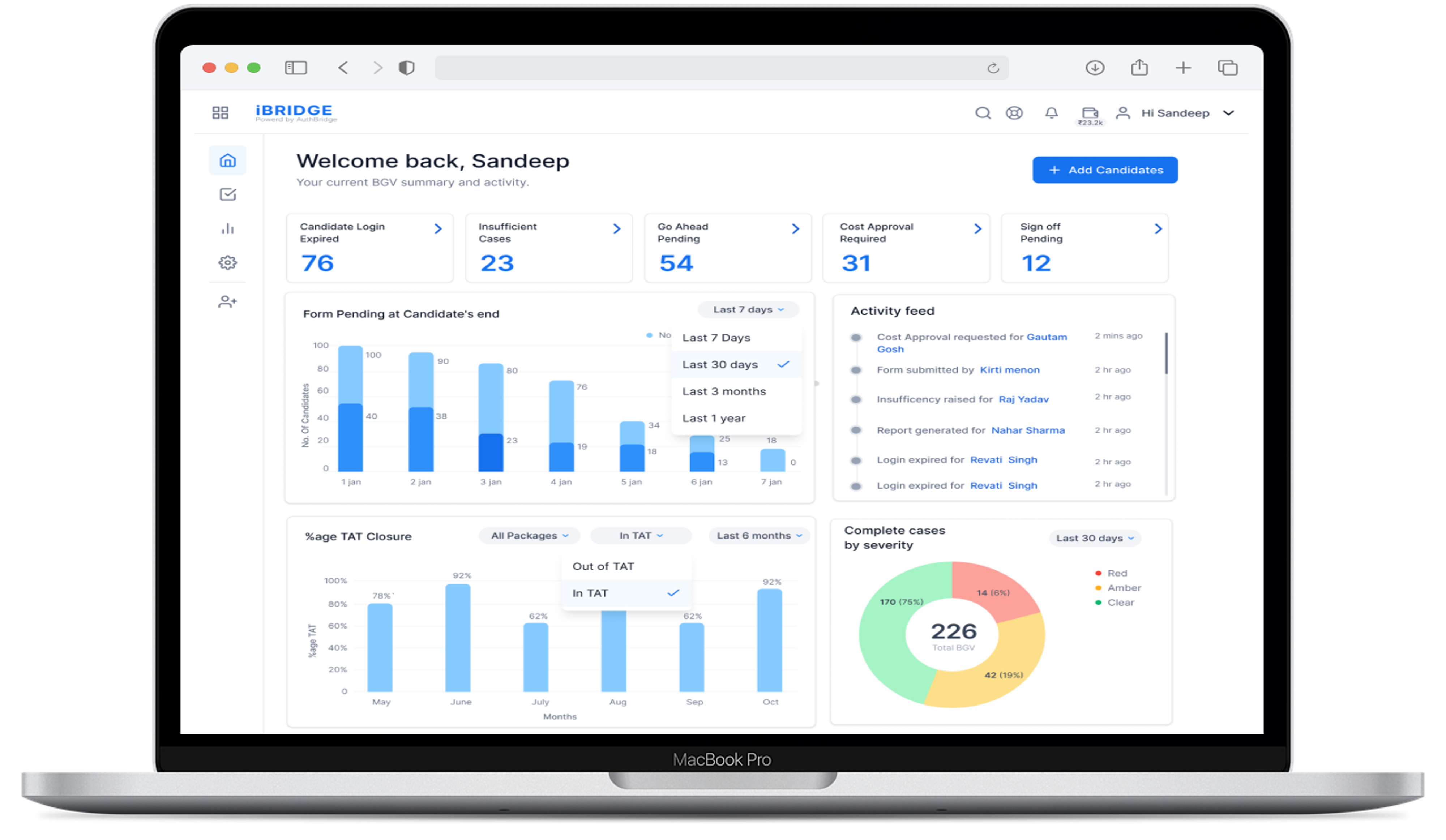
When tooling is limited, similar insights can be approximated through weekly exports or manual trackers that flag cases breaching configurable aging thresholds. A practical weekly cadence includes a short cross-functional review with HR Ops and Compliance that covers three items. First, a list of cases within a set percentage of their SLA limit. Second, the top recurring root causes such as candidate non-response, data insufficiency, or external data-source delay. Third, specific remediation actions with owners and deadlines.
Program Managers can also share a concise weekly summary with Procurement and the CISO that shows SLA adherence rates, exceptions, and corrective steps already in progress. That proactive communication, backed by consistent dashboard or report evidence, demonstrates control over verification operations. It reduces the likelihood that stakeholders resort to formal escalation as their only way to regain visibility.
If the BGV/IDV APIs go down during peak hiring, what’s the recovery plan, and how should SLA credits work so Procurement stays comfortable at renewal?
B1783 Outage recovery and renewal risk — In employee BGV/IDV operations, what is the recovery plan when the IDV API gateway has an outage during a mass hiring drive, and how should SLAs and service credits be structured to avoid Procurement veto at renewal?
When an IDV API gateway fails during a mass hiring drive, the recovery plan should queue verification attempts, temporarily halt or constrain access grants, and document all affected cases, while the contract defines clear outage metrics and service credits so Procurement treats the event as governed rather than grounds for veto. Operational controls and commercial terms need to be aligned in advance.
Operationally, organizations benefit from decoupling front-end data capture from real-time IDV calls so candidate information can still be collected and stored when the gateway is down. New hires can be placed in a "verification pending" state where HR can progress low-risk steps such as documentation or training, but system or facility access is withheld until IDV completes. If access must be granted, this should follow a risk-tiered rule set with explicit time limits and enhanced monitoring, and every exception should be logged against the case.
A structured incident playbook should define roles, communication templates, and decision criteria. The playbook can specify when to switch traffic to a backup endpoint or alternate verification method, how often to update HR and business leaders, and how to create an incident report that lists duration, scope, root cause, and remediation items.
Contractually, organizations should define API uptime as a measurable percentage over a period, exclude announced maintenance windows, and classify incident severities with associated response and resolution targets. Service credits can be tied to missed availability or extended P1 incidents, applied as discounts on future invoices, and capped at an agreed share of monthly fees. Clear definitions reduce disputes about whether an event counts as a compensable outage. Evidence obligations, such as post-incident reports and trend metrics, help Procurement show that outages lead to concrete improvements rather than only financial offsets.
If a candidate revokes consent, what’s the step-by-step process to honor it without breaking our BGV audit trail?
B1784 Consent revocation operational checklist — In employee background screening under DPDP-style consent expectations, what is the operational checklist for responding to a consent revocation request while keeping audit trail integrity intact?
Under DPDP-style consent expectations, handling a consent revocation request requires an operational checklist that stops new processing under that consent, evaluates any narrower legal need to retain data, and preserves immutable audit logs documenting both the original consent and the revocation. The objective is to cease purpose-specific use while keeping enough evidence to prove lawful behavior.
A practical checklist includes several steps. First, verify the identity of the requester using available IDV methods to avoid unauthorized revocations. Second, locate all open background verification or identity verification cases tied to the consent artifact and immediately pause discretionary processing. Third, ask Compliance or the DPO to decide whether any data elements must be retained for obligations such as statutory recordkeeping, dispute handling, or audit defense, and document that decision.
System operators should then flag the consent as revoked so the data is no longer used for new verification decisions or re-screening under the original purpose. Where data has been shared with BGV vendors or subprocessors, they should be notified to stop processing and align deletion or restriction actions with the controller’s instructions.
Audit trails require special care. Historical logs that record consent capture, checks performed, decisions taken, and the revocation event itself should not be edited. Instead, an additional entry can record the revocation timestamp, scope, and actions taken, with retention and deletion aligned to pre-defined policies. Overwriting or deleting audit events risks weakening the organization’s ability to show regulators that processing before revocation complied with consent and purpose limitations.
Change Control, SLAs & Renewals
Covers change control processes, SLA enforceability, and renewal risk management. Aims to avoid deal-breaker findings related to pricing or rights during re-compete.
If liveness fails for real users due to device or network issues, what fallback flow keeps onboarding moving without weakening security?
B1785 Liveness failure fallback workflow — In employee IDV with selfie and liveness, what is the fallback workflow when liveness fails for genuine users (poor connectivity, low-end devices) without triggering HR pressure to weaken controls that the CISO would veto?
In employee IDV with selfie and liveness, fallback workflows for genuine users should change the verification channel or timing while preserving the intended assurance level, so the organization does not weaken controls in response to HR pressure that the CISO would later veto. The guiding rule is to maintain face-match and liveness confidence, even if the journey becomes more assisted.
Where feasible, organizations can offer supervised alternatives such as scheduled video verification, office-based kiosks, or guided sessions where trained staff help the user complete selfie and liveness capture using better connectivity and devices. Clear retry rules can reduce friction, for example allowing a limited number of automated retries with contextual tips on lighting, camera positioning, and network conditions before escalating to a supervised path.
In remote-heavy organizations without physical locations, fallbacks can emphasize scheduled windows where candidates connect from more reliable networks, or alternative devices, with support staff on call. In all cases, the fallback should still include selfie-to-ID face match and liveness checks, even if they use different tooling or flows. Manual document uploads without liveness should be reserved, if allowed at all, for tightly defined exceptions with explicit risk acceptance by senior stakeholders.
Cases that remain unresolved after all defined fallbacks should be routed into a "cannot complete IDV" state rather than informally overridden. Policies can describe how HR may proceed for lower-risk roles under documented exceptions, or when offers must be withdrawn for higher-risk positions. Regular reporting on liveness failure rates, fallback utilization, and outcomes helps governance forums adjust journeys and training instead of diluting zero-trust standards under ad hoc pressure.
What should an audit evidence pack contain—fields and timestamps included—so a DPO won’t reject it as unverifiable?
B1786 Evidence pack acceptance criteria — In employee BGV vendor evaluation, what are the concrete acceptance criteria for 'audit evidence packs' (required fields, timestamps, reviewer actions, document hashes) that prevent a DPO from vetoing due to unverifiable provenance?
In employee BGV vendor evaluation, audit evidence packs are acceptable when they let a DPO independently reconstruct who did what, when, using which sources, and under which consent and retention rules, without relying on informal explanations. The criteria center on structured fields, timestamped events, and integrity markers that together establish provenance.
For each verification case, a minimal evidence pack should include a unique case ID and candidate reference, a list of checks performed with status and result values, and timestamps for key events such as case creation, consent capture, check initiation, check completion, and final decision. Reviewer-related data should identify users or service accounts that initiated checks, reviewed results, approved exceptions, or changed statuses, along with any reason or comment fields where judgement calls were made.
Document-related evidence should go beyond storing files. Packs should record document types, capture or upload timestamps, and non-reversible integrity markers such as file hashes or system-generated IDs linked to storage locations. These markers make later tampering or silent replacement of documents easier to detect.
From a governance perspective, the pack should include a reference to the consent artifact used, the declared purpose category for processing, and the retention or deletion date applied under policy. An ordered audit log of system and user actions, with immutable timestamps, should be available in a machine-readable format for sampling and audits. DPOs can then test a vendor’s implementation by requesting sample evidence packs and verifying that fields are consistently populated, events are chronologically coherent, and changes are visible rather than overwritten.
How do HR, Compliance, and CISO agree on trust thresholds so one team can’t tighten rules and choke hiring?
B1787 Shared trust thresholds governance — In employee BGV/IDV platform rollouts, how should HR, Compliance/DPO, and the CISO agree on a single 'trust threshold' policy (rules + scoring) so that one group cannot unilaterally tighten controls and effectively veto hiring throughput?
In employee BGV/IDV rollouts, a single trust threshold policy works when HR, Compliance or the DPO, and the CISO jointly define role-based risk tiers, minimum verification requirements, and decision rules, and then lock these into a governed change process so no function can tighten or relax controls alone. The trust threshold becomes a documented standard with shared ownership.
A practical starting point is to classify roles into a small number of tiers such as high-privilege access, regulated or sensitive data handling, and standard access. For each tier, stakeholders specify mandatory checks like identity proofing, employment and education verification, criminal or court record checks, and any additional screening for leadership or regulated positions. They also define what outcomes are acceptable, for example which combinations of clear or discrepant results still allow hiring under conditions.
Where platforms support it, organizations can express these rules as scores or decision matrices that combine multiple check outcomes into actions like approve, conditional approve, or reject. Where they do not, the same logic can be written as explicit if-then rules that are implemented in workflows and standard operating procedures.
To prevent unilateral veto through configuration changes, change control should require any modification to required checks, thresholds, or decision rules to be proposed in writing, assessed for impact on TAT and risk, and approved by a small cross-functional governance group. Regular reviews of metrics such as approval rates, discrepancy patterns, and incident reports provide the evidence base for adjustments. Publishing the current policy and change log to all stakeholders reduces the scope for silent tightening by a single team that would otherwise slow hiring or, conversely, erode assurance.
How do we verify your BGV/IDV data sources are lawful and consented, instead of trusting marketing claims and getting DPO pushback later?
B1788 Validate lawful data sources — In employee BGV/IDV procurement, what is the practical process to validate that a vendor’s data sources are lawful, consented, and purpose-limited, rather than relying on marketing claims that trigger DPO veto later?
In employee BGV/IDV procurement, organizations validate that a vendor’s data sources are lawful, consented, and purpose-limited by demanding a transparent source inventory, reviewing underlying data contracts for privacy and purpose clauses, and inspecting how consent is operationalized in workflows. The aim is to replace marketing claims with verifiable evidence that satisfies the DPO.
A structured review begins with a data source register from the vendor that names each registry, bureau, court database, or aggregator used, along with jurisdiction and broad data categories. For major sources, buyers should examine representative contracts or terms to see whether the vendor has explicit rights to access and process the data for background verification or identity verification, whether onward sharing is controlled, and whether retention and deletion are constrained to defined purposes.
Procurement and Compliance can probe for indirect or opaque sourcing by asking vendors to identify all subprocessors or aggregators and to confirm in writing that no scraping or unauthorized harvesting is used. Any reluctance to disclose key sources or legal bases is a signal for deeper scrutiny.
Operationally, evaluators should request a live or recorded demonstration of consent capture, purpose selection, and revocation handling in the platform. They can ask the vendor to show how a candidate’s consent is stored, how checks are restricted if consent is limited to certain purposes, and what happens in the system when consent is withdrawn. If only slideware is available, buyers can compensate by using detailed questionnaires that require descriptions of consent ledgers, purpose tags, and data minimization practices. Documented responses and sample artifacts give the DPO a tangible basis to assess whether data use is consistent with lawful, consented, and purpose-limited processing.
If court record digitization causes a false-positive spike, how do HR and Compliance handle speed vs accuracy without chaos?
B1789 False positives spike coordination — In employee BGV operations, what is the cross-functional workflow when a court record digitization feed produces a spike in false positives and the CHRO demands speed while Compliance demands precision?
When a court record digitization feed generates a spike in false positives, the cross-functional workflow should shift into an incident mode that increases human review, tightens documentation, and adjusts matching configurations where possible, while HR and Compliance agree explicitly on where to prioritize speed versus precision by role. The aim is to contain risk without disabling checks or silently ignoring alerts.
Operationally, verification teams can create a special queue for new court-record hits and require manual confirmation before treating them as adverse findings. If the feed or platform exposes match scores or similarity indicators, thresholds can be raised temporarily for lower-risk roles so only higher-confidence hits trigger review. If only binary hits are available, teams can enrich matching with more identity attributes such as date of birth or address during manual triage.
For high-risk or regulated positions, the organization may decide to preserve conservative matching even at the cost of longer TAT, but this should be communicated to hiring managers and candidates as a temporary quality-control measure. Transparent messaging about additional verification steps and expected timelines reduces perception of arbitrary delay.
A small incident group including HR Ops, Compliance, and relevant technical or vendor contacts should meet frequently during the spike. This group can track volumes, override rates, and any genuine hits that emerge, and then adjust search parameters or workflows accordingly. All decisions to raise thresholds, add manual steps, or revert changes should be logged. That log, along with post-incident analysis of false-positive patterns, provides evidence for auditors that the organization responded proportionately rather than sacrificing either speed or legal defensibility.
How do we ensure audit trails and consent logs are exportable if we exit, so Procurement is comfortable on sovereignty and lock-in?
B1790 Exportability of audit and consent — In employee BGV/IDV, what contractual and technical controls ensure that audit trails and consent ledgers remain accessible and exportable if the vendor relationship ends, preventing a data-sovereignty veto from Procurement?
In employee BGV/IDV, organizations avoid data-sovereignty vetoes when contracts and technical designs ensure that audit trails and consent ledgers are exportable in full, usable form before or at offboarding, and when internal archives can preserve this evidence independently of the vendor. The objective is to keep verification history under the organization’s control even if the platform changes.
Contract terms should grant explicit rights to export all case data, audit logs, and consent records in structured formats, with timelines for export both during the contract and at termination. Agreements can define supported formats, reasonable export fees if any, and a limited post-termination window during which the vendor retains data solely for export and legal defense, aligned with applicable retention rules. Procurement can also request an annual or periodic "portability test" in which a sample of cases and logs are exported and validated by internal teams.
On the technical side, platforms should provide bulk export capabilities or APIs that include case identifiers, check types and results, timestamps of key events, user or system actors, and consent events such as capture and revocation. Consent ledgers should be exportable in a way that preserves linkages between individuals, purposes, and processing activities.
Internally, organizations need an archival pattern ready to receive and store exported evidence, for example a secure data store with access controls, retention policies, and reporting tools that allow future audits. Without such a destination, even well-structured exports can become unusable. Aligning vendor export capabilities with internal archiving and clear contractual rights assures Procurement and risk stakeholders that the organization will not lose regulatory proof or decision histories when the vendor relationship ends.
Incident Response, Redressal & Breach
Outlines incident response, redressal, and breach notification processes. Emphasizes timely, regulator-ready communications and accountability.
For HRMS/ATS integrations, what are the minimum security requirements—least privilege, logs, keys—that decide CISO sign-off?
B1791 Secure HRMS/ATS integration baseline — In employee IDV/BGV integrations with HRMS/ATS, what are the minimum requirements for least-privilege access, logging, and key management that typically decide CISO approval?
In employee IDV/BGV integrations with HRMS or ATS, CISOs typically look for least-privilege access scopes, detailed integration logging, and disciplined key management, all implemented under a zero-trust mindset. These controls limit blast radius, support investigations, and reduce the chance that the integration becomes a weak link.
Least-privilege starts with dedicated service accounts or client credentials for the integration, restricted to specific operations such as creating verification cases or reading status and decision fields. The HRMS or ATS should not receive full raw documents or unnecessary personal data when a summarized outcome is sufficient. Human users should interact through role-based access controls so only designated reviewers can see sensitive evidence or detailed discrepancy reasons.
Logging should record each API interaction between systems with timestamps, requesting system or user identity, endpoint called, high-level operation type, and outcome codes. Correlation identifiers allow security teams to trace a request across both platforms during incident response.
Key management should place API keys, tokens, or certificates in a secure secrets store, enforce rotation policies, and avoid reuse of the same credentials across environments or services. Integrations should use encrypted channels and, where possible, network controls such as IP allowlisting or private connectivity, consistent with the organization’s broader zero-trust and data protection posture.
What control levers can Procurement keep in the BGV/IDV contract—price changes, subprocessors, audit rights—without endless renegotiations?
B1792 Procurement control levers that scale — In employee BGV/IDV vendor governance, what are the most effective 'control levers' Procurement can retain (approval of price changes, change control on subprocessors, audit rights) without creating constant renegotiation friction?
In employee BGV/IDV vendor governance, Procurement can retain effective control by structuring transparent pricing guardrails, defined subprocessor change controls, and risk-based audit rights that are predictable to exercise. These levers preserve oversight without forcing continual renegotiation that slows verification programs.
For pricing, contracts can define rate cards per check type, volume tiers, and caps on annual increases linked to agreed percentages or indices, with notice periods for any structural pricing changes. This reduces surprise costs while still allowing vendor economics to adjust within known limits.
Subprocessor governance benefits from obligations to provide and update a list of subprocessors that handle personal data, to give advance notice before adding or changing material subprocessors, and to allow the buyer a fixed review window. During that window, Risk or the DPO can assess implications for data localization, security, or compliance and discuss mitigations, rather than defaulting to absolute vetoes.
Audit rights can be tiered by risk. Baseline rights include access to up-to-date security and privacy documentation, independent assessments where available, and responses to structured questionnaires. For higher-risk use cases, contracts can also allow targeted audits under reasonable notice, with scope and frequency pre-agreed to avoid operational disruption. Procurement then triggers these levers based on risk signals such as incidents, regulatory changes, or major architectural shifts, which keeps oversight active but focused.
What are signs we’re choosing a BGV/IDV vendor just because they’re ‘the safe logo,’ and might still trigger CISO/DPO veto later?
B1793 Risks of logo-driven selection — In employee BGV/IDV, what are the practical indicators that a buying committee is relying too much on 'consensus safety' (logo-driven choice) and missing fit-for-purpose risks that later cause CISO or DPO veto events?
In employee BGV/IDV evaluations, over-reliance on consensus safety and vendor logos becomes visible when buying committees focus on who else uses a platform, avoid failure scenarios, and leave critical checks to "someone else" on the team. These indicators suggest that fit-for-purpose risks are being deferred, which often reappear later as CISO or DPO vetoes.
One sign is that shortlists are built primarily from brand recognition or peer usage, and evaluation discussions center on reference customers instead of consent operations, audit evidence, or data localization. Questions like "Have our competitors deployed this?" dominate over "How will this handle a consent revocation or audit?" Another sign is that requirements around audit trails, retention, and security are captured in documents but never deeply tested in demos, pilots, or technical workshops.
Diffusion of accountability is a further indicator. HR assumes Compliance will validate data sourcing and DPDP alignment. Compliance assumes IT will test integration security and observability. Procurement assumes both have confirmed risk coverage. No one leads scenario-based evaluations such as outage simulations or sample evidence pack reviews. When security or privacy sign-offs finally occur late in the process, previously unexamined misfits can lead to last-minute vetoes.
Committees that recognize these patterns can counterbalance them by assigning explicit owners for privacy, security, and operational fit, and by embedding at least one adverse scenario test into evaluation, such as a mock audit or breach-response walk-through. This shifts the process from logo-driven reassurance to evidence-based suitability without discarding the value of market references.
What dashboards and drill-downs do we need for instant audit readiness on consent, retention, access, and breach response?
B1794 Minimum audit-readiness dashboards — In employee BGV/IDV compliance operations, what is the minimum set of dashboards and drill-down reports that enable 'auditor in the lobby' readiness for consent, retention, access, and breach-response evidence?
In employee BGV/IDV compliance operations, "auditor in the lobby" readiness depends on a small set of dashboards and drill-down reports that expose consent status, processing history, retention actions, and incident handling in a few clicks. These views translate complex logs into auditor-friendly evidence.
At a minimum, organizations benefit from three summary dashboards. A consent dashboard should show counts of active, revoked, and expired consents over time, with the ability to click through to an individual consent artifact and see linked verification cases. A processing dashboard should summarize verification volumes, outcomes, and TAT, and let users open a specific case to view its full audit trail of checks, decisions, and user actions. A retention and deletion dashboard should highlight datasets and cases nearing end-of-retention, deletions performed, and documented exceptions.
Supporting these summaries, drill-down reports are necessary for detailed questions. Consent reports should list each consent record with timestamps, purposes, and revocation status. Access reports should show which users or systems accessed case data or documents, with timestamps and operation types, in a format that can be filtered by individual, timeframe, or case. Incident or breach reports should capture detection, containment, notification, and remediation steps for each event.
Many operational SLA or throughput dashboards already exist in verification programs. Extending them with consent-centric, retention-centric, and access-centric slices ensures Compliance teams can respond quickly when auditors request specific proof, rather than assembling it manually from raw logs.
How do we set liability and indemnity terms so Legal is protected but the contract still gets signed on time for BGV/IDV?
B1795 Calibrate liability without delays — In employee BGV/IDV contracting, how should limitation-of-liability and indemnity be calibrated so Legal feels protected, but Procurement does not face vendor pushback that delays the hiring program timeline?
In employee BGV/IDV contracting, limitation-of-liability and indemnity are calibrated effectively when they reflect the vendor’s role in risk, keep total exposure finite and insurable, and clearly allocate responsibility for privacy and security obligations. That balance gives Legal meaningful protection without creating terms that stall vendor agreement and delay hiring programs.
For limitation of liability, a common pattern is to cap aggregate liability at a multiple of fees paid over a defined period, with differentiated caps for general claims and for data protection or security incidents. General commercial claims might be limited to a lower multiple, while breaches of agreed security measures or privacy obligations are capped higher but remain finite. This signals that data-related failures are taken seriously while staying within what vendors can accept.
Indemnity clauses can then target specific third-party claims arising from the vendor’s failure to meet contractually defined security, privacy, or regulatory requirements. The contract should also state that the buyer retains responsibility for its own misuse of data, policy violations, or integration decisions that deviate from agreed security patterns.
Clarity about how indemnified claims interact with liability caps helps avoid later disputes. Contracts should state whether indemnity obligations are subject to the same caps or have separate, defined limits. Organizations in more regulated sectors may choose higher caps or additional insurance-backed commitments, but the underlying approach remains anchored in proportionality to the BGV/IDV service’s control over data and processes.
How do we prevent scope creep into continuous monitoring so we don’t trigger DPO concerns about surveillance and purpose expansion?
B1796 Prevent surveillance-related scope creep — In employee BGV/IDV post-purchase operations, what governance process prevents 'scope creep' into continuous employee monitoring in a way that triggers DPO veto for surveillance concerns and purpose expansion?
In employee BGV/IDV post-purchase operations, a governance process prevents scope creep into continuous employee monitoring by requiring that any new screening or data reuse be checked against stated purposes, consents, and employee expectations before activation. The goal is to keep verification as a defined control, not an open-ended surveillance mechanism that would trigger DPO veto.
Organizations can maintain a simple register of approved verification uses that lists which employee segments are screened, at what points in the lifecycle, and for which purposes. Any proposal to add periodic re-screening, expand checks to new populations, or use historical BGV data for ongoing risk scoring should be logged as a change request. HR, the DPO, and where relevant the CISO can then review whether privacy notices and consents cover the new activities and whether additional transparency or consent is needed.
On the technical side, platforms should be configured so that continuous monitoring features, adverse media feeds, or periodic re-checks are enabled only for groups explicitly approved in that register. Where platforms lack fine-grained purpose tags, governance can still require documented approvals and configuration change logs whenever new monitoring is switched on.
Employee communication is a parallel safeguard. Clear explanations in policies, onboarding materials, or internal FAQs about what is checked, when, and why help align expectations and reduce perceptions of hidden surveillance. Regular reviews of the monitoring register by the DPO ensure that incremental changes over time do not collectively shift the program beyond its original, consented scope.
Strategic Alignment, ROI & Long-Term Value
Promotes strategic alignment of HR, Compliance, and IT with ROI considerations. Sets governance around KPIs to avoid misaligned incentives.
Can we run a tabletop exercise—breach, audit, outage—with HR, DPO, CISO, and Procurement to surface veto risks before we decide?
B1797 Tabletop exercises to surface vetoes — In employee BGV/IDV evaluation, what are the practical steps to run a joint tabletop exercise (breach, audit, outage) with HR Ops, DPO, CISO, and Procurement to reveal veto risks before selection?
In employee BGV/IDV evaluation, a joint tabletop exercise with HR Ops, the DPO, the CISO, and Procurement reveals veto risks by testing how candidate solutions support breach response, audits, and outages before selection. The exercise converts abstract requirements into concrete observations about workflows, evidence, and contracts.
Organizations can schedule these exercises after initial shortlisting but before final commercial negotiation. The team selects a small set of scenarios, such as a regulator demanding proof of consent and retention decisions, a security incident affecting verification data, and an IDV outage during peak hiring. For each scenario, participants outline the sequence of events, identify which function leads, and list what they need from the platform and vendor, such as audit logs, consent ledgers, or incident communication channels.
If vendors cannot attend, buyers can still use demos, documentation, and trial environments to simulate how they would obtain required evidence or support in each scenario. During the session, each function role-plays their response, capturing where the solution appears strong and where gaps or ambiguities exist.
Afterward, findings should be translated into explicit evaluation criteria and contract asks. Examples include mandatory availability of certain reports, data export capabilities, or clarified SLA and incident-reporting clauses. Capturing these in scoring matrices or RFP updates ensures that insights from the tabletop exercise shape vendor selection and reduce the likelihood of late CISO or DPO objections.
When BGV results come back as ‘cannot verify,’ what policy prevents HR pressure to force-close and create audit risk?
B1798 Policy for cannot-verify cases — In employee BGV programs, what is the practical policy for handling 'cannot verify' outcomes (low coverage) so HR does not pressure Ops to 'force close' cases in ways that create audit and compliance veto risk?
In employee BGV programs, a practical policy for "cannot verify" outcomes treats them as a separate category with defined risk-handling options, so HR cannot simply "force close" cases as clear and create audit exposure. The policy links this status to role-based decisions, approvals, and documentation.
Operationally, verification teams should mark cases as "unable to verify" when reasonable attempts to obtain evidence fail, such as non-responsive institutions or missing records, and record the attempts made. For each role tier, the policy can then specify whether such cases are ineligible for hiring, may proceed under defined conditions, or require additional compensating checks like extra references.
Conditional hiring, where permitted, should be paired with concrete controls such as restricted system access, shorter review cycles, or time-bound follow-up checks if new data sources or integrations become available. These conditions and timelines should be reflected in both HR records and access-management configurations, not just in narrative notes.
Policy design benefits from joint ownership by HR, Compliance, and the CISO, who can agree on thresholds per role and document them in standard operating procedures. Communication templates for hiring managers should explain the meaning of "cannot verify," the approved options, and any access or supervision implications. Periodic reports on the number of such cases, their role distribution, and eventual outcomes help identify systemic coverage issues and support a consistent, defensible approach during audits.
What documents can you share so our DPO can confidently sign off on purpose limitation, minimization, and retention in BGV/IDV?
B1799 DPO sign-off documentation set — In employee BGV/IDV vendor selection, what documentation should a vendor provide to prove purpose limitation, storage minimization, and retention schedules in a way that a DPO can sign without personal anxiety?
In employee BGV/IDV vendor selection, DPOs gain confidence when vendors supply a focused documentation set that shows, in verification-specific terms, which data is collected, for what purposes, for how long, and with what consent and minimization controls. The documentation should allow independent checks rather than rely on generic privacy statements.
Vendors should provide a data processing description that lists personal data categories used in background and identity checks, the corresponding purposes such as identity proofing, employment history verification, or criminal record checks, and how these purposes map to consent or other lawful bases. A retention and deletion schedule should specify storage durations by data type, events that trigger deletion or anonymization, and conditions under which retention may be extended for legal or audit reasons.
Evidence of storage and collection minimization can include configurable forms or APIs that show which fields are mandatory, optional, or disabled for certain use cases, along with explanations of why each attribute is needed. Vendors can also document how data subsets are used for different workflows so that not all data is exposed everywhere by default.
DPOs benefit from examples of consent management and lifecycle enforcement in practice, such as sample consent records, descriptions of revocation handling, and case-level audit excerpts where consent, purpose tags, and retention dates are visible. Selection teams can then compare this documentation with demos or pilots to confirm that stated purpose limitation and minimization principles are reflected in actual behavior.
What pricing guardrails—caps, tiers, true-ups, billing audits—prevent Procurement pushback if our hiring volume swings?
B1800 Pricing guardrails for volume swings — In employee BGV/IDV commercial governance, what pricing guardrails (volume tiers, caps, true-ups, audit rights on billing) prevent Procurement veto when hiring volume swings unexpectedly?
In employee BGV/IDV commercial governance, pricing guardrails that handle volatile hiring volumes without provoking Procurement veto combine tiered unit rates, clear caps on how fast spend can grow, defined true-up cycles, and proportionate billing audit rights. These mechanisms make cost behavior predictable for both parties.
Tiered pricing can link per-check rates to annual or quarterly volume bands, with automatic rate reductions when usage enters higher tiers and defined conditions for reverting if volumes fall. To protect against sudden spikes, contracts can set maximum percentage increases in total spend over a period relative to baseline forecasts, while still allowing higher absolute usage.
True-up clauses allow the parties to compare forecasted and actual volumes at set intervals and adjust pricing, credits, or future tiers accordingly. Vendors may seek minimum volume or revenue commitments over a term, which Procurement can balance with flexibility clauses that revisit commitments if business conditions change significantly.
Billing audit rights should permit periodic, not constant, verification that invoiced checks and applied tiers align with usage records, using agreed data extracts or reports. Defining reasonable frequency and notice for such audits maintains trust while deterring systematic misbilling. Together, these guardrails reduce the need for emergency renegotiations when hiring plans shift, and they give Procurement a structured framework to manage cost-risk without disrupting verification operations.
What findings most often kill a BGV/IDV deal late—audit rights, subprocessors, breach SLAs—and how do we write the RFP to avoid surprises?
B1801 RFP design to prevent deal-breakers — In employee BGV/IDV procurement risk reviews, what are the most common 'deal breaker' findings (missing audit rights, unclear subprocessors, weak breach SLAs) that cause late-stage veto, and how can an RFP prevent them?
The most common BGV/IDV deal breakers in procurement are missing verifiable auditability, opaque data flows, and weak incident and retention commitments. RFPs reduce late-stage vetoes when they force vendors to surface these areas early, in concrete, evidence-backed form.
Compliance and DPO teams usually veto when there are no robust consent artifacts, unclear purpose limitation, or missing retention and deletion schedules that align with DPDP-style expectations. Another frequent blocker is the absence of demonstrable audit trails and chain-of-custody for background checks, including reviewer actions, data lineage from fragmented sources such as courts or registries, and explainable decision records. Risk and security teams also raise red flags when subprocessors and data aggregators are not listed, when cross-border processing is unclear, or when breach SLAs lack explicit notification timelines and remediation steps.
An effective RFP specifies BGV/IDV-relevant documentation rather than generic policies. It asks for sample consent ledgers, example audit bundles covering case evidence, reviewer activity, and data provenance, and written retention and deletion policies tied to verification purposes. It requests disclosure of all subprocessors and jurisdictions, API uptime and TAT SLAs, and escalation procedures for SLA or incident breaches. It can also ask vendors to describe any automated scoring or rule engines used in verification, including how human-in-the-loop overrides are logged, without assuming that AI is always present. When these requirements are scored alongside TAT, hit rate, false positive management, and cost-per-verification, Procurement can compare vendors consistently and reduce the risk of late-stage Compliance or IT veto.
How do we document rules, thresholds, and human overrides so Compliance can defend outcomes and not block AI scoring in BGV/IDV?
B1802 Document decisioning for defensibility — In employee BGV/IDV governance, what are practical ways to document decisioning rationale (rules, thresholds, human-in-the-loop overrides) so Compliance can defend outcomes and avoid vetoing AI scoring?
Employee BGV/IDV governance is stronger when decisioning rationale is captured as explicit policies, structured logs, and reusable evidence rather than informal practice. Clear documentation of rules, thresholds, and human overrides helps Compliance defend outcomes and reduces resistance to automated or AI-assisted scoring.
A practical approach is to maintain a policy register that maps role criticality, jurisdiction, and check type to required verification bundles and pass/fail criteria. For rule- or score-based engines, organizations document which inputs are used, such as identity proofing results, criminal record hits, or address discrepancies, and what thresholds trigger pass, review, or fail. Where composite trust scores exist, teams record the factors and weightings in plain language rather than exposing model details.
Human-in-the-loop governance relies on structured override logs. Reviewers select standard reason codes when they deviate from default outcomes and add short justifications. Escalation rules for edge cases and adverse findings are also written down and linked to case records. During implementation, these elements are bundled into audit-ready artifacts that pair consent logs and chain-of-custody with decision reasons and reviewer actions. When Compliance can query policies, see how they were applied to specific cases, and inspect override histories, they are better able to defend automated decisioning and less likely to veto the use of scoring or rules in BGV/IDV workflows.