
Operational Lenses for BGV/IDV governance, experience, and risk management
This data model organizes 22 BGV/IDV questions into five operational lenses to help HR, risk, and IT teams plan, measure, and execute verification programs. Each lens defines governance, candidate experience, reliability, compliance, and global execution; the mapping enables scalable reuse of insights across questions while preserving independent decision contexts.
Explore Further
Operational Framework & FAQ
Governance, SLAs, and auditability
Defines how HR Ops, Compliance, and IT coordinate verification programs, establish SLAs, and maintain regulator-defensible audit trails across vendors.
For employee screening, what RACI between HR Ops, Compliance, and IT prevents bottlenecks but keeps accountability clear for SLA misses and disputes?
C0450 RACI to avoid bottlenecks — For employee background screening programs, what governance model (RACI) between HR Ops, Compliance, and IT best prevents verification bottlenecks while keeping accountability clear for SLA misses and disputed cases?
An effective governance model for employee background verification assigns clear, complementary roles to HR Operations, Compliance, and IT so that verification does not become a bottleneck and responsibility for SLA misses or disputed cases is explicit. The model typically uses a RACI-style approach mapped to key activities rather than a single, generic ownership statement.
HR Operations is usually Responsible for initiating and tracking verification cases, monitoring turnaround times, and managing candidate communication and documentation collection. HR is often the primary owner of hiring-facing SLAs, such as readiness to onboard by a target date, because these outcomes are closest to recruitment and workforce planning.
Compliance is generally Accountable for verification policy and regulatory defensibility. This includes defining which checks apply to different role tiers, setting rules for consent, retention, and deletion, and shaping how adverse findings are categorized and escalated. Compliance is typically responsible for decisions on disputed cases that raise legal or regulatory concerns, often in collaboration with HR.
IT is Responsible for the technical operation of the BGV/IDV platform, including integration with HRMS or ATS systems, uptime, data protection, and observability. IT is commonly accountable for meeting agreed technical SLAs such as API availability and for managing incidents involving security or data leakage.
To prevent bottlenecks, organizations can build a RACI table for discrete steps like case initiation, exception handling, policy interpretation, audit evidence preparation, and vendor performance reviews. They also define expected response times for escalations to Compliance or IT so that cases do not stall. Regular service reviews where HR presents SLA and volume metrics, Compliance reviews policy adherence and disputed outcomes, and IT reports on stability and incidents help maintain alignment and reinforce that each team remains accountable for its part of the verification lifecycle.
When we look for a “safe standard” BGV/IDV vendor, what peer signals matter most, and how should we run references to reduce risk?
C0451 Peer signals and references — In employee BGV/IDV vendor evaluation, what does “safe standard” peer adoption actually mean for HR—industry logos, revenue-band matches, or similar hiring volumes—and how should reference checks be structured to reduce selection risk?
In employee BGV/IDV vendor evaluation, a “safe standard” of peer adoption means selecting a platform that is already operating reliably for organizations with comparable regulatory exposure and verification complexity, rather than relying only on famous logos. For HR, this usually involves checking that reference customers face similar audit scrutiny, run similar types of checks, and handle similar hiring patterns, even if size or revenue bands differ.
Peer similarity can be evaluated along several axes. Industry and regulatory regime matter because a vendor proven in BFSI or other tightly regulated sectors often demonstrates strong compliance and auditability, although operational fit for gig or blue-collar hiring still needs separate validation. Verification volume, role mix, and geography also matter because they influence whether the platform can handle a buyer’s TAT expectations and candidate demographics.
Structured reference checks help reduce selection risk. HR, Compliance, and Procurement can ask peers qualitative questions about observed TAT performance, consistency of SLA adherence, escalation handling, and candidate experience, even if precise KPIs are not shared. They can also probe how the vendor supported audits, responded to regulatory or policy changes, and managed incidents.
Questions about integration with HRMS or ATS stacks, data localization and retention practices, and support responsiveness during hiring peaks provide additional confidence that the vendor is a safe operational choice, not only a compliant one. Asking for perspectives across different relationship stages, from implementation through renewal, helps HR understand whether the vendor sustains performance and governance over time.
By combining evidence of peer adoption in comparable contexts with disciplined reference conversations, HR buying teams can treat “safe standard” as a concrete risk-reduction tool rather than a vague preference for well-known brands.
For a BGV/IDV rollout, what’s a realistic 30–60–90 day plan with clear pilot gates we can hold the vendor to?
C0453 30–60–90 rollout with gates — For employee BGV/IDV rollouts, what is a realistic 30–60–90 day go-live plan that HR Ops can hold a vendor accountable to, including pilot gates like UX completion rate, TAT distribution, and escalation ratio?
A realistic 30–60–90 day go-live plan for an employee BGV/IDV rollout stages scope definition, pilot validation, and scale-up so HR Operations can hold the vendor to clear milestones. The exact duration may flex by organization, but the sequencing of activities and gates typically follows this pattern.
In roughly the first 30 days, teams define use cases and role-criticality tiers with HR and Compliance, select check bundles for each tier, and configure core workflows. IT sets up initial integrations with HRMS or ATS systems and basic observability for TAT and error logs. During this period, stakeholders also agree on pilot metrics and pass/fail gates for UX completion rate, TAT distributions, escalation ratio, and case closure rate, and capture privacy and retention requirements for consent artifacts and deletion SLAs.
Between about days 30 and 60, organizations run a controlled pilot with representative candidate cohorts. HR measures completion of self-service journeys, identifies drop-off points, and records TAT distributions by check type and role. Escalation ratios and exception volumes are monitored to see how many cases require manual review, and whether internal teams and vendor support can handle that load. Compliance and IT verify that consent capture, audit logs, and data handling behave as designed.
From around days 60 to 90, the focus shifts to widening coverage to more roles or locations, formal training for HR Ops and hiring managers on workflows and exception playbooks, and establishing recurring reporting and governance routines. This phase also validates incident-response processes and confirms that audit evidence, consent ledgers, and retention and deletion configurations are ready for internal or external review.
Throughout the plan, HR Ops should maintain a written checklist of vendor deliverables and internal actions, tied to the agreed pilot gates. Regular triage meetings with IT and Compliance help ensure that UX completion, speed, and defensibility all meet thresholds before committing to full-scale go-live.
In employee BGV, how should we tier checks by role criticality so depth and TAT match hiring urgency and risk?
C0455 Role-criticality tiering approach — In employee BGV programs, how should HR leaders design role-criticality tiers (e.g., executives, finance, field, gig) so that verification depth and turnaround times align with hiring urgency and risk exposure?
In employee BGV programs, HR leaders should design role-criticality tiers so that verification depth and turnaround expectations reflect each role’s risk exposure and hiring urgency. Tiers help avoid both over-screening low-risk roles and under-screening positions with significant financial, data, or reputational impact.
A practical approach starts by grouping roles into categories based on factors such as access to funds, access to sensitive information, potential reputational damage, and degree of customer interaction. Roles that score high on several of these factors, such as senior leadership or key finance positions, form a high-criticality tier that typically justifies deeper verification within acceptable timelines.
Moderate-criticality tiers might include supervisors or back-office roles with some control responsibilities. These roles often receive a standard set of checks appropriate to the organization’s risk appetite, with TAT targets that balance assurance and the need to fill positions within business timelines.
Lower-criticality tiers, which may include certain high-volume or gig roles, still require baseline verification aligned with legal and policy requirements. For these roles, organizations may prioritize rapid identity proofing and other essential checks while setting more aggressive TAT targets to protect hiring throughput.
Across all tiers, HR should collaborate closely with Compliance and relevant business owners to agree which checks are mandatory and which can vary by tier. They should document both the verification bundle and TAT expectations for each tier and review them periodically as regulations, business models, or incident patterns change. This structured approach makes it easier to explain verification decisions to stakeholders and auditors and to adjust screening depth as risks evolve.
In BGV ops, what cadence (weekly reviews, escalation playbooks, QBRs) actually keeps HR, Compliance, and the vendor aligned on speed and defensibility?
C0459 Operating cadence and QBRs — In employee verification operations, what service management rituals—weekly SLA reviews, escalation playbooks, and QBR packs—most effectively keep HR, Compliance, and the vendor aligned on speed and defensibility?
In employee verification operations, structured service management rituals keep HR, Compliance, and vendors aligned on both speed and defensibility. Common practices include regular SLA reviews, predefined escalation playbooks, and periodic business reviews supported by concise metric packs.
Regular SLA reviews, held at a cadence that fits team capacity, focus on operational indicators such as TAT distributions, case closure rates, escalation ratios, and rework patterns. HR and vendor operations use these sessions to spot bottlenecks by check type or geography and to agree on near-term actions. Compliance and IT join when observed issues touch policy or technical performance.
Escalation playbooks set out how urgent or complex scenarios are handled. They define which roles in HR, Compliance, IT, and the vendor are involved, expected response times, and preferred communication channels. Playbooks cover situations like suspected fraud, high-profile leadership checks, widespread data-source outages, or repeated SLA breaches, so responses are consistent rather than improvised.
Quarterly or similar business reviews use compact packs that summarize trends in key metrics, such as TAT, hit rate or coverage, escalation volumes, and adherence to consent and deletion SLAs. These sessions bring together HR leadership, Compliance, IT, and Procurement to assess whether verification is meeting agreed objectives and to decide on adjustments to policies, workflows, or resourcing.
When these rituals are linked to clear decision rights and follow-up actions, they create a feedback loop between daily operations and strategic governance. This helps organizations detect emerging risks early, refine verification depth or journey design, and maintain alignment on the balance between hiring speed and regulatory defensibility.
In employee BGV, how should we define SLAs so they reflect reality (vendor time vs candidate time vs third-party delays) and avoid constant disputes?
C0461 Define SLAs to avoid disputes — In employee BGV, how should HR teams set SLA definitions that reflect business reality—separating vendor processing time from candidate response time and third-party dependency delays—to avoid endless SLA disputes?
HR teams should define BGV SLAs so that vendor-controlled processing time is explicitly separated from candidate response time and third-party dependency delays, and so that each segment is measured with simple, observable timestamps. The vendor SLA should describe what the vendor owns directly, and adjacent KPIs should describe what candidates and information providers influence.
A practical pattern is to define a clear “case start” event such as consent plus minimum documents received. Organizations should then measure vendor processing time from this event until a documented outcome is produced. Candidate time can be measured from invitation sent until consent and minimum documents are received. Third-party dependency time can be approximated from the first outreach to an employer, university, or court until a response window has clearly lapsed or evidence is received.
HR should avoid overly complex state machines that are hard to maintain in low-maturity environments. A limited set of standard states, such as “waiting on candidate,” “waiting on third party,” and “with vendor for processing,” is usually sufficient. Contracts and playbooks should reference these states and require basic audit traces for each transition. This approach allows leadership dashboards to separate systemic vendor delay from market realities such as non-responsive employers, while still allowing Compliance and HR to scrutinize whether vendor UX, communication patterns, or follow-up processes are contributing to candidate and third-party delays.
For a BGV/IDV rollout, what training and change plan reduces HR Ops resistance but still gets consistent use of workflows and exception handling?
C0462 Change management for HR ops — In employee BGV/IDV solution evaluation, what training and change-management approach minimizes HR Ops resistance while still ensuring consistent use of workflows, exceptions, and dispute handling?
An effective BGV/IDV change-management approach minimizes HR Operations resistance by training to concrete daily workflows, limiting the number of exception paths, and making benefits to time-to-hire and audit defensibility visible, while acknowledging fear of added scrutiny. Training should be tightly scoped to real tasks and backed by simple governance routines rather than large, one-off programs.
Organizations can deliver short, role-specific walk-throughs that demonstrate how recruiters initiate checks, how coordinators track consent and documents, and how verification managers handle exceptions and disputes. Even when only one live session is possible, targeted recordings and quick-reference guides focused on a few high-frequency scenarios can anchor consistent behavior. HR and Compliance should agree on a small catalogue of exception types and dispute outcomes and ensure that the system presents these as structured choices, which reduces ambiguity in case handling.
To prevent reversion to legacy methods, leaders should link the new workflows to shared KPIs such as escalation ratio, case closure rate, and rework rate, and review these in regular operations check-ins rather than only at audits. Change champions in HR Ops can reinforce that standardized workflows protect individuals by creating clear evidence of decisions, instead of exposing them. This combination of pragmatic training, limited variability in process, and routine metric-based reviews improves consistency without overwhelming HR teams or triggering a perception of surveillance.
Candidate experience and friction controls
Focuses on consent flows, identity proofing UX, and metrics to minimize drop-offs while preserving verification integrity.
For employee BGV, how do we decide the right friction in ID and consent steps so we don’t spike drop-offs but still stay rigorous?
C0446 Balance friction vs drop-offs — In employee BGV programs, how should HR and Talent Acquisition leaders decide the “right amount of friction” in candidate identity proofing and consent flows without increasing candidate drop-offs or compromising verification assurance?
HR and Talent Acquisition leaders should define the right amount of friction in identity proofing and consent flows as the minimum interaction needed to achieve required assurance and legal compliance for a given role. The objective is to avoid both under-collection that weakens verification and over-complication that increases candidate drop-offs.
A practical starting point is risk-tiered journeys designed jointly with Compliance. Higher-risk roles, such as leadership, finance, or regulated positions, generally warrant deeper verification, which can include more extensive document capture or additional checks, as long as they remain clearly explained and logically ordered. Lower-risk or high-volume roles still need to meet regulatory baselines but can avoid extra steps that do not materially increase assurance.
Consent UX should reflect privacy requirements without overwhelming candidates. Effective flows present purpose, scope of checks, and retention in clear language, then capture affirmative action such as explicit agreement. Legal and Compliance teams should validate that simplified wording still covers all required elements under DPDP and comparable regimes so that usability does not erode lawful basis.
Leaders should also monitor journey analytics to locate friction points. Drop-off patterns during registration, document upload, or liveness checks can indicate technical or design issues, such as unstable mobile capture or confusing instructions, even when the number of steps is limited. Addressing these issues can improve completion rates without altering assurance.
Collaboration with IT is important when choosing verification technologies, because latency, device compatibility, and error handling directly affect perceived friction. When HR, Compliance, and IT co-design risk-weighted flows and review data on completion, rework, and disputes, they can adjust friction in a controlled way that protects both candidate experience and verification integrity.
In India-first BGV/IDV onboarding, what typically causes candidate drop-offs, and what should we design upfront to prevent them?
C0449 Prevent candidate drop-off drivers — In India-first employee BGV/IDV onboarding, what common candidate experience failure points (consent confusion, document upload friction, mismatch rework) most often drive drop-offs, and how should HR leaders design mitigations upfront?
In India-first employee BGV/IDV onboarding, frequent candidate experience failure points include confusing consent communication, high-friction document and data capture, and repeated rework from mismatches between inputs and official records. These points often cause candidates to abandon the process or delay completion, which slows hiring and complicates compliance.
Consent confusion occurs when candidates see dense legal text, vague lists of checks, or no clear explanation of why verification is required. This can result in hesitation, partial completion, or later disputes about scope. HR leaders should work with Compliance to present purpose, categories of checks, and retention expectations in clear language while still covering required DPDP and privacy elements, and to capture explicit, trackable agreement.
Document and data capture friction is common in document-heavy workflows for identity, address, education, or employment checks. Pain points include unclear guidance on acceptable documents, strict or opaque file requirements, and forms that do not align with how data appears on Indian IDs or registries. Mitigations include aligning form fields with local ID formats, supporting common file types, providing examples, and optimizing flows for the devices most candidates actually use.
Mismatch-driven rework arises when names, addresses, or dates entered by candidates do not match documents or records, triggering follow-up queries. Upfront controls such as field validation, structured address components, and inline hints about matching official spelling reduce these loops. Where connectivity or device access is limited, organizations may need assisted or alternate channels in addition to self-service journeys.
HR leaders can prioritize mitigations by analyzing where in the onboarding journey drop-offs and repeated contacts cluster. Collaborating with IT and Compliance to simplify high-friction steps, provide FAQs and help content in relevant languages, and maintain clear support channels helps preserve verification assurance while improving completion rates.
Operational reliability metrics and visibility
Centers on TAT, distribution, escalation, hit rates, and executive dashboards to forecast reliability after go-live.
In BGV/IDV for hiring, how do you define “time-to-hire impact,” and how should we link verification TAT to real hiring outcomes?
C0445 Link TAT to hiring outcomes — In employee background verification (BGV) and digital identity verification (IDV) for hiring, what is the practical definition of “time-to-hire impact,” and how should HR teams translate verification turnaround time (TAT) into measurable hiring outcomes?
In hiring, time-to-hire impact from employee background verification and digital identity verification is the portion of the overall hiring cycle that is determined by verification turnaround time instead of sourcing, interviewing, or offer processes. HR teams should interpret verification TAT as a controllable component of the journey from offer acceptance to a candidate being ready for productive access.
A practical approach is to measure typical time from offer acceptance to verification completion for each role or segment. HR can then compare this verification window to the total pre-joining interval. This shows how much of the cycle is consumed by identity proofing, employment and education checks, criminal or court record checks, and address verification within regulatory constraints.
To make the impact visible, HR should track TAT distributions rather than only averages. For example, they can monitor what percentage of verification cases close within agreed targets and how many outliers exceed them. They can then observe whether extended verification cases correlate with delayed joining dates, deferred access provisioning, or rescheduling of start dates, while recognizing that other factors also influence outcomes.
Segmentation by role criticality and geography improves interpretation. High-volume or time-sensitive roles, such as gig or field workforces, may be sensitive to even small TAT variations, while senior leadership roles may accept longer verification windows. Aligning TAT targets with these segments helps design risk-tiered verification policies that respect both compliance requirements and hiring urgency.
For reporting, HR can express time-to-hire impact through metrics such as median days from offer to verification clearance, share of candidates cleared before planned start dates, and trend lines for verification-related delays. These measures make BGV/IDV performance visible to leadership without overstating causal links or relying on speculative financial conversions.
When we assess a BGV/IDV platform for high-volume hiring, which metrics beyond average TAT best predict reliability after go-live?
C0447 Metrics that predict reliability — When evaluating an employee BGV/IDV platform for high-volume hiring, what HR operations metrics beyond average TAT—such as TAT distribution, escalation ratio, and case closure rate—best predict operational reliability post go-live?
For high-volume hiring, average turnaround time is an incomplete predictor of how a BGV/IDV platform will perform in production. HR operations teams get a more reliable view of post go-live behavior by examining TAT distribution, escalation ratio, and case closure rate alongside a small set of quality and effort metrics.
TAT distribution shows how verification times are spread across cases, rather than a single mean. By looking at the share of cases that complete within agreed targets versus those that exceed them, HR can assess predictability and understand the likelihood of long-tail delays that disrupt onboarding schedules.
Escalation ratio measures what proportion of cases need extra handling, such as manual review, additional documents, or vendor intervention. Higher escalation ratios signal more operational effort, greater dependency on exception handling, and potential strain on verification teams when volumes spike.
Case closure rate within agreed timelines indicates how consistently cases reach a final decision in line with expectations. During PoC, this metric helps HR understand the combined effect of platform behavior and their own processes on SLA adherence, highlighting whether workflows or policies need adjustment before scaling.
Complementary signals include hit rate or coverage for key checks, false positive rate where automated risk scoring is used, and reviewer productivity for internal teams. When HR evaluates these metrics together, using representative datasets, they gain a realistic picture of operational reliability that a simple average TAT cannot provide.
For employee BGV, what’s a practical HR scorecard that balances speed, quality, and manual effort without gaming the numbers?
C0448 Balanced HR verification scorecard — In employee background verification, what is a sensible HR-focused scorecard that balances speed (time-to-hire, TAT), quality (hit rate, false positives), and effort (manual touches, reviewer productivity) without creating perverse incentives?
A sensible HR-focused scorecard for employee background verification balances speed, quality, and effort by tracking a small, clearly weighted set of metrics across these three dimensions. The aim is to improve time-to-hire without incentivizing weaker verification or excessive operational toil.
For speed, HR can monitor median TAT and the share of cases completed within agreed timelines. These measures show how quickly typical cases clear and how often verification supports planned joining dates. Using distributions rather than just averages helps prevent focusing on a few fast cases while many others lag.
For quality, relevant metrics include hit rate or coverage for key checks and, where automated scoring exists, false positive rate. Hit rate shows how often checks complete successfully, while false positive rate indicates how frequently candidates are incorrectly flagged and require unnecessary follow-up. Escalation ratio can supplement these by showing how many cases need deeper review relative to total volume.
For effort, HR can track manual touches per case, rework rate, and reviewer productivity. Manual touches and rework reveal how often cases loop back due to incomplete or mismatched information. Reviewer productivity reflects how well workflows and automation support internal teams without compromising review depth for complex cases.
Because risk appetite and regulation vary, organizations should adjust the weighting of these metrics by segment. Highly regulated or leadership roles may prioritize quality measures more heavily, while high-volume gig or field roles may place more emphasis on speed within defined quality floors. Mature programs avoid tying incentives to a single metric and instead use the balanced scorecard in governance forums to interpret trade-offs across speed, quality, and effort.
In BGV ops, how do we measure “low rework” so we can tell what’s on the candidate vs the vendor/data sources vs our own process?
C0452 Define and isolate rework — In employee background verification operations, how should HR teams define and measure “low rework” in a way that separates candidate-caused issues from vendor/data-source issues and internal process gaps?
In employee background verification operations, “low rework” should be defined as a modest share of cases that need to be reopened or corrected after initial submission, combined with clear visibility into why those cases recycled. Measuring rework in this way lets HR separate candidate-related issues from vendor or process-related issues instead of treating all rework as a single problem.
A basic measure is the rework rate, calculated as the percentage of cases that enter an “insufficient,” “on hold,” or reopened status at least once before closure. Tracking this metric by role type, geography, and check type reveals where verification workflows generate disproportionate follow-up.
To distinguish causes, HR teams can categorize each reworked case using structured reason codes. Candidate-related reasons include incorrect or inconsistent data entry, missing or illegible documents, and non-response to clarification requests. Vendor or data-source reasons include external registry outages, field agent errors, or third-party delays. Internal process reasons include confusing forms, ambiguous instructions, or configuration issues in workflows or integrations.
Because many cases involve overlapping factors, teams should allow multiple reason tags where appropriate and periodically review coding patterns for consistency. Training operations staff to select the most accurate reasons, and sampling cases for quality review, helps keep this data reliable.
Over time, analyzing rework rate alongside cause categories enables targeted interventions. HR and Compliance can refine forms and instructions where internal causes dominate, vendors can be engaged where external issues are frequent, and candidate guidance can be improved where candidate-related reasons are common. In this way, “low rework” becomes a governance objective tied to specific responsibilities instead of a vague aspiration.
In employee screening, which platform features actually cut HR Ops toil (fewer clicks, better status, automation), and how do we validate that in a PoC without heavy customization?
C0454 Validate toil reduction in PoC — In employee screening and onboarding, what platform capabilities most directly reduce “clicks” and daily HR Ops toil—such as bulk actions, workflow automation, and clear status views—and how should these be validated in a PoC without over-customization?
In employee screening and onboarding, the platform capabilities that most directly reduce clicks and daily HR Ops toil are those that compress repetitive actions and make verification state obvious without manual tracking. Bulk actions, workflow automation, and focused status views are particularly impactful in high-volume environments.
Bulk actions allow HR teams to apply operations such as initiating checks, sending reminders, or closing cleared cases across multiple candidates at once. This is especially useful for standardized hiring events, where similar verification packages and follow-ups repeat across many profiles.
Workflow automation manages predictable steps so staff do not have to coordinate them manually. Examples include triggering specific check bundles once consent is recorded, sending configured notifications on status changes, and auto-escalating cases that approach or breach SLA timers. These automations help maintain consistency and reduce the number of screens HR users must touch for each case.
Clear status views present pipeline health in operational terms, such as counts of candidates pending at the candidate, vendor, or internal review stage, and simple aging indicators. Dashboards that distinguish between genuinely delayed cases and those waiting on external dependencies let HR prioritize work where it most affects TAT and completion.
In PoC, HR should validate these capabilities by running realistic case volumes through mostly standard configurations. Observing how many clicks and transitions common tasks require, whether non-technical users can adjust basic automations, and whether dashboards highlight bottlenecks without manual spreadsheets gives a truer picture than highly customized demos. Limiting customization during evaluation avoids masking friction that will matter during full-scale operations.
For a BGV/IDV platform, what dashboards should HR leadership get (pipeline, SLA risk, aging, bottlenecks), and how do we design them so they’re not misleading?
C0460 HR leadership dashboards that work — For employee BGV/IDV platforms, what are the most important dashboard views HR leadership expects—pipeline status, SLA risk, aging, and bottleneck reasons—and how should those dashboards be designed to avoid misinterpretation?
For employee BGV/IDV platforms, HR leadership expects dashboards that make verification pipeline status, SLA risk, aging, and bottleneck reasons visible in an interpretable way. The goal is to quickly see where candidates sit in the journey, which cases are at risk, and what structural issues drive delays, without confusing raw volumes with performance problems.
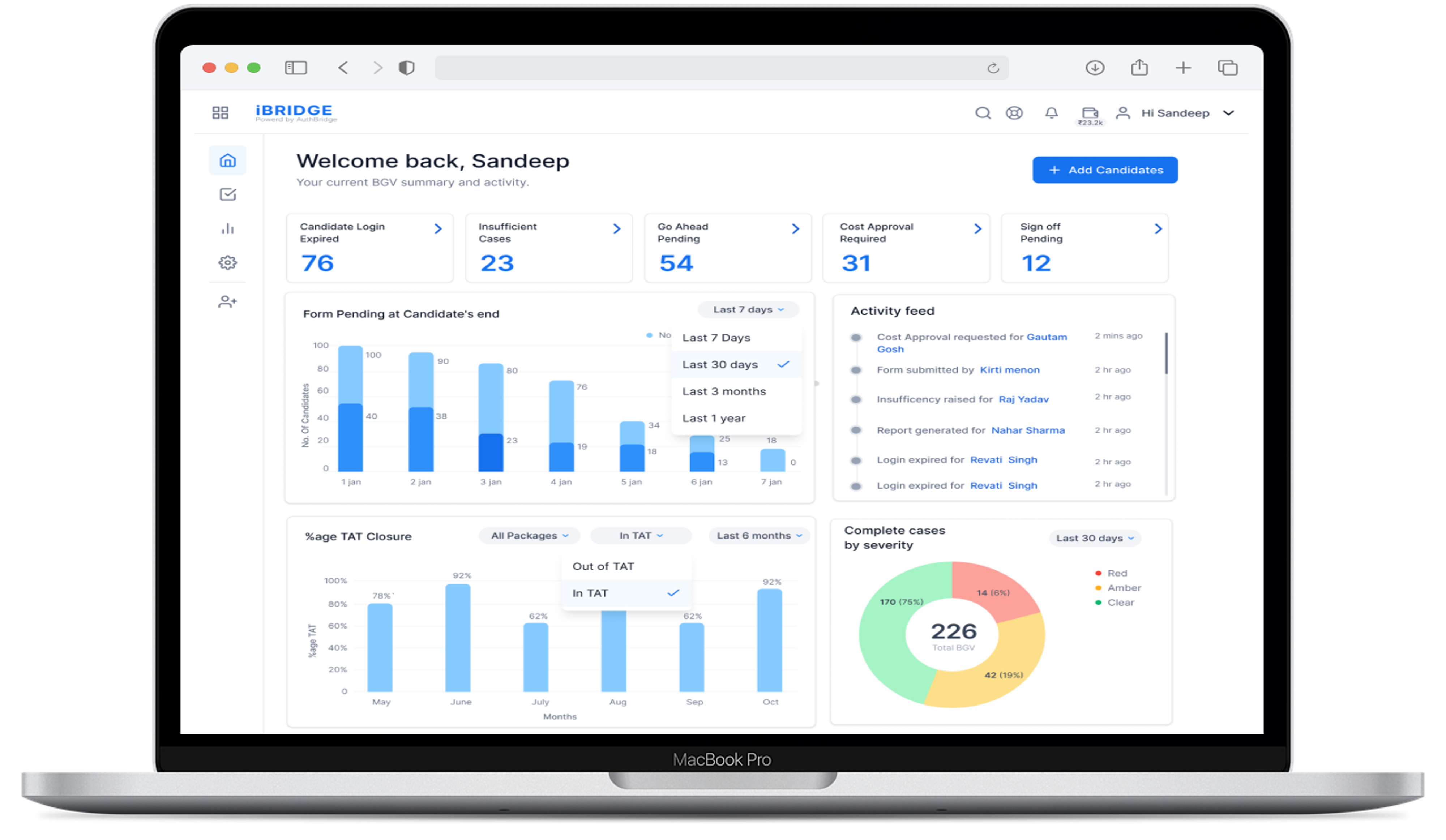
Pipeline status views typically show counts of candidates or cases by key workflow states such as pending at candidate, in progress, insufficient, on hold, and completed, often segmented by business unit, location, or role tier. Summary tiles and charts, as seen in many BGV operations dashboards, help leaders gauge overall load and completion at a glance.
SLA risk and aging indicators highlight cases approaching or exceeding agreed turnaround thresholds. Dashboards should clearly differentiate between cases delayed due to candidate actions, vendor dependencies, or internal review queues. Labels and legends need to make these distinctions explicit so users do not misinterpret all aging as HR performance issues.
Bottleneck reason views attribute pendency to categories like missing documents, data mismatches, manual field verification, or system errors. Presenting these as simple breakdowns allows HR to target improvements in candidate communication, process design, or vendor management. Drill-down from aggregate charts to case lists supports validation and avoids overreacting to outliers.
To reduce misinterpretation, dashboards should expose metric definitions, filters, and time windows clearly on-screen and avoid mixing fundamentally different measures on a single axis. HR leadership should pair dashboard use with regular review sessions where HR Ops, Compliance, and vendors explain trends in context of seasonality, hiring campaigns, or regulatory shifts. This combination of well-labelled visuals and structured interpretation helps dashboards drive informed decisions rather than superficial judgments.
In BGV ops, what exactly is escalation ratio, why does it affect hiring SLAs, and how can we reduce it without cutting corners?
C0465 Explain escalation ratio for HR — In employee BGV operations, what does “escalation ratio” mean, why does it matter for hiring SLAs, and what are the typical levers HR can use to reduce escalations without lowering check quality?
In BGV operations, “escalation ratio” is best defined as the share of verification cases that cannot be resolved through standard rules and require a higher level of review, either within the vendor team or by HR and Compliance. This KPI influences hiring SLAs because escalated cases typically take longer, consume scarce expert capacity, and make time-to-hire less predictable.
HR should distinguish at least two views of escalation ratio. One view covers internal vendor escalations between reviewer tiers, which affects vendor productivity and cost. The other view covers escalations that reach HR or Compliance, which directly impact hiring decisions and perceived friction. Even when detailed accuracy metrics like precision and recall are not available, combining escalation ratio with measures such as case closure rate within SLA and rework rate can help identify whether low escalation simply reflects suppressed scrutiny.
Practical levers to reduce unnecessary escalations include clearer decision rules for common situations, better consent and document collection flows to reduce incomplete inputs, and structured exception categories that allow frontline reviewers to act confidently on routine discrepancies. Governance should explicitly protect escalation for genuinely ambiguous or high-risk criminal record matches and fragmented court data. HR and Compliance can then set targets that differentiate between avoidable process-driven escalations and appropriate risk-driven escalations, instead of treating all escalations as failures.
Compliance, data privacy, and evidence readiness
Covers consent management, data portability, audit packs, and lifecycle monitoring while avoiding surveillance concerns.
From an HR Ops view, what should “audit-ready” mean in BGV—what evidence should we be able to pull instantly for audits?
C0456 HR audit-ready evidence bundle — For employee background verification vendors, what does “audit readiness” look like from an HR Ops perspective—what evidence bundles, timestamps, and chain-of-custody artifacts should be instantly retrievable during internal audits?
For employee background verification vendors, “audit readiness” from an HR Ops perspective means that verification activities are recorded with sufficient detail, structure, and governance to be reliably retrieved and presented during internal or external reviews. HR should be able to assemble coherent evidence about consent, checks performed, results, and decisions without reconstructing events from scattered sources.
Core audit-ready elements include consent artifacts that show when and how candidates agreed to specific checks, along with purpose and retention information. These records should be time-stamped and linked to the corresponding verification case so that lawful basis under regimes like India’s DPDP can be demonstrated.
Case logs are another central component. They capture which checks ran, which data sources were contacted, what outputs were received, and when each step occurred. Each entry should be associated with relevant identifiers for systems or reviewers and point to underlying evidence such as documents or registry responses, providing a traceable chain-of-custody.
Decision records complement these logs by capturing outcomes such as “clear,” “insufficient,” or “adverse,” with associated decision reasons, escalation notes, and any overrides. Time-stamped reviewer identifiers and comments enable later governance reviews of manual judgments and consistency checks across similar cases.
Retention and deletion records round out audit readiness. These indicate when data was created, how retention rules were applied, and when records were deleted or anonymized according to policy. HR Ops should be able to work with vendors to extract structured evidence bundles for defined periods or segments, under appropriate access controls, so that audits, DPIA exercises, or data-subject requests can be addressed efficiently and defensibly.
In picking a BGV/IDV vendor, what exit and portability commitments should HR insist on so we aren’t locked in?
C0457 Reversibility and portability terms — In employee BGV/IDV vendor selection, what are the most meaningful “reversibility” commitments HR should demand—such as data export, exit support, and portability—so the hiring engine is not held hostage by vendor lock-in?
In employee BGV/IDV vendor selection, meaningful “reversibility” commitments are those that let an organization change providers or architectures while maintaining compliance, access to necessary evidence, and hiring continuity. HR teams should focus on high-level guarantees around data export, exit support, and portability so verification does not become an immovable dependency.
Data export commitments define what verification data can be retrieved, in what format, and within what timeframe. Important elements include the ability to obtain case histories, core decision outcomes, and relevant consent records in structured form when needed, subject to privacy and retention rules. This supports ongoing audit and dispute obligations even if the relationship ends.
Exit support concerns how the vendor will cooperate during a transition. Typical expectations include honoring existing SLAs during a defined notice period and providing reasonable assistance so that in-flight verification cases can complete and new workflows can be established. Clear expectations here reduce the risk of degraded service when moving away from a provider.
Portability focuses on the practical ability to use exported data in alternative systems without being constrained by proprietary formats or opaque schemas. HR and IT should seek assurances that essential verification data can be understood and ingested elsewhere, while still complying with data minimization and retention policies so that only necessary information is carried forward.
Collectively, these reversibility elements help Procurement, IT, and HR treat BGV/IDV platforms as components in an API-first stack rather than permanent fixtures. They lower the risk of vendor lock-in and give buying teams more confidence that they can adapt verification infrastructure as regulations, scale, or business models evolve.
In employee screening, what’s the difference between one-time BGV and continuous re-screening, and when should HR use monitoring without creating a surveillance backlash?
C0464 Point-in-time vs continuous screening — In employee screening, what is the high-level difference between point-in-time background verification and continuous re-screening, and when should HR consider lifecycle monitoring without creating a “surveillance” backlash?
Point-in-time background verification refers to checks performed once at a defined moment, such as before hiring or promotion, while continuous re-screening refers to scheduled or trigger-based checks during employment that look for new risk signals like fresh court cases or adverse media. Point-in-time checks establish a baseline of trust, and lifecycle monitoring updates that baseline as facts change.
Organizations typically apply point-in-time verification broadly for new hires using employment, education, criminal record, and address checks that are appropriate for the role and jurisdiction. Continuous re-screening is usually reserved for roles where ongoing assurance is critical, for example where employees handle financial transactions, access sensitive data, or operate in regulated environments. The specific thresholds and frequencies depend on sector, regulation, and internal risk appetite, so they should be defined through joint HR and Compliance governance.
To avoid a perception of surveillance, policies should clearly state which checks will recur, how often they will run, and for what purpose. Consent processes should reflect that scope, and data retention should follow purpose limitation and deletion rules rather than open-ended storage. HR and Compliance should involve employee representatives or leadership in explaining that continuous checks are targeted risk controls rather than behavioural monitoring. Access and privileges can then be aligned to the level of verification assurance required, without expanding into broader observation of employee behaviour.
In BGV vendor governance, what should a “one-click audit pack” include, and how do we verify it’s complete and defensible?
C0466 Explain one-click audit pack — In employee BGV vendor governance, what does a “one-click audit pack” typically include (consent artifacts, verification evidence, timestamps), and how should HR validate that the pack is complete and regulator-defensible?
In BGV vendor governance, a “one-click audit pack” is a consolidated export that brings together the core artifacts needed to evidence lawful, defensible verification decisions for a candidate or group of cases. At a minimum, it should contain consent records for the checks performed, structured verification results for each check type, and timestamps that show when key actions occurred.
Stronger audit packs also include logs of user actions, escalation and dispute records, and clear final decision outcomes per case. These elements support expectations around audit trails, explainability, and chain-of-custody under regimes such as DPDP and global privacy norms. However, the contents must align with agreed retention and data minimization policies. Retaining more information than necessary or beyond defined retention windows can increase compliance risk rather than reduce it.
HR should validate audit pack completeness by running sample exports during PoC and at agreed intervals after go-live. Compliance and Legal stakeholders should participate in this review to confirm that the pack provides regulator-ready evidence for consent, purpose limitation, data access, and deletion. The cross-functional team should agree a checklist of required fields and artifacts and verify that each export is machine-readable and traceable back to individual checks and decisions. Where specific obligations, such as DPIA inputs or deletion proofs, cannot be derived from the pack, HR should treat the “one-click” claim as incomplete and adjust governance expectations accordingly.
Global coverage and integration readiness
Addresses cross-border coverage, ATS/HRMS integrations, and staged go-live gates to balance speed and accessibility.
For global hiring with BGV/IDV, how do we handle country-to-country coverage differences without hurting candidate experience when some checks take longer?
C0458 Global coverage vs candidate UX — For a global hiring organization using employee BGV/IDV, how should HR teams plan for cross-border coverage differences without degrading candidate experience, especially when some regions require manual checks and longer TAT?
For a global hiring organization using employee BGV/IDV, HR teams should plan for cross-border coverage differences by defining region-aware verification policies and timelines while preserving a coherent candidate experience. The aim is to respect local data and registry realities without creating confusingly different journeys for candidates in each country.
A useful step is to group countries or regions based on factors such as availability of digital data sources, prevalence of manual checks, and typical verification turnaround times. For each group, HR and Compliance can agree on minimum check bundles, expected TAT ranges, and any required manual steps, such as field visits or issuer confirmations, that affect timelines.
On the front end, organizations can maintain a consistent verification journey framework that adapts content by region. This includes using similar consent UX patterns, self-service portals, and communication channels, while clearly explaining which checks apply locally and what timelines candidates should expect. Transparent messaging about why certain regions involve longer verification helps manage expectations and reduce frustration.
Where regulations permit, HR can coordinate start dates and access provisioning policies so that candidates are not penalized for regional verification constraints, for example by aligning role-specific onboarding plans with local TAT expectations. In more tightly regulated sectors, policies may require full verification before any access, in which case planning must focus on early initiation of checks and proactive communication.
Cross-border planning should also consider data localization and transfer rules, which may require regional processing or limit where candidate data is stored. Regularly reviewing regional TAT distributions, hit rates, and escalation patterns allows HR to refine policies and, together with IT and Compliance, to invest in improved local integrations or process changes where delays and coverage gaps are most significant.
For fast hiring with BGV/IDV, what’s the minimum ATS/HRMS integration we should insist on so recruiters aren’t stuck working in two tools?
C0463 Minimum ATS/HRMS integration bar — In employee BGV/IDV vendor selection for fast hiring cycles, what minimum integration expectations should HR set—such as ATS/HRMS handoffs, webhooks, and status sync—so recruiters are not forced to work in two systems?
For fast hiring cycles, HR should define minimum BGV/IDV integration expectations that eliminate duplicate data entry and surface verification status inside the ATS or HRMS, so recruiters do not have to manage candidates in two systems. The core requirement is a reliable handoff of candidate data into the verification platform and a structured status sync back into the hiring system.
In practice, a minimal pattern is one-way creation of BGV cases whenever a candidate reaches a defined stage such as “offer accepted,” using whatever mechanism the systems support. This could be an API call, a scheduled file export, or another standardized interface. The verification platform should then return key status fields such as “initiated,” “in progress,” “insufficient information,” and “completed with clear or adverse outcome” into the ATS or HRMS. These fields should be visible alongside other hiring stages so recruiters can decide when to move candidates forward without logging into the BGV console.
Where APIs and webhooks are available, HR and IT can extend this to more real-time updates and error signalling. However, even in constrained environments, HR should insist that any additional dashboards are mainly for operations and exception management and that recruiters' day-to-day decisions rely on status values embedded in their primary system. During vendor evaluation, teams should test that the chosen integration pattern reduces manual touches and status-chase communication and does not simply relocate complexity from email to a second interface.