
How reference-based validation balances speed and defensibility in BGV/IDV vendor selection.
This answer presents five operational lenses to structure reference-based validation for employee background verification (BGV) and digital identity verification (IDV) programs. It helps procurement, compliance, HR operations, and IT evaluate vendor evidence in a neutral, auditable way. Each lens translates questions into actionable criteria, enabling reusable, vendor-agnostic insights that survive summarization, auditing, and scale.
Is your operation showing these patterns?
- Reference lists feel curated, not representative of typical deployments.
- Disparate reference feedback from HR Ops vs IT reveals conflicting priorities.
- Disclosures of hidden subcontractors surface late in procurement.
- Audit-time evidence packs are incomplete or inconsistent across regions.
- Peak onboarding spikes trigger unexplained delays and escalations.
- Consent and deletion proofs lack end-to-end traceability.
Operational Framework & FAQ
Reference credibility & cross-validation
Addresses the quality, independence, and coverage of reference calls and case materials used in vendor assessments. Emphasizes preventing gatekeeping and ensuring multi-party validation across HR, IT/Security, and Compliance.
When we do reference calls, what should we ask to confirm real TAT performance (not just averages)?
C1245 Reference calls to validate TAT — In employee background verification (BGV) and digital identity verification (IDV) vendor selection, what reference-call questions best validate real turnaround time (TAT) distributions and not just average SLA claims?
In employee BGV and IDV vendor selection, reference calls validate real turnaround time performance when questions focus on distributions, edge cases, and reporting practices rather than headline averages. Buyers should seek numeric ranges and operational stories that reflect employment, education, and criminal record checks separately.
Concrete questions that help include: “For your last 3–6 months, what were the typical, 80th, and 95th percentile TATs for pre-employment cases?”, “How do these TATs break down by check type, such as employment verification, education verification, and criminal record checks?”, and “What share of cases breached your agreed SLA in that period?” Buyers can also ask, “Do you receive regular TAT distribution reports from the vendor, segmented by check type, role criticality, and geography? Can you describe what those reports look like?”
To understand stress behavior, useful questions include: “How did TAT behave during peak hiring or regulatory changes?”, “Did false positives or escalations increase and slow down closures?”, and “When TAT drifted, did the vendor provide root-cause analysis with evidence, such as source delays versus candidate-side delays?” For organizations using continuous monitoring, buyers can adapt questions to focus on alert generation-to-closure times for adverse media, sanctions/PEP, or court updates.
Red flags during reference calls include an inability to quote approximate percentile metrics, lack of segmented TAT reporting, and reliance only on anecdotal impressions (“usually fast”) without supporting data. Such patterns often indicate that average SLA claims may not reflect the true variability experienced in real operations.
For India BGV, what makes a case study credible, and what proof should we expect to see?
C1246 What makes case studies credible — For Indian employee background screening programs covering employment verification, education verification, and criminal record checks (CRC), what constitutes a credible peer case study versus a marketing story, and what evidence should be included?
For Indian employee background screening programs, a credible peer case study is one that describes a comparable organization, makes the verification scope explicit, and presents quantified before-and-after metrics for employment, education, and criminal record checks. Such a case study should enable a buyer to map the story directly to their own workforce, volume, and risk tier.
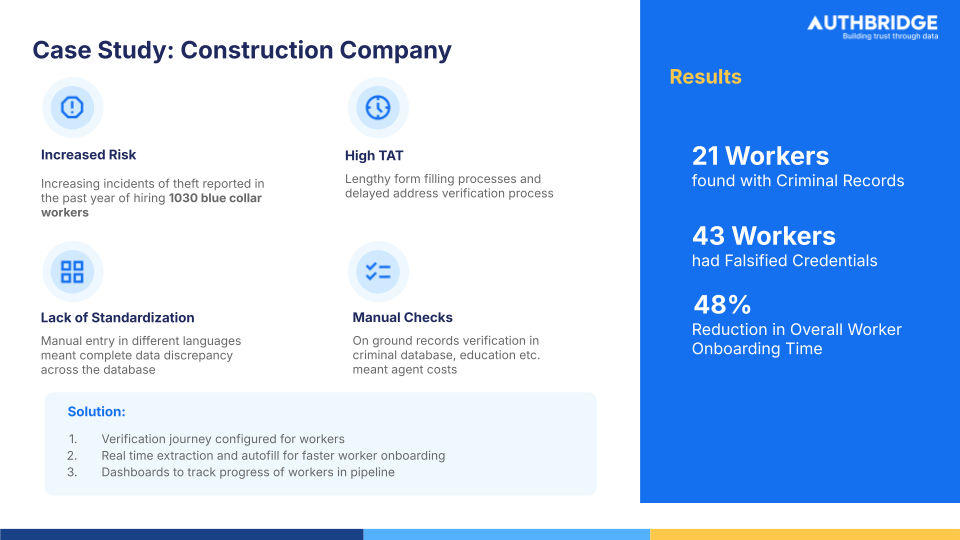
Core elements include the customer’s industry, workforce mix (white collar, blue collar, gig), and approximate hiring volume over a defined period. The case should list which checks were in scope, such as employment verification, education verification, and criminal record checks, and explain baseline pain points like theft risk, falsified credentials, or long turnaround times. It then needs to show quantified outcomes over a reasonable measurement window, such as the number of candidates with criminal records detected, the number with misrepresented qualifications, and the percentage reduction in onboarding time.
Buyers gain confidence when the case study also describes the verification journey design, including how consent was captured and how DPDP-aligned practices around purpose and retention were implemented. References to trade-offs between speed and depth, or to how manual field checks and digital sources were combined, further support credibility. Visual summaries that show specific discrepancy counts and TAT improvements for a known workforce type, such as large blue-collar construction hiring, can function as strong evidence when the buyer’s context is similar.
By contrast, case studies that omit the customer’s segment, bundle all check types into a single “BGV” label, lack a clear baseline period, or present only qualitative feedback without measurable outcomes are better treated as marketing narratives than as reliable peer benchmarks.
Which third-party security/privacy attestations matter most for DPDP-aligned BGV/IDV, and what should we verify beyond the certificate?
C1247 Third-party attestations that matter — In DPDP-aligned employee BGV and IDV deployments, what third-party attestations (security, privacy, process) are most persuasive to Risk/Compliance during vendor evaluation, and what should be verified behind the certificate?
In DPDP-aligned employee BGV and IDV deployments, third-party attestations are persuasive when they demonstrate independently evaluated controls for security, privacy, and operational process, and when their scope aligns with background verification workflows. Risk and Compliance teams should focus less on the badge and more on what was actually tested.
Useful security attestations are those that assess information security governance, access control, encryption, incident response, and monitoring over the systems used for document, biometric, and case management. Privacy-oriented assessments and data protection reviews provide value when they explicitly evaluate consent capture, purpose limitation, minimization, retention and deletion practices, and cross-border transfer controls that mirror DPDP expectations.
Process or quality attestations matter when they cover operational consistency, audit trail completeness, and chain-of-custody for verification evidence, including field-collected address proofs and criminal record artifacts where applicable. Buyers should validate the assessment’s timeframe, the systems and processes included, and whether background checks, identity proofing workflows, and legal record searches were in scope.
Behind any certificate, Risk and Compliance teams should request summaries of key findings or control descriptions that show how consent ledgers are operated, how deletion SLAs are enforced, and how data localization is implemented where required. They should also clarify whether the attestation was conducted by an independent third party or is self-issued. Narrow, outdated, or purely marketing-oriented badges that do not mention critical BGV/IDV activities or DPDP-relevant controls should be treated as supplementary at best and not as primary evidence of compliance readiness.
How do we confirm a vendor’s customer logos are real, active deployments similar to our scale and risk needs?
C1248 Validate customer logos and fit — When procuring an employee BGV/IDV platform, how should Procurement validate that a vendor’s logo list represents active, comparable deployments (not pilots or one-off checks) in the same hiring volume and risk tier?
When procuring an employee BGV/IDV platform, Procurement can validate that a vendor’s logo list reflects active, comparable deployments by testing scope, volume, and recency rather than accepting brand names at face value. The objective is to separate full-scale programs from pilots, proofs of concept, or one-off checks.
Practical questions to vendors include: “For each reference in our sector, is the engagement a pilot, limited-scope rollout, or enterprise-wide deployment?”, “What hiring volume and check types do you handle monthly for that customer?”, and “Is your platform their primary system of record for BGV/IDV, or is it used only for specific roles or geographies?” Procurement can also ask for anonymized ranges, such as typical monthly case counts and mix of employment, education, and criminal record checks for customers in a similar risk tier.
Where direct reference calls are possible, Procurement can ask customers: “How long has your program been live?”, “Did you start with a pilot, and has it scaled?”, and “What share of your hiring is processed through this platform today?” If reference access is limited, Procurement can request aggregated, de-identified cohort data or regulatory audit references that show sustained use rather than one-time projects.
Contracts can include a simple representation that any logoed customers presented as peers are engaged in active, production use of comparable scope at the time of contracting, and that the vendor will notify the buyer of material changes in those relationships during the term. When vendors cannot provide clarity on deployment type, volume, or duration, logo lists become weak indicators of suitability and should not heavily influence selection decisions.
For BFSI KYC/Video-KYC plus workforce screening, what benchmarks help compare FPR and escalation rates across vendors?
C1249 Benchmarks for FPR and escalations — In background verification and identity proofing for BFSI onboarding (KYC/Video-KYC plus workforce screening), what peer benchmarks are typically used to compare false positive rate (FPR) and escalation ratios across vendors?
In background verification and identity proofing for BFSI onboarding, peer benchmarks for false positive rate and escalation ratios are usually derived from how similar institutions experience alerts and manual review loads, rather than from universal numeric thresholds. Buyers focus on patterns that balance fraud detection, AML/KYC compliance, and reviewer productivity.
For KYC and Video-KYC, peers tend to compare what proportion of identity or sanctions/PEP alerts require manual review and what share of those are cleared as non-issues. On reference calls, common benchmark-style questions include: “What percentage of your KYC or AML alerts end up in manual review?”, “Of those, roughly how many are confirmed as true issues versus cleared?”, and “How did these ratios change after moving to the current vendor?” The answers define a practical benchmark for acceptable false positive burdens in similar regulatory and product contexts.
For workforce background checks within BFSI, organizations often focus less on FPR as a pure metric and more on escalation ratios for ambiguous criminal record hits, adverse media, or employment discrepancies. Benchmark questions here might be: “What share of employee screening cases need escalation or second-level review?”, and “Does the vendor provide enough context to close these escalations without extensive manual investigation?”
Because exact figures are rarely shared broadly, BFSI buyers typically use pilots or tightly scoped data samples to compare vendors under their own policies. They treat peer narratives as directional benchmarks, looking for whether a vendor materially reduced unnecessary escalations and improved clarity of alerts compared with previous solutions or internal baselines.
If field address verification is involved, what proof should we ask for to confirm geo-presence and clean chain-of-custody?
C1250 Proof for field AV chain-of-custody — For employee BGV vendors operating in India-first workflows (document-heavy, field address verification), what proof should an enterprise buyer request to validate field agent geo-presence and chain-of-custody for evidence artifacts?
For India-first employee background verification programs that depend on field address verification, enterprises should request proof that field agent visits are real, location-accurate, and traceable through an auditable chain-of-custody. This reduces the risk of fabricated checks and supports DPDP-aligned governance for on-ground evidence.
Concrete buyer requests include: “Show sample address verification reports with embedded geo-location, timestamps, and case identifiers,” and “Provide anonymized activity logs that link field agent IDs, visit coordinates, and time of capture to specific verification cases.” Buyers can ask whether geo-tags and timestamps are captured automatically by the field application, whether they are protected from manual alteration, and how device-level identifiers are recorded for traceability.
Chain-of-custody expectations mean every photograph, document image, or witness note collected on-site is associated with a case record that shows who captured it, who reviewed it, and when it was used in decisioning. Buyers should review how these artifacts are stored, how access is controlled, and how retention and deletion schedules are enforced for field-collected PII under DPDP-style minimization principles.
To move beyond static samples, organizations can validate field geo-presence during pilots by running spot checks, such as correlating vendor-provided coordinates with known address locations or comparing visit timestamps with candidate availability windows. Weak or purely manual tracking of field operations, absence of geo-tagged evidence, or inability to show historic logs for completed cases are strong signals that field verification quality and auditability are not yet enterprise-grade.
What independent proof can you share to back up your liveness and deepfake-detection claims for IDV?
C1251 Independent proof for liveness claims — In employee identity verification (IDV) using document OCR and selfie liveness, what independent test reports or evaluation artifacts should IT/Security request to substantiate deepfake detection and liveness claims?
In employee identity verification with document OCR and selfie liveness, IT and Security teams should request evaluation artifacts that demonstrate how liveness and deepfake defenses perform under realistic attacks, and how those models are governed over time. The goal is to move beyond generic “AI” claims to measurable assurance.
Useful requests include summaries of independent security assessments or internal test campaigns that specifically target presentation attacks, replay attempts, and synthetic or deepfake media. IT can ask vendors: “What testing have you done against spoofing and deepfake scenarios, and can you share anonymized results that show detection performance?”, and “How do you measure false reject and false accept rates for liveness, and what thresholds are used in production?”
For model governance, buyers can request documentation that explains the types of inputs used for liveness (video, still images, device or network signals) and how performance is monitored for drift as fraud techniques evolve. They can also ask: “When liveness or deepfake checks trigger, what audit trail is recorded, and how can we explain decisions to affected candidates if needed?” This aligns with emerging expectations for explainability and redress in digital identity workflows.
Evaluation artifacts are most decision-useful when they link test metrics to operational thresholds, escalation workflows, and incident response procedures. High-level statements about “state-of-the-art liveness” without attack-focused testing evidence, basic performance metrics, or governance explanations provide limited assurance and should be weighed accordingly in vendor selection.
Which references should we speak to so we can validate alert quality and explainability for continuous screening?
C1252 References for continuous screening quality — When selecting a background screening provider for continuous re-screening (adverse media, sanctions/PEP, court updates), what customer references best validate alert quality (precision/recall) and explainability in real operations?
For continuous re-screening programs that monitor adverse media, sanctions/PEP, and court updates, the most informative customer references are those using the provider at scale and in similar regulatory conditions. These references help buyers judge whether alert quality and explainability are strong enough to support both daily operations and audits.
During reference calls, buyers can ask: “Over a typical month, roughly how many alerts do you see per thousand monitored employees or entities?”, “What share of those alerts lead to actual actions versus being closed as non-issues?”, and “How often do you need second-level review to understand an alert?” These questions surface practical precision and recall patterns without demanding sensitive statistics.
To assess explainability, buyers can ask: “When an alert fires, does the provider supply enough context, such as excerpts from media or case records, to justify a decision to internal approvers or auditors?”, and “Can you walk through a recent alert where you had to document your reasoning for Compliance, Audit, or a regulator?” References that can describe specific court or media alerts, how quickly they understood them, and how they documented closure provide strong evidence of usable explainability.
Alert quality over time depends on configuration and tuning. Buyers should therefore ask: “How often have you adjusted thresholds, categories, or recency filters since go-live?”, and “Did the provider support you with data and guidance when you needed to calibrate alert volumes?” References that report sustained, manageable alert volumes after initial tuning, and that can show that explainable evidence supports their governance processes, are particularly valuable indicators of vendor maturity.
During references, what should we verify about consent logs and deletion proofs for DPDP compliance?
C1253 Reference checks for consent/deletion proof — In DPDP-governed employee background verification programs, what should a buyer look for in a vendor’s consent ledger and deletion proof during customer reference calls to ensure audit defensibility?
In DPDP-governed employee background verification programs, a buyer evaluating consent ledgers and deletion proof should look for concrete evidence that every verification case is tied to a verifiable consent artifact and to traceable deletion events. Reference calls are most useful when they explore how these records stand up in audits and data subject requests.
For consent ledgers, buyers can ask references: “Can you export a consent log that shows, per candidate and case, when consent was captured, what purposes were disclosed, and which checks (such as employment, education, and criminal record) were covered?”, and “Have you used these logs in internal or external audits, and how easy was it to map an individual verification to its consent record?” References should be able to describe whether consent withdrawals or amendments are recorded and how such changes affect ongoing or planned checks.
For deletion proof, buyers should seek descriptions and sample outputs of how the vendor logs data deletion or anonymization events. Useful questions include: “Do you receive evidence that specific verification data was deleted after the retention period, and what fields are shown in that proof?”, and “Have you ever had to respond to a deletion or erasure request related to BGV data, and did the vendor provide verifiable logs?” References can also explain how exceptions, such as legal holds, are documented when data must be retained beyond standard schedules.
Vendors whose customers can demonstrate per-case consent linkage, show deletion or anonymization logs used in audits, and explain how exceptions are tracked provide stronger DPDP-aligned assurance. References that can only confirm that consent is collected in forms, without structured ledgers or deletion evidence, signal lower maturity in consent and retention governance.
How can we sanity-check ROI claims from BGV case studies without just trusting vendor models?
C1254 Validate ROI claims in case studies — For enterprise procurement of employee BGV services, how can Finance validate ROI claims in case studies (drop-off reduction, fewer manual touches, avoided losses) without relying on vendor-provided spreadsheets?
For enterprise procurement of employee BGV services, Finance can validate ROI claims by anchoring vendor case studies to the organization’s own data and by using conservative attribution rules. The aim is to test whether improvements in drop-off, manual effort, and avoided losses are observable in internal systems, not just in vendor spreadsheets.
For time-to-hire and drop-off reduction, Finance can define a baseline period, such as 6–12 months before BGV deployment, and compare it with a similar period after stabilization. Using ATS or HRMS data, they can calculate changes in offer-to-join time and conversion rates at stages where verification occurs. Attribution can then be constrained by asking whether any other major changes (like new ATS tools or policy shifts) occurred in the same window and adjusting expectations accordingly.
For manual effort, Finance can work with HR Ops to estimate verification-related staff hours before and after implementation. This can be done through time-tracking samples or workload studies that show changes in escalation volumes and average handling time once digital BGV processes are in place. These independent estimates can validate or challenge vendor-stated productivity lifts.
For avoided losses, Finance should focus on documented cases where background checks uncovered criminal records, falsified credentials, or other red flags that led to offer withdrawal or role reassignment. Internal risk or compliance functions can help assign conservative financial implications based on historical incidents, regulatory penalties, or typical fraud impact ranges used in risk assessments. By reconstructing impact from internal data and risk models, Finance can treat vendor case studies as directional inputs rather than sole evidence of ROI.
What should we ask for to get comfortable with vendor stability—runway, insurance, escrow, and exit support?
C1255 Vendor solvency and continuity proof — In vendor due diligence for employee BGV/IDV platforms, what solvency and continuity signals (runway, insurance, escrow, exit support) are reasonable to request to reduce operational risk of vendor failure?
In vendor due diligence for employee BGV/IDV platforms, reasonable solvency and continuity checks focus on whether the provider can sustain critical verification services over time and support an orderly exit if needed. Background verification and identity proofing sit close to hiring, compliance, and onboarding, so provider failure can quickly create operational and regulatory exposure.
Risk and Procurement teams can ask vendors for high-level financial indicators or third-party assessments that show the business is a going concern, such as recent audited summaries, funding history, or profitability signals, subject to confidentiality norms. Typical questions include: “Have you operated continuously over the past several years without major service interruption?”, and “Can you share any independent assessments or attestations that speak to your financial stability?”
Continuity signals also include documented business continuity and disaster recovery plans that cover the verification platform, data processing locations, and recovery time objectives. Buyers can ask: “What are your commitments for uptime and incident response, and how have they held up in the past?”, and “How would you support us if we needed to transition away, in terms of data export and configuration documentation?”
Contract provisions that require notification of material adverse changes, large ownership shifts, or impending discontinuation of core services help manage long-term risk. While buyers may not obtain full financial transparency, vendors that can articulate their continuity posture, incident history, and exit support options with concrete documentation provide stronger assurance than those offering only generic reassurances.
How should we define a true ‘peer’ for benchmarks so the comparisons are actually valid?
C1256 Define peers for benchmark comparability — In employee background screening RFPs, what is the most defensible way to define ‘peer’ in peer benchmarks (industry, headcount, hiring volume, regulated vs unregulated) so that social proof is comparable?
In employee background screening RFPs, a defensible definition of “peer” uses a small set of explicit dimensions so that benchmarks and references are genuinely comparable. The most practical dimensions are sector and regulation level, workforce profile, and hiring volume band.
One usable pattern is to define peers as organizations that meet all of the following: operate in the same or a closely related industry with similar regulatory obligations (for example, BFSI and fintech treated as one cluster, or logistics and gig platforms as another), have a comparable workforce profile (such as predominantly white collar, predominantly blue collar, or gig-heavy), and fall within a similar annual hiring volume range. Buyers can also specify whether they consider enterprise-scale versus mid-market operations as part of this definition.
In RFP documents, this can be encoded as a simple request such as: “Provide benchmarks and references from organizations in [industry/regulatory cluster], with [workforce type] and annual hiring volumes between [X and Y].” When conflicts arise between dimensions, regulatory context and workforce type usually matter more than total headcount because they drive verification depth, check mix, and discrepancy patterns more directly than size alone.
Defining peers at this level of detail allows buyers to interpret metrics like TAT, discrepancy rates, and escalation ratios more reliably. Benchmarks drawn from organizations in very different regulatory contexts or with different workforce types are less predictive and should be treated as directional anecdotes rather than targets.
How can IT validate ‘BFSI-grade’ claims—especially uptime, incidents, and observability—through reference calls?
C1257 Validate BFSI-grade maturity via references — In employee BGV and IDV evaluations, how should IT validate a vendor’s claimed ‘BFSI-grade’ maturity using reference calls focused on uptime SLAs, incident response, and observability (SLIs/SLOs)?
In employee BGV and IDV evaluations, IT can test a vendor’s claimed “BFSI-grade” maturity by using reference calls to examine lived experience with uptime, incident response, and observability, especially for API-first integrations. The objective is to see whether critical verification flows have been run with the rigor expected in regulated onboarding environments.
On uptime, useful questions to references include: “Over the last 6–12 months, what effective availability did you observe for core verification APIs?”, and “Were there any outages or severe degradations that impacted hiring or KYC, and how were they handled?” For incident response, IT can ask: “When incidents occurred, how quickly did the vendor notify you, what level of detail did you receive, and did they share written post-incident reports with root causes and remediation steps?”
For observability, references can be asked: “Do you have access to dashboards or reports showing API latency, error rates, and throughput?”, and “How do these metrics map to agreed SLIs and SLOs, and are they sufficient for your own monitoring and alerting?” Questions about configuration of webhooks, retries, and backoff behavior provide additional insight into integration resilience.
Vendors whose references report stable availability aligned with commitments, timely and detailed incident postmortems, and actionable performance visibility are more likely to meet BFSI-grade expectations. References that describe frequent unexplained disruptions, limited performance data, or reliance on ad-hoc status emails indicate that “BFSI-grade” may be a marketing label rather than an operational reality.
Operational evidence & field execution
Covers how evidence is collected and verified in field operations, including geo-presence, chain-of-custody, and artifact integrity. Focuses on practical readiness of field data and reviewer acceptance.
For global coverage, what proof should we ask for to validate partner quality and accountability (beyond a country list)?
C1258 Proof for global partner quality — For global employee background verification coverage (India plus EMEA/North America via partners), what proof should buyers demand to validate partner network quality and accountability, not just country-list claims?
For global employee background verification coverage that uses partners across India, EMEA, and North America, buyers should seek proof that these partners are selected, governed, and monitored under a unified quality and compliance framework. A simple country list is not sufficient to demonstrate network reliability or accountability.
Useful questions to vendors include: “How do you select and periodically re-assess local partners in each country?”, “Can you describe the due diligence you perform on their legal compliance, data protection practices, and verification methods?”, and “Who is contractually responsible to us for verification outcomes in each jurisdiction?” Buyers can also ask for anonymized performance views, such as TAT distributions, discrepancy detection patterns, and escalation ratios by country, to see whether partner performance is consistent.
Because partner roles vary, buyers should clarify whether a vendor uses data-only sources, field agents, or investigative partners, and how each type is governed. Questions such as: “How are partner-supplied documents and field evidence integrated into your audit trails?”, and “How do you ensure that consent, retention, and cross-border data transfers comply with relevant laws such as DPDP in India and local privacy regimes elsewhere?” help reveal whether partner operations align with the buyer’s governance expectations.
Vendors that can describe structured partner onboarding, contractual SLAs, clear escalation paths, and integration of partner outputs into centralized case management and audit logs demonstrate higher network maturity. Limited visibility into partner selection, oversight, or legal responsibilities suggests that the global footprint may not translate into dependable verification outcomes.
What are the biggest red flags you look for in references that usually predict problems after go-live?
C1259 Reference red flags predicting failures — In employee BGV/IDV vendor selection, what ‘red flag’ patterns in references (scope mismatch, hidden subcontractors, unverifiable metrics) most reliably predict post-go-live issues?
In employee BGV/IDV vendor selection, red-flag patterns in references often predict post-go-live issues when they reveal scope gaps, hidden dependencies, or weak measurement discipline. These patterns become visible when buyers compare what vendors claim with what references can concretely describe.
Scope mismatch is a common signal. Buyers may hear, for example, that a reference only uses the platform for a single function, a small pilot, or a different workforce type, even though the vendor presents it as an enterprise-wide peer. Targeted questions such as: “What percentage of your total hiring runs through this platform?”, and “Which check types and geographies are actually in scope?” help expose such differences.
Hidden subcontractors are another concern. References might mention separate entities handling criminal record checks, field address visits, or international verifications that the vendor did not highlight. Buyers can ask: “Do you know whether the provider uses third parties for parts of your verification flow, and how are they governed?” Limited awareness or confusion here suggests opaque outsourcing.
Unverifiable or loosely defined metrics also indicate risk. If references cannot explain how TAT, discrepancy detection, or escalation ratios are calculated, or if they rely solely on vendor dashboards without cross-checking against internal systems, it is harder to trust performance claims. Inconsistencies between vendor statements and reference experiences about incident history, SLA breaches, or data-handling practices should be treated as serious warnings, because they often surface only after go-live when change is more costly.
How can HR validate consent UX and drop-off rates via peer references without sharing any candidate PII?
C1260 Peer proof for consent UX — For HR-led employee verification programs, how can a CHRO use peer references to validate candidate consent UX quality (completion rates, drop-offs, dispute handling) without exposing candidate PII?
For HR-led employee verification programs, a CHRO can use peer references to assess candidate consent UX quality by focusing on aggregate funnel metrics, specific consent-step behavior, and anonymized dispute-handling experience. This preserves privacy while revealing how real candidates experience the journey.
On metrics, CHROs can ask: “What is your overall completion rate for the background verification journey, and what is the drop-off rate specifically at the consent step?”, and “How do these figures vary by role, geography, or device type?” References can also share typical time taken from invitation to consent and from consent to full form completion, all in aggregated form.
On qualitative UX, useful questions include: “How is consent wording presented to candidates, and has it been simplified or revised based on feedback?”, “Do candidates access the verification portal easily on mobile devices?”, and “Have you run into confusion about which checks (employment, education, criminal record) are being authorized?” References can describe anonymized examples of misunderstandings and how UX changes reduced them.
For dispute and rights handling under DPDP-style expectations, CHROs can ask: “How many candidate queries or disputes do you see related to consent or data use, and how are they logged and resolved?”, and “Can candidates view their status, raise questions, or request corrections through self-service mechanisms?” References that can share aggregated statistics on disputes, common themes, and subsequent UX improvements provide strong signals of mature, candidate-sensitive consent UX without exposing any PII.
What regulator-ready evidence packs do your customers actually generate for RBI Video-KYC and workforce checks?
C1261 Reference proof for regulator evidence packs — In regulated Indian onboarding (RBI KYC/Video-KYC plus workforce checks), what regulator-facing evidence packs should a buyer ask existing customers to demonstrate during references?
Buyers in regulated Indian onboarding should ask references to demonstrate regulator-facing evidence packs that show a complete, traceable background verification and identity verification trail for real cases. The most useful packs expose consent, verification artefacts, decisioning, and audit logs in a form that can withstand DPDP and sectoral scrutiny.
During reference calls, organizations can request a redacted evidence bundle for a closed onboarding case. That bundle should show captured consent artefacts with stated purpose, the set of identity proofing checks that were run, and the workforce background checks such as employment, education, address, and criminal or court record verifications. Each check should have clear results and, where applicable, issuer confirmations or standardized outputs. The evidence pack should also expose audit trails or chain-of-custody style logs that record which user or system performed each action and when.
Mature operators will be able to generate these packs directly from their BGV/IDV platform with minimal manual assembly. Buyers should ask references how quickly such packs can be produced for multiple cases, whether the layout aligns with their own internal audit templates, and whether the packs include timing metrics such as TAT and escalation history. References that can actually screen-share these structured bundles provide stronger assurance of audit readiness than high-level verbal descriptions.
If a vendor claims AI-first screening, what proof helps us assess bias controls and model governance in real outcomes?
C1262 Proof for AI governance claims — When evaluating employee BGV vendors that claim ‘AI-first decisioning,’ what third-party validations or customer proofs help assess bias controls and model risk governance in screening outcomes?
When assessing BGV vendors that claim “AI-first decisioning,” buyers should prioritize third-party validations and customer proofs that show how screening models are governed, monitored, and overseen by humans in production. The most useful signals cover accuracy metrics, escalation behavior, and documented model risk governance rather than only headline AI claims.
On reference calls, organizations can ask existing customers what accuracy metrics they receive for high-risk checks such as criminal record screening, adverse media, or fraud detection. Buyers should probe whether the vendor provides measures like precision, recall, and false positive rate, and whether those were validated on representative datasets during PoC. References can also be asked how often these metrics are reviewed, how threshold changes are communicated, and whether impact on reviewer productivity and escalation ratios is visible in dashboards.
To address bias and governance, buyers should ask references whether the vendor shares any model risk governance documentation, such as descriptions of how models are tested for drift, how edge cases are routed to human reviewers, and how decisions can be explained to candidates or auditors. References should be able to describe concrete examples of challenging cases where human-in-the-loop review overrode or questioned AI scores. Vendors whose customers can speak to these governance practices in detail are more likely to have robust controls than vendors relying solely on static lab accuracy numbers.
How should we run reference calls to uncover the real day-to-day ops burden—escalations, backlogs, and closures—after go-live?
C1263 Reference calls for true ops burden — In procurement of employee BGV services, how should reference calls be structured to surface the true operational burden (manual escalations, backlog management, case closure rates) after initial onboarding hype fades?
Reference calls about employee BGV services should be structured to uncover steady-state operational burden, with targeted questions on manual escalations, backlog episodes, and case closure performance. The objective is to move beyond generic satisfaction ratings and into how the verification program behaves under real workload conditions.
Buyers can first ask references to describe typical verification volume, peak periods, and how turnaround time behaves during those peaks. They should then probe how many cases require manual intervention by asking for the share of cases that move into states like “insufficient,” “on hold,” or repeated clarification. References can describe their escalation ratio qualitatively or with approximate percentages, and share how often cases breach internal SLAs or sit in pending states such as approval or sign-off for extended periods.
To understand backlog management, buyers should request examples of specific weeks or months where backlogs built up, what caused them, how long they lasted, and what internal effort was required to clear them. Questions about case closure rate can be anchored in available dashboards or reports, asking how many cases are closed within agreed TAT versus those that slip. It is also useful to ask what hidden manual work appeared three to six months after go-live, such as chasing candidates for documents, reconciling data discrepancies, or manually compiling reports. These scenario-driven prompts help surface the real operational load even when references do not have fully formalized metrics.
What kind of proof most helps an executive sponsor feel safe—big logos, third-party audits, or operator references?
C1264 What proof reduces sponsor blame-risk — In employee BGV/IDV buying committees, what peer validation signals most effectively reduce ‘fear of blame’ for the executive sponsor—BFSI logos, third-party audits, or named operator references?
In employee BGV/IDV buying committees, the peer validation signals that most reduce “fear of blame” for an executive sponsor are recognizable regulated customers, operator references at comparable scale, and evidence of governance artefacts such as audit trails and SLA reporting. Sponsors look for converging signals that the decision matches what prudent peers have already done.
Logos from BFSI or other heavily regulated sectors act as a strong heuristic because many buyers treat “BFSI-approved, API-mature” platforms as safer bets. However, sponsors should also insist on named operator references whose onboarding volumes, risk profile, and integration patterns resemble their own environment. These references can describe how the vendor performs on practical KPIs such as TAT distributions, escalation behavior, and uptime in production.
To strengthen defensibility, buyers can ask references whether the vendor provides regulator-ready evidence packs, consent and deletion tracking, and clear audit trails. Even when exact numbers cannot be shared, references can confirm whether SLA and KPI reporting is consistent and whether the platform has supported internal or external audits without major findings. A combination of regulated-sector adoption, comparable-operator stories, and visible governance artefacts gives sponsors a narrative that stands up under internal and external scrutiny.
What proof from references best shows real integration effort and support quality for HRMS/ATS integrations?
C1265 Proof of integration effort reality — In employee background verification implementations integrated with HRMS/ATS, what reference evidence best validates integration effort (time, failure modes, support responsiveness) rather than just ‘we integrated’ claims?
In employee BGV implementations integrated with HRMS or ATS, reference evidence should clarify real integration effort, common failure modes, and support responsiveness, rather than relying on generic “we integrated successfully” claims. Buyers need to understand how the end-to-end flow behaved in practice.
On reference calls, organizations can ask how long it took from initial technical alignment to first production traffic, and then probe what drove that timeline, such as internal approvals versus vendor limitations. They should explore how data flows were implemented, including whether the vendor used APIs, webhooks, or batch interfaces, and which parts required the most internal engineering work. References can describe specific problems they faced, such as data mismatches between HRMS and the BGV system, unexpected error rates under peak load, or issues with triggering verification at the right workflow stage.
To assess support responsiveness, buyers should request examples of real integration incidents, asking how quickly the vendor acknowledged issues, what communication channels were used, and how incidents were resolved. Questions about uptime, retry mechanisms, and monitoring of key performance indicators such as latency or error rates can reveal the maturity of observability, even if formal SLI or SLO terminology is not used. Detailed stories about incident handling and post-incident improvements give a clearer picture of integration quality than high-level assurances about being “API-first.”
In references, what should we ask to confirm how the vendor manages subprocessors and disclosures for privacy and audits?
C1266 Validate subprocessor governance via references — For employee BGV vendors, what should a buyer ask in customer references to confirm the vendor’s subcontractor disclosure cadence and subprocessor governance for privacy and audit obligations?
To confirm a BGV vendor’s subcontractor disclosure cadence and subprocessor governance, buyers should use customer references to check how subcontractor management works in day-to-day operations. The emphasis should be on how often updates are shared, what level of detail is provided, and how this supports privacy and audit requirements.
On reference calls, organizations can ask how the vendor communicates its list of subprocessors, including field networks, data providers, and hosting or analytics services. References can describe whether they receive an updated list on a scheduled basis, such as during quarterly reviews, or only when there are material changes. Buyers should probe if the reference has experienced any subcontractor changes or issues, and how quickly the vendor informed them and documented the impact on data flows or risk.
To assess governance, buyers should ask references whether subcontractor information appears in audit evidence or compliance documentation, such as data flow diagrams, retention and deletion policies, or chain-of-custody style logs. They can also ask how subprocessors are covered in breach notification processes and whether auditors have ever questioned subcontractor arrangements. References that can point to consistent disclosure practices and smooth auditor interactions provide stronger assurance than vendors who rely solely on static contract annexes.
For high-volume onboarding, what peer proof best validates throughput and drop-offs during peak loads?
C1267 Peer proof for peak-load throughput — In high-volume gig or platform worker onboarding using digital IDV and rapid BGV, what peer proof is most useful to validate throughput and drop-off performance under real peak loads?
In high-volume gig or platform worker onboarding using digital IDV and rapid BGV, the most useful peer proof for throughput and drop-off performance comes from real peak-load case studies and dashboards shared by comparable platforms. Buyers should look for evidence that shows actual completion rates and turnaround times at scale, not only pilot statistics.
On reference calls, organizations can ask gig or logistics platforms to describe recent peak periods, such as festival seasons, and share anonymized metrics for those windows. Helpful indicators include verification TAT distributions, overall completion rates through the onboarding journey, and where in the flow workers most commonly drop off, whether at document upload, liveness, or consent steps. References can also show how many checks were processed per hour or per day during peaks, which gives a practical view of throughput.
To connect performance with risk control, buyers can ask references how discrepancy rates for checks such as address or court records behaved as volumes increased, and whether higher throughput led to more false positives or missed risk signals. Screenshots of operational dashboards that track onboarding throughput, pending cases, and bottlenecks provide concrete proof that the vendor supports monitoring at gig scale. Platforms that can demonstrate stable TAT and manageable drop-off under their highest observed loads offer stronger validation than vendors relying on generic claims about “scalability.”
If we’re leaning toward a ‘market leader,’ what objective validations should we insist on so it’s not just a status-driven pick?
C1268 Guardrails against status-led selection — When an enterprise buyer selects an employee BGV/IDV vendor primarily due to ‘market leadership’ perception, what objective validation should be required to prevent status-driven choices from overriding operational fit?
When an enterprise buyer is drawn to an employee BGV/IDV vendor mainly for perceived “market leadership,” they should require objective validation of operational performance, compliance readiness, and economics before final selection. These validations help ensure that reputation does not override measurable fit.
On the operational side, buyers should insist on PoC or pilot results based on representative datasets that surface TAT distributions, hit rates, precision, recall, and false positive rates for critical checks. They can ask to see how escalation ratios, reviewer productivity, and case closure rates look for deployments with comparable volume and complexity. Reference calls should prioritize organizations whose integration patterns and risk thresholds resemble the buyer’s own environment.
For compliance and governance, buyers should review samples of audit evidence such as consent tracking, chain-of-custody style logs, and retention or deletion policies, and confirm through references that these artefacts have been acceptable in audits. Commercially, buyers can use peer references to understand cost-per-verification, the handling of true-ups, and any SLA-related disputes. If the vendor’s market reputation is not matched by transparent metrics, solid evidence packs, and credible peer stories, buying committees should treat the brand signal as only one input among many, not as the deciding factor.
If a mishire becomes a board issue, what references or third-party validations prove the BGV process is truly defensible?
C1269 Proof under board-level scrutiny — In an employee background verification (BGV) program where a high-profile mishire triggers board scrutiny, what customer references and third-party validations most credibly demonstrate that the BGV vendor’s process is defensible under audit and media attention?
When a high-profile mishire triggers board scrutiny, the most credible way to show that a BGV vendor’s process is defensible is to present customer references and artefacts that evidence thorough coverage, leadership-focused due diligence, and clear audit trails. Boards and auditors look for proof that the organization applied reasonable background screening for the role in question.
Buyers should prioritize references from organizations that use the vendor for senior leadership or other sensitive positions. These references can explain which checks are bundled for such roles, including employment and education verification, criminal or court record searches, address checks, adverse media review, and structured reference checks. Case examples where leadership offers were modified or withdrawn because of adverse findings help demonstrate that the process can detect material risk and support tough decisions.
To support defensibility, buyers should ask references to show redacted evidence packs for leadership cases, including consent artefacts, verification results for each check, and documented decision rationales. They can also ask whether these packs have been used in internal audits or board reviews and whether any gaps were identified. Vendors whose customers can produce such structured files on demand, and recount how they held up under internal challenge, provide a stronger foundation for responding to board and media questions about due diligence.
Can you show a one-click audit evidence pack, and can we confirm with a customer reference that it works in real audits?
C1270 Pressure-test audit-ready claims — In DPDP-governed employee BGV and IDV operations, how should a buyer pressure-test a vendor’s ‘audit-ready’ claim by asking for a one-click evidence pack demo and confirming the same capability with customer references?
In DPDP-governed employee BGV and IDV operations, buyers should pressure-test a vendor’s “audit-ready” claim by asking for a live demonstration of automated evidence generation and then confirming that comparable artefacts are routinely used by existing customers. The focus should be on completeness, consistency, and alignment with consent and retention obligations.
During evaluation, organizations can request that the vendor export a redacted evidence bundle for a recently closed case directly from the platform. The bundle should show captured consent artefacts, the specific verification checks that were run, the results of each check, and audit logs that record key actions on the case. Buyers should ask where retention and deletion information is maintained and how it can be produced during an audit, even if it resides in a separate report.
On reference calls, buyers can then ask how often such evidence bundles are generated, for example during internal audits or periodic compliance reviews, and how much manual work is involved. References should be able to confirm that consent records, access logs, and retention or deletion practices are easy to evidence when a DPO, Compliance Head, or auditor asks. Alignment between what is shown in the demo and what references actually use in operations is a strong indicator that “audit-ready” reflects real capabilities rather than a marketing label.
Governance, consent, data protection & DPDP alignment
Addresses consent management, deletion proofs, retention schedules, data localization, and third-party subprocessor governance to support DPDP-aligned assessments.
If liveness issues are causing drop-offs, what benchmarks or references help prove real completion rates (not just lab scores)?
C1271 Proof of real-world completion rates — In employee identity verification (IDV) where liveness failures cause onboarding drop-offs during a hiring surge, what peer benchmarks and reference evidence help distinguish a vendor’s true UX completion performance from lab accuracy claims?
When liveness failures cause onboarding drop-offs during a hiring surge, buyers should rely on peer benchmarks and reference evidence that reflect real production completion rates rather than lab accuracy claims. The most informative signals show how many candidates finish the liveness step successfully under actual hiring conditions.
On reference calls, organizations can ask employers who run large hiring waves what proportion of candidates complete the liveness-enabled IDV step and what proportion abandon or get stuck there. References can describe how these rates behaved during peak campaigns and whether drop-offs were concentrated at liveness or at other steps like document upload or consent. Buyers should also ask how liveness parameters were calibrated in production, how often legitimate candidates were wrongly rejected, and whether human reviewers could quickly recover genuine cases.
Peer benchmarks are particularly useful when tied to specific high-volume events such as campus drives or gig platform expansions. Buyers can request screenshots or summaries from dashboards that track candidate-side form pendency, step-wise completion, and TAT during those periods. Vendors whose customers can talk through these production metrics provide clearer evidence of UX performance than those who rely mainly on static liveness benchmark figures.
If competitors are talking up their verification stack, how do we separate status pressure from real value using verifiable peer case studies?
C1272 Separate status pressure from value — In employee BGV vendor selection after a competitor announces a ‘modern verification stack,’ how should an enterprise separate status-driven benchmark anxiety from genuine risk reduction using independently verifiable peer case studies?
When a competitor announces a “modern verification stack,” enterprise buyers should distinguish status-driven pressure from genuine risk reduction by demanding peer case studies and reference evidence that show concrete KPI improvements. The decision should rest on measurable changes in assurance, speed, and compliance rather than marketing language.
Buyers can ask vendors to provide case studies from organizations with similar scale and risk profile that quantify changes in turnaround time, drop-off, precision, recall, and false positive rates after adopting the newer stack. These case studies should also describe effects on escalation ratios, reviewer productivity, and adverse media or sanctions screening quality where relevant. Direct reference calls can then be used to confirm whether the reported metrics reflect day-to-day reality and how the stack performs during peak workloads.
Enterprises should compare these peer metrics with their own current KPIs to see whether the proposed stack offers material gains or only marginal improvements at higher complexity or cost. If references and case studies show clear reductions in fraud-related incidents, SLA breaches, or audit issues, then modernization is linked to real risk reduction. If not, buyers can treat competitor adoption as a signal to monitor rather than an obligation to follow, keeping focus on their own risk and performance baselines.
What should we ask references about to prove the platform holds up under load—rate limits, retries, MTTR, and uptime?
C1273 References for resilience under load — In employee background screening implementations where IT fears a vendor will fail under load, what reference-call evidence should be required around rate limiting, retries, incident response MTTR, and uptime SLAs?
When IT fears that an employee BGV/IDV vendor will fail under load, reference calls should gather evidence about how the platform has behaved during real high-volume periods. The focus should be on rate limiting, retry behavior, incident response times, and delivered uptime, not just design claims.
On reference calls, buyers can ask organizations to describe specific peak events and whether they noticed request throttling or slowdowns from the verification APIs. References can explain how rate limits affected end-to-end turnaround time and whether hiring teams experienced visible backlogs. Buyers should also ask how failed API calls were handled in practice, for example whether automatic retries and idempotent endpoints prevented duplicate or lost cases.
To assess incident response, buyers should request examples of significant outages or performance degradations, asking how long it took to restore normal service and how frequently updates were communicated during the event. For uptime, references can indicate whether the vendor has broadly met its stated availability targets over months or years and whether any formal SLA discussions were triggered. These concrete stories and historical patterns give IT teams a more reliable picture of resilience than architecture diagrams alone.
If Procurement is pushing lowest cost, what attestations and peer references help justify paying more for defensibility?
C1274 Justify premium with proof — In employee BGV procurement negotiations where Procurement is pressured to pick the lowest bid, what third-party attestations and peer references are most effective to justify a higher-priced vendor on ‘defensibility’ grounds?
In employee BGV procurement where there is pressure to pick the lowest bid, third-party-style evidence and peer references can justify a higher-priced vendor by showing stronger defensibility on compliance, fraud risk, and operational stability. The argument shifts from unit price to total risk and rework cost.
Procurement teams can request from vendors sample audit evidence bundles that demonstrate consent tracking, retention and deletion practices, and chain-of-custody style logs for verification steps. They can then verify with peer references whether such artefacts have satisfied internal auditors, DPOs, or compliance heads over time. References from regulated or risk-sensitive sectors can also describe how precision, recall, false positive rates, and escalation ratios affect manual workload and error risk in daily operations.
Case studies and reference stories that connect verification quality to reduced SLA breaches, fewer disputes, or mitigated misconduct incidents help illustrate the hidden cost of weaker assurance. Procurement can compare vendors not only on cost-per-verification but also on the likelihood of rework, delays, and compliance exposure. A higher-priced vendor that consistently meets TAT targets, supports privacy requirements, and passes audits with minimal findings may present a lower overall risk cost than a cheaper alternative with limited governance evidence. Peer references provide credible support for this trade-off in internal negotiations.
Which references can confirm you actually follow localization and cross-border safeguards, not just promise it in the contract?
C1275 References validating localization safeguards — In DPDP and cross-border employee verification programs, what customer references can credibly confirm data localization practices and cross-border transfer safeguards rather than relying on contractual promises?
In DPDP and cross-border employee verification programs, buyers should rely on customer references to confirm how data localization and transfer safeguards work in practice, rather than depending solely on contract language. The most credible references can describe how data flows have been documented, monitored, and reviewed internally.
On reference calls, organizations can ask customers in similar regulatory environments where verification data is processed and stored, and whether sensitive attributes remain in-country when required. References can explain how the vendor documented hosting locations, subprocessors, and data movement paths, for example through architecture diagrams or data flow descriptions. Buyers should probe whether any internal audits examined these flows and whether any remediation actions were needed.
For cross-border transfers, buyers can ask references what technical and organizational controls were presented, such as encryption, access limitation, or tokenization, and how these were recorded for privacy and security teams. They can also ask how retention and deletion policies are applied across regions and how evidence of deletion is produced when data must be removed from specific locations. References that can speak confidently to these practices, and report uneventful audit outcomes on localization topics, offer stronger assurance than contractual statements alone.
If false alerts overwhelm reviewers, what peer proof can you share to validate precision/recall and escalation rates at scale?
C1276 Proof for alert quality at scale — In employee background verification operations where a vendor’s adverse media or sanctions/PEP screening generates false alarms that overwhelm reviewers, what peer proof should be requested to validate precision/recall and escalation ratios at scale?
In employee BGV programs where adverse media or sanctions/PEP screening generates overwhelming false alarms, buyers should request peer proof that shows how these controls perform at scale on precision, recall, and escalation ratios. The goal is to understand whether the screening configuration can be tuned to a manageable signal-to-noise level.
On reference calls, organizations can ask customers using the same screening modules to describe the share of alerts that eventually prove to be true issues versus benign hits. References can provide approximate precision and false positive behavior or at least qualitative estimates of how often reviewers clear alerts as non-issues. Buyers should also ask how many alerts are routed to manual review, how this affects reviewer productivity and case closure rates, and whether alert volumes differ significantly during peak onboarding periods.
Buyers can further probe what changes were made after initial deployment, such as adjusting risk thresholds, refining rules, or altering monitoring frequency, and what impact these changes had on alert volumes and missed-risk concerns. Requests for anonymized reporting views that summarize alert counts, escalation ratios, and average time-to-close over time help validate that the vendor supports ongoing tuning. Vendors whose customers can demonstrate improved stability of alert quality after calibration offer stronger assurance than those relying solely on broad claims about database coverage.
What do we do if a vendor only offers friendly references and won’t share operator references from similar-scale deployments?
C1277 When vendors gatekeep references — In employee BGV/IDV vendor evaluations, how should a buyer handle situations where the vendor offers only ‘friendly’ references and refuses hard operator references from comparable scale deployments?
When a BGV/IDV vendor provides only highly positive “friendly” references and refuses operator references from comparable-scale deployments, buyers should recognize a potential evidence gap and adapt their evaluation. Limited access to demanding references makes it harder to assess real-world performance.
Buyers can start by clearly requesting at least one reference with similar verification volume, risk profile, and integration complexity. If the vendor cannot or will not provide this, the buyer should document the explanation and treat the lack of comparable references as a factor in risk assessment. With the available references, buyers should ask targeted questions about SLA misses, incident history, escalation behavior, and backlog periods, while remaining aware that these accounts may lean toward best-case narratives.
To supplement reference limitations, organizations should rely more heavily on structured PoC or pilot data, including TAT distributions, hit rates, false positive rates, and escalation ratios measured on representative workloads. Detailed anonymized case studies that include both metrics and descriptions of operational challenges can also help. Where reference evidence is constrained, buyers may weight measurable performance and governance artefacts more heavily in their vendor comparison.
What should we ask on reference calls to uncover hidden subcontractors and accountability gaps before we sign?
C1278 Uncover hidden subcontractors early — In employee BGV implementations that fail due to hidden subcontractors (field agents, data providers), what reference-call prompts help uncover subprocessor sprawl and accountability gaps before contract signature?
In employee BGV implementations that fail because of hidden subcontractors, buyers should use reference-call prompts that reveal how many third parties are involved and how transparently they are managed. The goal is to detect subprocessor sprawl and accountability gaps before signing.
On reference calls, organizations can ask customers which types of subcontractors their vendor relies on, such as field verification networks, data providers, or infrastructure services. References can explain whether they received a full list of subprocessors before go-live, how often that list has been updated, and how changes were communicated. Buyers should also ask if any problems were traced back to subcontractors, for example inaccurate checks or delayed responses, and how responsibility and remediation were handled between the vendor, subcontractor, and customer.
To assess governance, buyers can ask references whether subcontractors appear in documentation used for audits or privacy reviews, including data flow descriptions, retention and deletion policies, and incident summaries. Clear answers about subcontractor visibility, notification practices, and ownership of errors indicate that the vendor has operationalized subprocessor management, rather than allowing it to remain opaque.
Which references can confirm renewal behavior—price hikes, true-ups, and how disputes are handled?
C1279 References for renewal pricing behavior — In employee BGV vendor selection where Finance fears a ‘surprise’ renewal hike, what peer references can credibly confirm pricing predictability, true-ups, and dispute patterns in renewals?
When Finance is concerned about “surprise” renewal hikes in employee BGV vendor selection, peer references are valuable for confirming how pricing behaves over time in practice. References can translate cost-per-verification models and SLA terms into real billing and negotiation patterns.
On reference calls, organizations can ask customers how actual spend compared to original estimates over the life of the contract, and whether increases at renewal matched what was anticipated from the pricing structure. References can describe how volume slabs, minimum commitments, or usage fluctuations affected invoices and whether any unexpected charges appeared. Buyers should also ask about true-up experiences, including how overages were billed and whether adjustments were handled transparently.
Finance teams can further probe whether renewal discussions were tied to observed performance, for example improvements in turnaround time, hit rate, or reduced manual effort, or whether price increases were proposed without clear justification. References that report stable commercial terms, predictable adjustments, and limited billing disputes provide stronger assurance against renewal shocks than contract wording alone. Where references lack renewal history, buyers may need to lean more on clear pricing constructs and caps negotiated upfront.
If HR and Compliance disagree, what peer benchmarks can help both align on a ‘safe speed’ standard?
C1280 Benchmarks to align HR and Compliance — In employee BGV/IDV buying committees with internal mistrust between HR (speed) and Compliance (defensibility), what shared peer benchmarks can be used to align both sides around a ‘safe speed’ standard?
In employee BGV/IDV buying committees where HR emphasizes speed and Compliance emphasizes defensibility, shared peer benchmarks can help define a “safe speed” that both sides accept. These benchmarks show what turnaround times and verification depths comparable organizations sustain while remaining audit-comfortable.
Committees can request from vendors or references anonymized metrics such as TAT distributions for different role categories, hit rates and coverage for key checks, and precision, recall, and false positive behavior for higher-risk screens like criminal records or adverse media. Peer organizations can explain whether they use explicit risk tiers or informal groupings, what checks they run for each category, and what response times they promise to business stakeholders.
References can also share observations on escalation ratios, reviewer productivity, and how often human review is invoked at their chosen speed levels. Information about how consent tracking, retention practices, and deletion expectations are met in these environments shows that compliance obligations can coexist with timely hiring. While benchmarks do not remove internal trade-offs, they provide an external reference that HR and Compliance can use to negotiate a balanced operating point that is both fast enough for the business and defensible for audits.
If you cite top bank references but we’re a high-volume non-BFSI hirer, what proof shows your performance fits our risk tiers and TAT needs?
C1281 When references don’t match use case — In employee background verification programs, what proof should be demanded when a vendor claims ‘top bank references’ but the buyer’s use case is non-BFSI high-volume hiring with different risk tiers and TAT expectations?
When a background verification vendor cites “top bank references” for a non-BFSI evaluation, the buyer should ask for evidence that aligns specifically with high-volume, risk-tiered hiring and defined turnaround time expectations. The most useful proof is anonymized operational data from comparable large-scale deployments that shows case volumes, TAT ranges by check bundle, and the proportion of “unable to verify” outcomes.
Buyers should request concrete examples of how the vendor’s policy engine or configuration approach was used outside BFSI to support tiered verification for different roles. The vendor should explain how employment, education, criminal record, and address verification were combined into risk-based bundles, and how checks were adjusted to manage TAT pressure without weakening assurance. It is helpful when this explanation is backed by summaries from quarterly governance or performance reviews, even if these are lightweight.
Banks and insurers often operate under different regulatory and consent constraints than non-BFSI employers. Their references can still be valuable but should not be treated as proof that the vendor can sustain fast, high-volume hiring with tight cost controls. Buyers can reduce this risk by requesting at least one reference from a segment closer to their own, such as gig, logistics, or large blue-collar workforces, or by asking existing BFSI references targeted questions about volumes, exception handling, and how TAT was balanced against verification depth.
What third-party security/privacy validations help IT and Compliance feel protected if a breach happens?
C1282 Validations that reduce personal liability — In employee BGV/IDV vendor selection, what third-party validation (penetration tests, SOC-style reports, privacy audits) helps IT and Compliance jointly reduce perceived personal liability if a data breach occurs?
In employee BGV/IDV vendor selection, IT and Compliance benefit most from third-party validations that demonstrate tested security controls and structured privacy governance across verification workflows. Useful artifacts include recent penetration testing or vulnerability assessment summaries from independent firms, with confirmation that critical findings related to APIs, access control, and encryption were addressed.
Privacy-focused audits and governance documents also matter. Buyers should look for descriptions of how consent capture and revocation are implemented, how data minimization and purpose limitation are enforced, and how retention and deletion SLAs are operationalized for background check data. Independent assessments that describe audit trails, chain-of-custody for evidence, and incident response procedures help link vendor controls to internal DPDP or GDPR-style obligations.
IT and Compliance can reduce perceived personal exposure by incorporating these third-party summaries into their own security review and DPIA materials, alongside internal assessments of integration, monitoring, and access management. A common failure mode is accepting generic claims like “bank-grade security” without verifying whether logging, breach response timelines, and deletion proofs have been independently reviewed in the specific context of BGV and identity proofing operations.
What’s a reasonable way to ask for runway and continuity proof without making it feel like an adversarial audit?
C1283 Non-adversarial solvency due diligence — In employee BGV vendor due diligence, what financial and operational evidence should be requested to satisfy the solvency check (runway, burn rate narrative, continuity plan) without turning the process into an adversarial audit?
In employee BGV vendor due diligence, buyers should focus on obtaining structured, high-level disclosures that indicate solvency and continuity, without demanding intrusive access to internal accounts. Vendors can be asked to describe their business stability in terms of years in operation, primary customer segments, and scale of verification volumes handled, because sustained operations at scale usually require a baseline of financial health.
Continuity risk is often better assessed through operational evidence than through detailed financials. Buyers should request a written overview of the vendor’s continuity and resilience approach, including how the verification platform is deployed across environments, how backups and failover are handled, and how incident response and disaster recovery are organized. It is also useful to ask how the vendor would prioritize and maintain critical BGV services in the event of financial or operational stress.
To avoid an adversarial tone, these requests should be explicitly linked to the buyer’s own obligations around risk management and regulator comfort, rather than framed as distrust. Reference calls can then be used to cross-check whether long-standing customers have experienced service disruption, unplanned termination of checks, or material degradation in SLA performance during periods of vendor change or market volatility.
Performance, throughput & resilience under load
Examines performance metrics, peak-load resilience, and the enforceability of SLAs, credits, and escalation processes. Prioritizes real-world outcomes over marketing claims.
If we have to go live next quarter, what are the non-negotiable references and attestations we must still get?
C1284 Minimum proof under tight deadlines — In employee BGV/IDV selection under a hard ‘go-live next quarter’ deadline, what minimum viable set of references and attestations should be treated as non-negotiable to avoid a rushed, regretful decision?
With a hard “go-live next quarter” deadline, buying committees should agree on a minimal, clearly defined set of external validation that can be obtained quickly, but still protects against obvious missteps in employee BGV/IDV selection. At a minimum, there should be at least one named customer willing to discuss live use, plus documentary evidence that the vendor operates with defined SLAs, TAT targets, and privacy controls for verification data.
The customer reference is most useful when it reflects comparable verification scale or complexity of check bundles, even if the sector differs. Buyers should use a structured question set that covers actual turnaround times, behavior during onboarding, quality of escalation handling, and how “unable to verify” cases and disputes were managed. This can surface operational realities that are not visible in demos.
Alongside references, vendors should provide concise descriptions or summaries of their security and privacy posture, including consent capture, retention and deletion practices, and incident response procedures for BGV workflows. These materials give Compliance and IT a baseline for sign-off without requiring full, lengthy audits. The non-negotiable principle is that every vendor selection should rest on at least one independent customer voice and on written evidence of how SLAs, TAT, and data protection are governed in production.
How can we confirm through references that dispute handling and redressal SLAs are truly met, especially for ‘unable to verify’ cases?
C1285 Validate redressal SLAs via references — In employee background verification operations, how should a buyer validate via references that dispute resolution and candidate redressal SLAs are actually met, especially when checks return ‘unable to verify’ outcomes?
To validate that a background verification vendor actually meets dispute resolution and candidate redressal SLAs, buyers should use reference checks to examine concrete case handling rather than relying only on SLA documents. Reference questions should focus on what happens when a candidate challenges a result or when a check returns an “unable to verify” outcome, and how quickly and transparently the vendor responds.
Peer organizations can describe how such cases are surfaced to HR, what information the vendor provides to explain the outcome, and how additional evidence from the candidate is collected and reviewed. Buyers should ask whether disputes routinely trigger structured manual review, how decisions are documented for audit trails, and whether redress timelines felt predictable and consistent with what the contract promised.
It is also useful to ask references for one or two examples of difficult disputes, including any interactions with internal auditors or regulators, and how the vendor supported them in those situations. These narratives help buyers assess whether redressal processes in BGV operations are well-governed, traceable, and aligned with their own expectations for fairness, consent, and explainability.
What peer evidence shows your policy engine reduces future change costs instead of increasing lock-in?
C1286 Peer proof for configurable policy engine — In employee BGV/IDV programs, what evidence from peer deployments best demonstrates that a vendor’s ‘policy engine’ and configurable check bundles reduce future scope-change costs rather than increasing lock-in?
In BGV/IDV programs, the most persuasive evidence that a vendor’s policy engine and configurable check bundles lower future scope-change costs is feedback from peers who have changed requirements without large technical projects. Reference calls should explore how often the customer adjusted verification policies for different roles or geographies and how those changes were implemented.
Buyers should ask whether new or modified bundles for employment, education, criminal, or address verification were handled through configuration changes or required custom code, new integrations, or separate statements of work. References can also describe who performs these changes in practice, such as vendor teams only or trained customer administrators, and how long it takes from request to production.
Lock-in risk becomes visible when every policy adjustment depends on specialist vendor intervention and opaque workflows. To assess this, buyers should ask whether configuration decisions and their history are documented in a way that supports audits and internal governance, and whether the customer felt able to evolve risk tiers and check combinations as their own compliance and hiring needs changed, without incurring disproportionate cost or delay.
Which references can confirm your QBRs are actually useful and actionable, not just slides?
C1287 References for QBR governance quality — In employee verification vendor renewals, what customer references can validate that the vendor’s quarterly business reviews (QBRs) produce actionable governance outputs rather than generic slideware?
When renewing an employee verification vendor, buyers should use customer references to determine whether quarterly business reviews (QBRs) lead to real governance and operational improvements. The key is to ask what changed as a result of these meetings, rather than whether they simply took place.
References can describe whether QBRs produced concrete action items, such as adjustments to SLAs, refinements in how verification policies were applied to different risk tiers, or improvements in escalation handling. Buyers should ask which performance indicators were regularly reviewed, how trends in turnaround time and case outcomes were interpreted, and whether decisions from QBRs were tracked with accountable owners and deadlines.
A common warning sign is when QBR content is largely static and does not influence day-to-day verification workflows or compliance posture. To avoid this, buyers should probe whether the vendor used QBRs to surface issues like data quality anomalies, emerging fraud patterns, or process bottlenecks, and whether they followed through with concrete recommendations and support for remediation between review cycles.
If an audit is coming soon, what’s the fastest credible way to get validation—references, attestations, or consultant sign-off—without cutting corners?
C1288 Fast credible validation before audits — In employee background screening where a regulator audit is imminent, what is the fastest credible pathway to obtain social validation—named references, independent attestations, or consultant sign-off—without sacrificing due diligence quality?
When an employee background screening program is approaching a regulator audit, the quickest credible form of social validation is usually a small set of named customer references combined with core governance documentation from the vendor. The goal is to demonstrate that similar organizations have successfully run BGV/IDV workflows under comparable regulatory expectations, and that the vendor’s controls are documented in a way that can be shared with auditors.
Buyers should first secure one or two references that operate under DPDP-like or other formal privacy and compliance regimes. Reference conversations should focus on how the vendor supported them during audits or regulatory reviews, what evidence packs were provided, and how consent, retention, and audit trails were demonstrated. These narratives carry weight because they show the verification stack functioning under real oversight.
In parallel, vendors should provide concise summaries of their security and privacy posture, including descriptions of consent ledgers, retention and deletion policies, and audit trail mechanisms for background checks. Where available, independent assessments or consultant reviews can help synthesize these materials, but they work best when anchored in actual documentation and reference experiences rather than replacing them. Under time pressure, a focused combination of one or two strong references plus clear governance artifacts is more defensible than broad but shallow endorsements.
What internal biases usually distort reference feedback, and how do we design reference calls to counter them?
C1289 Counter bias in reference feedback — In employee BGV/IDV buying committees, what internal politics commonly distort reference feedback (e.g., HR prioritizing speed, IT prioritizing control), and how should the reference process be designed to counter that bias?
In employee BGV/IDV buying committees, reference feedback is often filtered through each function’s priorities. HR usually focuses on time-to-hire and candidate experience. Compliance focuses on regulatory defensibility and auditability. IT prioritizes security and integration stability. Procurement emphasizes cost predictability and contractual safeguards.
These differing priorities can distort how references are interpreted. HR may treat strong comments about fast onboarding as an overall endorsement, even when the same reference flags gaps in reporting or retention governance. Compliance or IT may underweight positive operational stories if the reference contact cannot speak in depth about security design, even though their own teams did that analysis.
To counter these biases, organizations can design the reference process with role-specific question sets and a simple shared evaluation template. Each stakeholder should record feedback across common dimensions such as TAT, verification accuracy, consent and retention practices, security posture, and escalation behavior. Consolidating these structured notes allows the committee to view references as multi-dimensional evidence, rather than as ammunition for a single stakeholder’s agenda, and supports more balanced trade-off decisions between speed, assurance, and cost.
What peer proof shows biometric hashing reduces PII risk without hurting false reject rates and onboarding speed?
C1290 Peer proof for biometric privacy tradeoff — In employee identity verification (IDV) programs, what peer proof helps validate that biometric templates and hashing approaches reduce PII exposure without increasing false rejects that slow onboarding?
For employee identity verification programs, useful peer proof about biometric templates and hashing should show that privacy exposure was reduced while onboarding performance remained acceptable. Buyers should ask references how the shift to template-based matching and non-reversible storage affected practical outcomes like candidate completion rates, manual review volumes, and overall TAT for identity proofing.
Reference conversations can explore how biometric data is handled across its lifecycle. Organizations can ask how templates are generated from raw biometrics, whether raw data is discarded or minimized after enrollment, and how access to stored templates is controlled and logged. It is also important to understand how long biometric templates are retained and how deletion is managed when verification purposes have been fulfilled or when candidates exercise rights under privacy regimes.
A frequent risk is that implementations designed for stronger privacy controls inadvertently increase friction by causing more false rejects or liveness failures, which then require manual intervention. Peer validation is strongest when other customers can describe how matching thresholds, liveness detection, and hashing-based storage were tuned in combination to keep verification both privacy-preserving and operationally viable for high-volume hiring.
How can Procurement prevent ‘reference shopping’ by insisting on role-matched references from HR Ops, Compliance, and IT at similar scale?
C1291 Prevent reference shopping with role matches — In employee BGV vendor selection, what hard proof can Procurement require to prevent ‘reference shopping’—for example, requesting role-matched references from HR Ops, Compliance, and IT, each from comparable scale deployments?
Procurement can limit “reference shopping” in employee BGV vendor selection by defining clear expectations for who references should be and what they should cover, rather than accepting only a single, highly favorable contact. Vendors can be asked to provide reference organizations where HR Operations, Compliance or Risk, and IT or Security have all been materially involved in the BGV program, even if a single person sometimes wears multiple hats.
Before calls, Procurement should outline what makes a deployment comparable, such as being enterprise scale, handling a diverse mix of checks like employment, education, criminal, and address verification, or operating under formal privacy and regulatory obligations. Reference question sets can then be structured to solicit separate perspectives on TAT and candidate experience, audit trails and consent governance, and security and integration reliability.
This approach does not remove all bias, but it reduces the risk that vendors route buyers only to one enthusiastic stakeholder who emphasizes speed while downplaying governance or technical issues. Comparing structured feedback across functions and across more than one customer gives buying committees a more balanced view of vendor performance and supports more defensible Procurement decisions.
For field address verification, what peer proof shows SLA credits are actually honored when TAT is missed?
C1292 Peer proof for SLA remedy enforcement — In employee background verification programs with field address verification, what peer evidence best validates that SLA credits and remedies are actually honored when the vendor misses TAT targets?
For background verification programs that rely on field address checks, the most relevant peer evidence about SLA credits is how often they were practically triggered and whether remedies were applied without friction. Reference conversations should explore whether address-verification TATs were monitored against contractual targets and what happened when those targets were missed.
Buyers should ask references how SLA breaches were identified, for example through periodic reports or review meetings, and whether the vendor acknowledged and documented delays in a transparent way. It is important to learn whether credits or other remedies were granted automatically based on reported performance, or whether customers had to push repeatedly to enforce contractual terms.
Another useful line of questioning is whether recurring TAT issues in specific regions or address types led to changes in how checks were scheduled or prioritized, and whether these adjustments were agreed collaboratively. This helps buyers understand not just whether SLA credits exist on paper, but whether the vendor treats them as part of an ongoing performance-management and governance process for field operations.
How do we validate a vendor is a true ‘market leader’ based on scale, audits, incidents, and attestations—not just brand hype?
C1293 Validate market leader claims with facts — In employee BGV/IDV vendor selection, what is the most credible way to validate that a vendor’s ‘market leader’ positioning is earned—deployment scale, audit outcomes, incident history, and independent attestations—rather than brand hype?
To validate a BGV/IDV vendor’s “market leader” positioning, buyers should look for consistent evidence of scaled operations, mature governance, and transparent performance, rather than relying on brand perception alone. Useful signals include anonymized data on verification volumes, diversity of check types supported, and longevity of relationships with enterprise customers in relevant segments.
Audit and oversight history provide an important second lens. Buyers can ask vendors to describe regulatory, privacy, or internal audits that have examined their verification workflows and data handling, and how any findings were addressed. They should also inquire about how the vendor manages security and privacy incidents in the context of identity proofing and background checks, including communication, remediation, and governance changes.
Independent assessments of security and privacy posture add a third perspective when they exist, especially if they describe consent mechanisms, retention and deletion practices, and audit trails. A vendor whose leadership claims are supported by evidence of high-volume, multi-year deployments, audit-ready documentation, and credible incident response is more likely to have earned its position than one whose case rests mainly on logos and marketing materials.
If your APIs go down and onboarding stops, which references can confirm your real incident response—MTTR, comms, and postmortems?
C1294 References for outage response reality — In employee background verification (BGV) operations, if a vendor’s API outage blocks onboarding for a day, what peer references can confirm the vendor’s real incident response behavior (MTTR, comms cadence, postmortems) versus promised SLAs?
When evaluating an employee background screening vendor, buyers should use peer references to understand how the vendor handles real API outages, because incident behavior often differs from written SLAs. Reference questions should focus on concrete past disruptions, including how quickly the vendor informed customers, what channels were used, and how long core verification functions remained unavailable.
References can describe whether the vendor provided timely status updates, realistic restoration estimates, and practical workarounds for critical onboarding flows. It is also helpful to ask whether the vendor shared a post-incident summary explaining root causes and corrective actions, and whether similar outages recurred after those measures were implemented.
By gathering input from both technical and operational stakeholders at reference organizations, buyers can gauge not only technical recovery speed but also the vendor’s transparency and accountability during incidents. This helps determine whether the vendor’s operational resilience and communication culture align with the buyer’s tolerance for onboarding interruptions in high-volume hiring environments.
If a candidate asks for deletion mid-dispute, which references can confirm how you handle retention vs purpose limitation in practice?
C1295 References for deletion during disputes — In DPDP-governed employee BGV programs, if a candidate files a deletion/erasure request during an ongoing verification dispute, what customer references can validate how the vendor resolves retention versus purpose-limitation conflicts in practice?
In DPDP-governed employee BGV programs, a candidate’s deletion or erasure request during an ongoing verification dispute tests how vendors balance purpose limitation with retention for governance. To understand how this plays out beyond policy documents, buyers should use references from organizations whose DPOs or privacy teams have handled such requests with the same vendor.
Reference discussions can explore how the vendor helped distinguish between data essential to an active verification or dispute and data that could be minimized or removed sooner. Buyers should ask how consent records, stated purposes, and retention timelines were consulted in those decisions, and how outcomes were documented for potential audits.
It is also helpful to ask whether the vendor supported clear communication with candidates about what could be deleted immediately, what had to be kept for a defined period, and why. Peer experience here offers practical insight into whether the vendor’s consent, retention, and audit-trail mechanisms are mature enough to handle complex edge cases under DPDP-style regimes, without leaving buyers exposed to inconsistent or opaque decisions.
During a deepfake spike, what third-party proof and peer incident examples can validate your deepfake detection without exposing your IP?
C1296 Proof during deepfake fraud spikes — In employee identity verification (IDV) during a deepfake fraud spike, what third-party validation artifacts and peer incident stories can substantiate a vendor’s deepfake detection claims without exposing sensitive detection logic?
In an employee IDV program facing deepfake fraud attempts, buyers should substantiate vendors’ deepfake detection claims with a mix of independent validation summaries and peer accounts of real incidents. Third-party security or fraud assessments that have exercised liveness and face-match controls with challenging inputs, even at a high level, can show that detection has been tested beyond lab conditions.
Customer references who have seen spoofing or synthetic media attempts in production provide complementary evidence. Buyers should ask how such attacks were identified, how often they were caught at the liveness or face-match stage, and what operational impact false positives had on onboarding speed and manual review workloads.
It is also important to understand how vendors treat deepfake detection as an ongoing risk-intelligence problem. References can describe whether the vendor communicated about new fraud patterns, adjusted thresholds or workflows in response to emerging techniques, and provided clear alerts and audit trails for suspected deepfake cases. This combination of external validation and field experience is more informative than static claims about “AI-first” detection alone.
Security, risk attestations & third-party validation
Centers on security audits, independent validations, AI governance, and regulator-ready proofs to support risk and compliance due diligence.
When HR wants speed and Compliance wants defensibility, what peer benchmarks help settle the TAT vs depth trade-off?
C1297 Shared benchmarks for TAT-depth tradeoff — In employee BGV buying committees, when HR demands speed and Compliance demands audit defensibility, what peer benchmarks can act as a ‘shared truth’ to resolve the TAT-versus-depth trade-off?
In BGV buying committees, peer benchmarks can give HR and Compliance a shared frame for negotiating the trade-off between turnaround time and verification depth. The most pragmatic benchmarks come from organizations of similar scale that have implemented risk-tiered policies, where different categories of roles receive different check bundles and SLAs.
References from such peers can outline how they grouped roles by criticality, which checks they attached to each group, and the typical TAT ranges they achieved for high-risk versus volume roles. They can also share how they explained this structure to auditors or boards as part of a broader governance narrative, including how residual risk for faster tiers is recognized and monitored.
Using these external patterns, buying committees can move from abstract disputes about “fast” versus “thorough” to explicit, documented choices about which roles justify deeper, slower checks and which can be handled with lighter, quicker bundles. This peer-anchored approach aligns with industry practice around risk-tiered verification and helps reconcile HR’s speed objectives with Compliance’s defensibility requirements.
For field address verification, what operator checklists should we validate via references—geo-tags, timestamps, photo standards, and acceptance rules?
C1298 Operator checklists for field evidence — In background verification vendor selection for India-first field address verification, what operator-level checklists should be validated via customer references to confirm evidence quality (geo-tagging, timestamps, photo standards) and reviewer acceptance criteria?
In background verification programs that rely on India-first field address checks, operator-level quality is best validated by speaking with customers who use the same vendor’s on-ground network at scale. Reference conversations should explore what evidence field agents collect on-site and how consistently that evidence meets internal reviewer expectations.
Buyers should ask peers how visits are documented, including how time and location of the visit are recorded, what kinds of photos or notes are typically captured, and how discrepancies between the candidate’s declared address and field observations are reported. References can also describe how often reports are rejected or require follow-up due to inadequate evidence, and what quality controls or training the vendor applies to reduce such rework.
This feedback helps buyers confirm that the vendor operates with clear field checklists and that evidence from address verification is detailed and reliable enough to support decisions, audits, and dispute resolution. It also surfaces whether field performance is monitored and discussed in governance forums, such as QBRs, when turnaround time or evidence quality consistently fall short of expectations.
What proof can IT ask for to ensure BFSI references reflect real security controls, not just logos?
C1299 Proof behind BFSI logo references — In employee BGV/IDV evaluations, what concrete proof should IT request to validate that ‘BFSI-grade’ customer references include similar security controls (pen tests, access logging, encryption, audit trails) rather than just brand-name logos?
In employee BGV/IDV evaluations, IT should treat “BFSI-grade” references as a prompt to seek specific evidence of security and privacy controls, rather than as validation on its own. Vendors should be asked to provide high-level descriptions of how data is protected in deployments for banking or financial customers. These descriptions should cover encryption practices, access control patterns, logging of administrative actions, and mechanisms for maintaining audit trails on verification cases.
IT teams can also request summaries of security or privacy assessments that BFSI customers have carried out on the same platform components they will use. Relevant points include how consent management, retention, and deletion practices were reviewed, and how incident response processes were examined in the context of identity proofing and background checks.
During reference calls with BFSI clients, IT should ask how satisfied those organizations are with integration security, monitoring, and the vendor’s response to any issues that arose. This combination of documented control descriptions and direct feedback from regulated customers provides a more grounded view of what “BFSI-grade” means in practice for the specific BGV/IDV stack.
Which references can confirm real data quality—hit rate, coverage, and ‘unable to verify’ patterns—across locations?
C1300 References validating data quality SLIs — In employee background screening programs that rely on multiple data sources (courts, education boards, employer confirmations), what peer references can validate data quality SLIs (hit rate, coverage, ‘unable to verify’ patterns) across geographies?
In employee background screening programs that rely on courts, education boards, and employer confirmations, peer references are a practical way to validate real-world data quality across geographies. Buyers should ask reference organizations about their observed completion or hit rates for each major check type and about how often they encounter “unable to verify” outcomes in specific regions or for particular institutions.
Reference discussions can also explore how vendors present these patterns. Organizations can describe whether they receive regular reporting that breaks down completion rates and gaps by geography and check category, and whether such reporting is discussed in governance forums like QBRs. This helps buyers see whether limitations in public records or source responsiveness are acknowledged and managed transparently.
It is useful to ask how peers responded when data quality issues became evident, for example by refining risk tiers, adjusting which checks are mandatory for certain locations, or changing how inconclusive results are handled in hiring decisions. This evidence allows buyers to gauge both the underlying data quality and the vendor’s willingness to address structural gaps as part of an ongoing verification strategy.
Can your peer customers show us live consent logs, purpose scoping, retention rules, and deletion proofs so we can defend this in an audit?
C1301 Peer demos for DPDP governance — In DPDP-aligned employee BGV vendor selection, what should Compliance ask peer customers to demonstrate live—consent artifacts, purpose scoping, retention schedules, deletion proofs—so the buyer can defend the choice in an audit?
Compliance teams should focus peer reference conversations on how DPDP-aligned consent, purpose limitation, retention, and deletion are evidenced in day-to-day BGV operations. The most useful outcome is confirmation that these artefacts exist in a usable, auditable form, not that every organization implements them identically.
In practice, Compliance should ask peers whether the background verification platform maintains a consent trail tied to each candidate case, and whether that trail is exportable as part of an audit evidence bundle. Compliance should probe how purpose scoping is represented, for example through case types, check bundles, or tagged workflows that distinguish pre-employment screening from ongoing monitoring.
Compliance should also ask peers how retention schedules are configured and monitored in their environment. It is sufficient if peers can show that retention durations are defined by check type or use case and that the vendor can demonstrate when data is scheduled for disposal. For deletion, Compliance should seek confirmation that the vendor can generate deletion reports or logs aligned with defined deletion SLAs, even if peers cannot screen-share sensitive examples. Questions should test whether the vendor’s artefacts have already passed internal or external audits and whether peers have successfully used those artefacts to respond to regulator or internal audit requests. This kind of evidence helps a new buyer defend vendor selection during DPDP-focused scrutiny.
If Procurement and Finance disagree on paying for deeper checks, what benchmarks help quantify the real cost of under-screening?
C1302 Benchmarks to price under-screening risk — In employee BGV procurement, when Procurement and Finance disagree on paying for premium ‘verification depth,’ what external validations or peer benchmarks best quantify the cost of under-screening (manual rework, fraud loss, audit risk)?
Procurement and Finance can quantify the cost of under-screening by anchoring negotiations in peer benchmarks for discrepancy rates, operational rework, and audit defensibility, rather than in license price alone. In practice, external validations are strongest when they connect verification depth to observed discrepancy patterns and downstream remediation costs.
During references, buyer teams should ask peers what discrepancy rates they see in key checks such as employment, education, address verification, and criminal or court record checks, and how these changed when they moved from lighter checks to deeper or continuous verification. High discrepancy rates typically signal that shallow screening would leave a material share of misrepresented or risky profiles undetected, which later manifests as rehiring, internal investigations, or disciplinary processes.
Procurement and Finance should also probe peers on manual rework indicators like escalation ratios, reviewer productivity, and case closure rates before and after enhancing verification depth or automation. Reductions in escalations and manual touches provide a usable proxy for avoided internal cost. To capture audit and regulatory exposure, buyers should ask whether peers have had audits where background verification artefacts such as consent logs, chain-of-custody records, and retention/deletion SLAs were examined, and whether deeper verification coverage contributed to a clean outcome. These peer responses can be converted into a simple model that compares the incremental cost of premium verification depth with expected savings from fewer discrepancies, less rework, and stronger audit resilience.
What peer case studies show how to drive HR adoption without hurting candidate experience, while still improving compliance evidence?
C1303 Peer proof for change adoption — In employee identity verification (IDV) rollouts where frontline HR teams resist process changes, what peer case studies best demonstrate change adoption tactics that preserved candidate experience while improving compliance evidence?
Case studies that best overcome frontline HR resistance to IDV rollouts are those that clearly demonstrate preserved or improved candidate experience together with stronger compliance evidence and operational control. These narratives are most persuasive when they come from high-volume environments where onboarding speed and user friction are critical.
Organizations should look for peer examples in blue-collar or gig hiring where automated verification journeys replaced fragmented manual checks. Effective case studies typically show that configured workflows for identity proofing and background checks reduced turnaround times, standardized data collection, and surfaced more discrepancies that matter for hiring risk. They also highlight that real-time monitoring dashboards allowed HR teams to track onboarding progress and pending actions, which increased HR’s sense of control rather than adding opaque steps.
Change adoption tactics that show well in peer stories include co-designing workflows with HR operations, using limited pilots to tune friction levels, and explicitly measuring candidate completion rates and time-to-hire before and after IDV introduction. When peers can point to faster onboarding, reduced on-ground verification effort, and better evidence bundles for audits, HR teams see that process changes serve their core priorities of “trust without delay,” candidate experience, and visible operational impact. These elements make such case studies compelling templates for adoption messaging.
Do you have a practical template for reference calls that covers HR Ops, IT/Security, and Compliance so we don’t get a biased view?
C1304 Three-way reference validation template — In employee BGV/IDV vendor due diligence, what is a practical operator-level template for conducting three-way reference validation (HR Ops, IT/Security, Compliance) that prevents each function from hearing only what it wants?
A practical three-way reference validation template for BGV/IDV vendors should structure questions so HR Ops, IT/Security, and Compliance provide complementary views on the same underlying capabilities. The aim is to test operational reality against the KPIs and artefacts that matter, rather than collect isolated satisfaction anecdotes.
For HR Ops, the template should focus on hiring throughput and workflow usability. Key questions include how the platform affected turnaround time distributions, case closure rates, escalation ratios, and candidate completion. HR should also be asked whether case management tools and dashboards reduced backlogs and manual follow-ups.
For IT/Security, questions should probe integration and resilience. The template should cover API stability, webhook reliability, error handling, observability, and any notable incidents affecting uptime or data protection. It should also ask how difficult it was to integrate with HRMS/ATS or other core systems.
For Compliance, the focus should be on defensibility. The checklist should ask how consent is captured and logged, how retention and deletion SLAs are evidenced, and whether audit trails and chain-of-custody artefacts have already been used in internal or external audits. Buyers can use a simple matrix to record responses from each function against shared dimensions like TAT, data quality, escalation handling, and audit readiness. Comparing this matrix across references helps prevent each internal stakeholder from hearing only the subset of information that confirms their own bias.
What peer proof shows SLA credits and support SLAs are actually enforced in real life, not just on paper?
C1305 Peer proof of SLA enforceability — In employee BGV vendor selection, what peer evidence can confirm that SLA credits, escalations, and support SLAs are enforceable and routinely used, rather than being theoretical contract language?
Peer evidence that SLA credits, escalations, and support SLAs are real rather than theoretical should focus on how often and how systematically these constructs are used in the vendor’s existing relationships. Buyers need confirmation that service levels are monitored, reported, and, when necessary, compensated in line with the contract.
In reference calls, organizations should ask whether peers track key SLAs such as turnaround time distributions, case closure rates, API uptime, escalation ratios, and, where relevant, consent and deletion SLAs. They should probe how these metrics are surfaced, for example via operational reports, dashboards, or QBR packs, and whether they are reviewed in recurring governance meetings.
Even if major breaches have been rare, peers can describe specific instances where SLA performance was challenged and how credits or escalations were handled. Buyers should ask whether agreed credits were honored without excessive negotiation and whether escalation paths led to tangible remediation actions, such as additional support capacity or process tuning. They should also confirm that the vendor can produce historical SLA evidence bundles on demand, including TAT distributions and availability logs, which indicates that SLAs are embedded in daily operations rather than existing only as contract language.
If the vendor is a startup, what solvency and continuity proof is ‘enough’ so we don’t default to incumbents just for comfort?
C1306 Sufficient solvency proof for startups — In employee BGV/IDV selection where the vendor is a fast-growing startup, what solvency and continuity proofs should be considered sufficient (financial posture, insurance, succession planning) to avoid over-indexing on brand-name incumbents?
For fast-growing BGV/IDV startups, buyers should look for solvency and continuity signals that align with how verification is described in the industry context: as trust infrastructure governed by clear SLAs, governance artefacts, and operational maturity. The objective is to balance innovation benefits with evidence that the vendor can sustain regulated workloads.
Risk and Procurement teams should probe whether the startup operates with defined and measurable SLIs and SLOs for availability and turnaround time, and whether these have been validated through production-scale pilots or ongoing relationships. They should examine whether the vendor provides audit-ready artefacts such as consent ledgers, audit trails, and retention/deletion SLAs, since these indicate investment in governance-by-design rather than ad hoc processes.
Continuity assessment should also cover the vendor’s operating model. Buyers can ask how the platform handles performance engineering under load, how incident response and escalation work in practice, and how data localization and privacy obligations are managed as the company scales. External validation can come from peer references where the startup supports continuous verification, regulated onboarding, or large-scale hiring programs with stable TAT and low escalation ratios. These elements collectively provide a more nuanced measure of solvency and continuity than brand age alone.
For leadership screening, what references and validation methods keep it discreet but still defensible?
C1307 Discreet yet defensible leadership screening proof — In employee background screening for leadership due diligence, what reference sources and validation methods help ensure discretion and reputational safety while still producing defensible outcomes?
For leadership background screening, defensible outcomes come from combining structured information sources with methods that minimize unnecessary reputational exposure. The most robust approaches triangulate formal records with carefully framed qualitative feedback rather than relying on informal opinion.
Organizations should prioritize formal verification workstreams such as employment and role history checks, court and regulatory record screening, and adverse media review. These checks provide documented evidence on tenure, responsibilities, and any visible legal or reputational issues associated with the individual.
Qualitative references are safer when they follow a structured template that focuses on observable behavior, decision-making track record, and whether any substantiated concerns were escalated through formal channels. Reference conversations should be limited to stakeholders who are already clearly associated with the candidate’s past roles and should be conducted with explicit expectations of confidentiality.
Findings from formal checks and references should be logged in a consolidated case file with clear links between evidence items and conclusions. This case file, together with audit trails and chain-of-custody for any legal record searches, helps boards and Compliance demonstrate that leadership hiring decisions were based on systematic due diligence rather than ad hoc judgments, while keeping sensitive information access tightly governed.
If an auditor challenges one specific verification decision, what peer proof shows chain-of-custody, reviewer actions, and explainability to defend it?
C1308 Peer proof for decision defensibility — In regulated onboarding (RBI Video-KYC and workforce screening) if an auditor challenges a specific verification decision, what peer proof best demonstrates chain-of-custody, reviewer actions, and explainability to defend the outcome?
In regulated onboarding that combines RBI Video-KYC and workforce screening, the most convincing peer proof for defending a specific verification decision is the ability to show a complete, case-level evidence bundle. That bundle should make it clear what data was collected, how it was processed, who reviewed it, and why a particular decision was taken.
Buyers should ask peers whether their verification platform can export a consolidated case record that includes consent artefacts, identity verification logs, and timestamps for key events in the Video-KYC or BGV workflow. They should also confirm that each background check result, such as employment confirmation, education verification, criminal or court record screening, and address verification, is attached to the case with clear metadata on source, time of retrieval, and verification outcome.
Equally important is how reviewer actions and decisions are recorded. Peer organizations should be able to show that decision reasons, risk assessments, and any escalations are captured in an audit trail that is understandable to non-technical auditors. References from organizations that have used such case bundles in internal or regulatory audits, and had their verification decisions accepted as adequately evidenced, provide strong reassurance that the chosen platform supports chain-of-custody and explainability expectations.
Which references can confirm if the vendor actually delivered promised roadmap items on time (new countries, checks, monitoring)?
C1309 References for roadmap delivery reliability — In employee BGV/IDV renewals, what peer references can validate whether the vendor’s roadmap commitments (new jurisdictions, new check types, continuous monitoring features) were delivered on time?
For BGV/IDV renewals, the most useful peer references are those that can describe whether vendor roadmap promises turned into deployed capabilities with measurable impact. Buyers should validate not only that new features exist but that they were delivered within agreed timeframes and integrated into real workflows.
Reference questions should focus on concrete roadmap items such as new jurisdiction coverage, additional background check types, or enhancements to monitoring and reporting. Peers should be asked how these items were documented during initial contracting or QBRs, what delivery timelines were communicated, and whether those timelines were met.
Buyers should also probe how roadmap progress is governed. Strong signals include regular QBRs where upcoming features are reviewed against prior commitments, clear release notes that map changes to earlier promises, and evidence that customers could plan policy updates or integration work based on reliable delivery. References that can describe both successful deliveries and how the vendor handled delays or re-scoping provide a realistic view of roadmap execution discipline, which is critical for renewal decisions.